Cognitive Ethology Laboratory, German Primate Center Göttingen, Germany.
Front Psychol. 2013 Mar 13;4:111. doi: 10.3389/fpsyg.2013.00111. eCollection 2013.
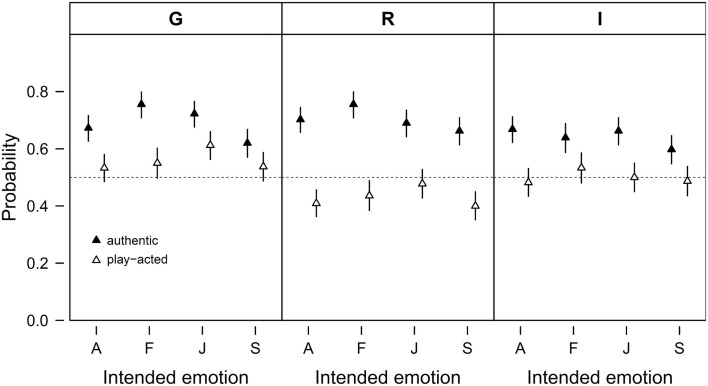
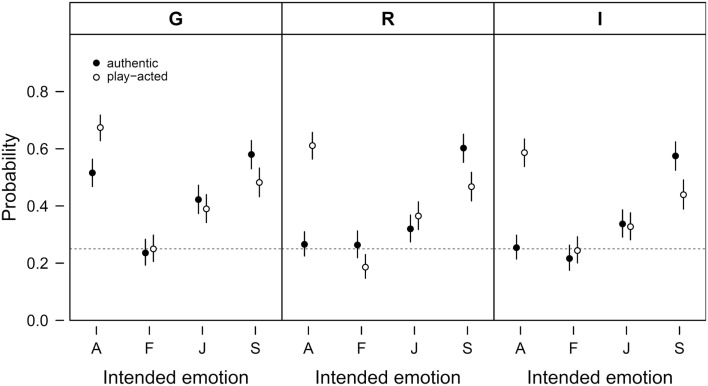
Although the expression of emotions in humans is considered to be largely universal, cultural effects contribute to both emotion expression and recognition. To disentangle the interplay between these factors, play-acted and authentic (non-instructed) vocal expressions of emotions were used, on the assumption that cultural effects may contribute differentially to the recognition of staged and spontaneous emotions. Speech tokens depicting four emotions (anger, sadness, joy, fear) were obtained from German radio archives and re-enacted by professional actors, and presented to 120 participants from Germany, Romania, and Indonesia. Participants in all three countries were poor at distinguishing between play-acted and spontaneous emotional utterances (58.73% correct on average with only marginal cultural differences). Nevertheless, authenticity influenced emotion recognition: across cultures, anger was recognized more accurately when play-acted (z = 15.06, p < 0.001) and sadness when authentic (z = 6.63, p < 0.001), replicating previous findings from German populations. German subjects revealed a slight advantage in recognizing emotions, indicating a moderate in-group advantage. There was no difference between Romanian and Indonesian subjects in the overall emotion recognition. Differential cultural effects became particularly apparent in terms of differential biases in emotion attribution. While all participants labeled play-acted expressions as anger more frequently than expected, German participants exhibited a further bias toward choosing anger for spontaneous stimuli. In contrast to the German sample, Romanian and Indonesian participants were biased toward choosing sadness. These results support the view that emotion recognition rests on a complex interaction of human universals and cultural specificities. Whether and in which way the observed biases are linked to cultural differences in self-construal remains an issue for further investigation.
虽然人类情感的表达被认为在很大程度上是普遍的,但文化因素会影响情感的表达和识别。为了理清这些因素之间的相互作用,本研究使用了经过表演的和真实的(非指令性)情感发声来进行研究,其假设是文化因素可能会对表演和自然情感的识别产生不同的影响。本研究从德国广播档案中获取了描绘四种情感(愤怒、悲伤、喜悦、恐惧)的语音样本,并由专业演员重新表演,然后将这些样本呈现给来自德国、罗马尼亚和印度尼西亚的 120 名参与者。来自这三个国家的参与者在区分表演和自然情感表达方面都表现不佳(平均正确识别率为 58.73%,且只有微小的文化差异)。然而,真实性确实会影响情感识别:在所有文化中,当情感表达为表演时,愤怒的识别准确率更高(z = 15.06,p < 0.001),而当情感表达为自然时,悲伤的识别准确率更高(z = 6.63,p < 0.001),这与之前来自德国人群的发现一致。德国参与者在识别情感方面表现出轻微优势,表明了适度的内群体优势。罗马尼亚和印度尼西亚参与者在整体情感识别方面没有差异。在情感归因的差异偏见方面,文化差异的影响尤为明显。虽然所有参与者都将表演时的情感表达标记为愤怒的频率高于预期,但德国参与者对自然刺激的情感表达表现出进一步的愤怒偏见。与德国样本不同,罗马尼亚和印度尼西亚参与者则倾向于将悲伤作为自然刺激的情感表达。这些结果支持了这样一种观点,即情感识别取决于人类普遍性和文化特殊性的复杂相互作用。观察到的偏见是否以及以何种方式与自我概念的文化差异有关,这仍然是一个需要进一步研究的问题。