You Tao, Stansfield Ian, Romano M Carmen, Brown Alistair J P, Coghill George M
School of Natural and Computing Sciences, University of Aberdeen, Institute of Complex System and Mathematical Biology, Aberdeen, UK.
BMC Syst Biol. 2011 Aug 18;5:131. doi: 10.1186/1752-0509-5-131.
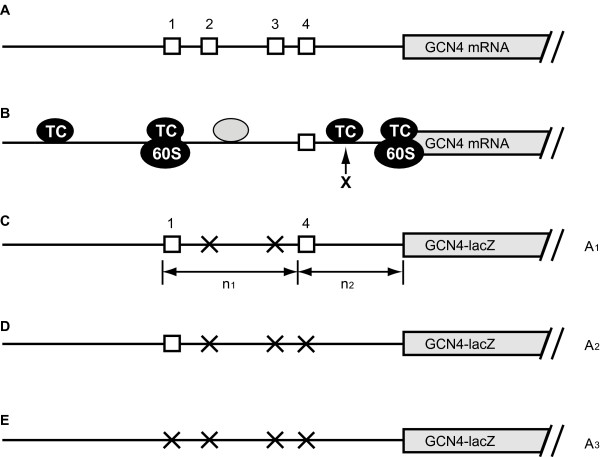
The yeast Saccharomyces cerevisiae responds to amino acid starvation by inducing the transcription factor Gcn4. This is mainly mediated via a translational control mechanism dependent upon the translation initiation eIF2·GTP·Met-tRNAiMet ternary complex, and the four short upstream open reading frames (uORFs) in its 5' mRNA leader. These uORFs act to attenuate GCN4 mRNA translation under normal conditions. During amino acid starvation, levels of ternary complex are reduced. This overcomes the GCN4 translation attenuation effect via a scanning/reinitiation control mechanism dependent upon uORF spacing.
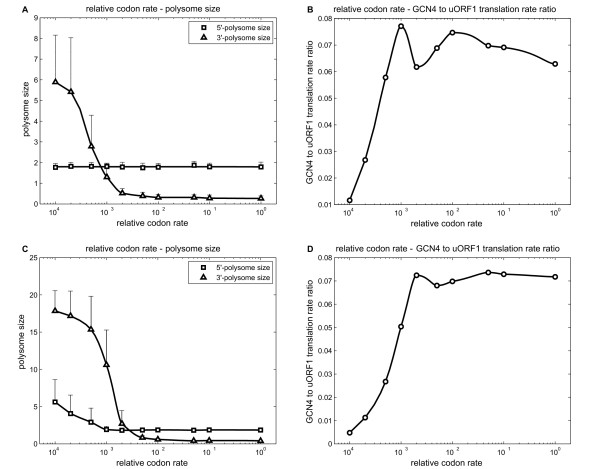
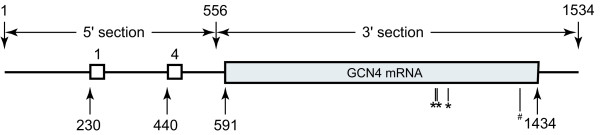
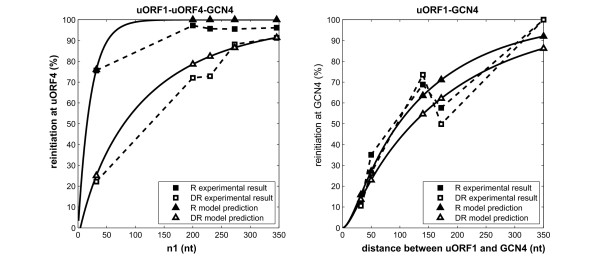
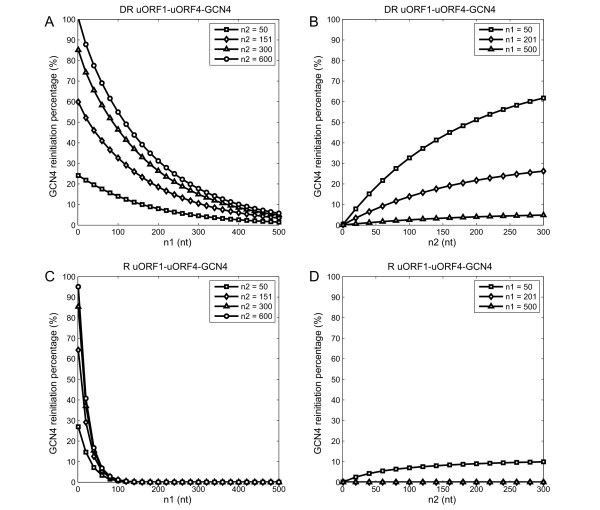
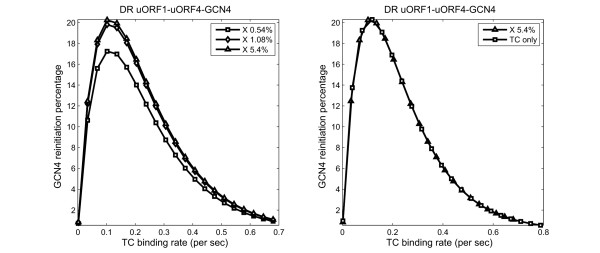
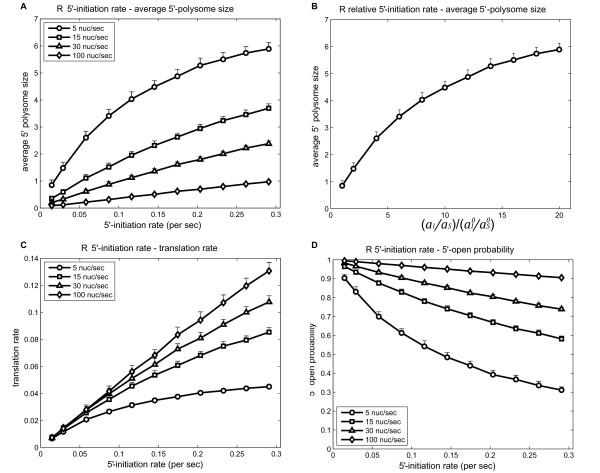
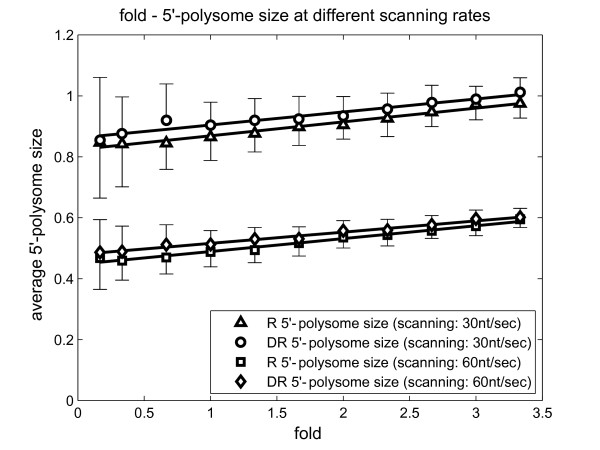
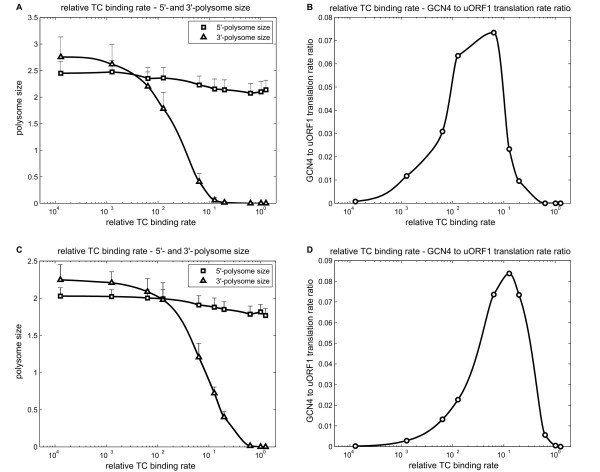
Using published experimental data, we have developed and validated a probabilistic formulation of GCN4 translation using the Chemical Master Equation (Model 1). Model 1 explains GCN4 translation's nonlinear dependency upon uORF placements, and predicts that an as yet unidentified factor, which was proposed to regulate GCN4 translation under some conditions, only has pronounced effects upon GCN4 translation when intercistronic distances are unnaturally short. A simpler Model 2 that does not include this unidentified factor could well represent the regulation of a natural GCN4 mRNA. Using parameter values optimised for this algebraic Model 2, we performed stochastic simulations by Gillespie algorithm to investigate the distribution of ribosomes in different sections of GCN4 mRNA under distinct conditions. Our simulations demonstrated that ribosomal loading in the 5'-untranslated region is mainly determined by the ratio between the rates of 5'-initiation and ribosome scanning, but was not significantly affected by rate of ternary complex binding. Importantly, the translation rate for codons starved of cognate tRNAs is predicted to be the most significant contributor to the changes in ribosomal loading in the coding region under repressing and derepressing conditions.
Our integrated probabilistic Models 1 and 2 explained GCN4 translation and helped to elucidate the role of a yet unidentified factor. The ensuing stochastic simulations evaluated different factors that may impact on the translation of GCN4 mRNA, and integrated translation status with ribosomal density.
酿酒酵母通过诱导转录因子Gcn4来响应氨基酸饥饿。这主要通过一种依赖于翻译起始eIF2·GTP·Met-tRNAiMet三元复合物及其5' mRNA前导序列中的四个短上游开放阅读框(uORF)的翻译控制机制来介导。这些uORF在正常条件下会减弱GCN4 mRNA的翻译。在氨基酸饥饿期间,三元复合物的水平会降低。这通过一种依赖于uORF间距的扫描/重新起始控制机制克服了GCN4翻译的减弱效应。
利用已发表的实验数据,我们使用化学主方程开发并验证了GCN4翻译的概率公式(模型1)。模型1解释了GCN4翻译对uORF位置的非线性依赖性,并预测了一个尚未确定的因子,该因子在某些条件下被认为可调节GCN4翻译,只有当顺反子间距离异常短时,才会对GCN4翻译产生显著影响。一个不包括这个未确定因子的更简单模型2很可能代表天然GCN4 mRNA的调控。使用针对这个代数模型2优化的参数值,我们通过 Gillespie算法进行了随机模拟,以研究在不同条件下GCN4 mRNA不同区域的核糖体分布。我们的模拟表明,5'非翻译区的核糖体负载主要由5'起始速率与核糖体扫描速率之比决定,但不受三元复合物结合速率的显著影响。重要的是,预测缺乏同源tRNA的密码子的翻译速率是在抑制和去抑制条件下编码区核糖体负载变化的最重要贡献因素。
我们的综合概率模型1和模型2解释了GCN4翻译,并有助于阐明一个尚未确定的因子的作用。随后的随机模拟评估了可能影响GCN4 mRNA翻译的不同因素,并将翻译状态与核糖体密度整合起来。