Cardiology Section, Wake Forest School of Medicine, Winston-Salem, NC 27157, USA.
Cardiol Res Pract. 2012;2012:806102. doi: 10.1155/2012/806102. Epub 2011 Jul 26.
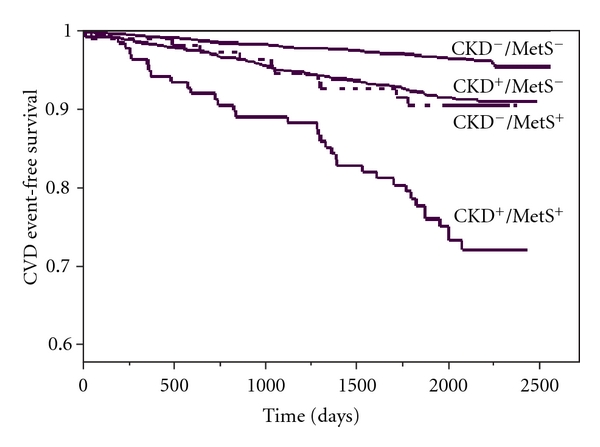
Background. There is an association between chronic kidney disease (CKD) and metabolic syndrome (MetS). We examined the joint association of CKD and MetS with incident cardiovascular (CVD) events in the Multiethnic Study of Atherosclerosis (MESA) cohort. Methods. We analyzed 2,283 Caucasians, 363 Chinese, 1,449 African-Americans, and 1,068 Hispanics in the MESA cohort. CKD was defined by cystatin C estimated glomerular filtration rate ≤ 60 mL/min/1.73 m(2) and MetS was defined by NCEP criteria. Cox proportional regression adjusting for age, ethnicity, gender, study site, education, income, smoking, alcohol use, physical activity, and total and LDL cholesterol was performed to assess the joint association of CKD and MetS with incident CVD events. Participants were divided into four groups by presence of CKD and/or MetS and compared to the group without CKD and MetS (CKD(-)/MetS(-)). Tests for additive and multiplicative interactions between CKD and MetS and prediction of incident CVD were performed. Results. During follow-up period of 5.5 years, 283 participants developed CVD. Multivariate Cox regression analysis demonstrated that CKD and MetS were independent predictors of CVD (hazard ratio, 2.02 for CKD, and 2.55 for MetS). When participants were compared to the CKD(-)/MetS(-) group, adjusted HR for the CKD(+)/MetS(+) group was 5.56 (95% CI 3.72-8.12). There was no multiplicative interaction between CKD and MetS (P = 0.2); however, there was presence of additive interaction. The relative excess risk for additive interaction (RERI) was 2.73, P = 0.2, and the attributable portion (AP) was 0.49 (0.24-0.74). Conclusion. Our findings illustrate that the combination of CKD and MetS is a strong predictor of incident clinical cardiovascular events due to presence of additive interaction between CKD and MetS.
慢性肾脏病(CKD)与代谢综合征(MetS)之间存在关联。我们在动脉粥样硬化多民族研究(MESA)队列中研究了 CKD 和 MetS 与心血管事件(CVD)发生的联合相关性。
我们分析了 MESA 队列中的 2283 名白种人、363 名中国人、1449 名非裔美国人以及 1068 名西班牙裔美国人。CKD 定义为胱抑素 C 估算肾小球滤过率≤60ml/min/1.73m²,MetS 定义为 NCEP 标准。使用 Cox 比例风险回归,调整年龄、种族、性别、研究地点、教育程度、收入、吸烟、饮酒、体力活动以及总胆固醇和 LDL 胆固醇,以评估 CKD 和 MetS 与 CVD 事件发生的联合相关性。将参与者根据是否存在 CKD 和/或 MetS 分为四组,并与无 CKD 和 MetS(CKD(-)/MetS(-))的组进行比较。进行 CKD 和 MetS 之间的相加和相乘交互作用检验以及 CVD 发生的预测。
在 5.5 年的随访期间,283 名参与者发生了 CVD。多变量 Cox 回归分析表明,CKD 和 MetS 是 CVD 的独立预测因子(CKD 的危险比为 2.02,MetS 的危险比为 2.55)。与 CKD(-)/MetS(-)组相比,CKD(+)/MetS(+)组的调整后的 HR 为 5.56(95%CI 3.72-8.12)。CKD 和 MetS 之间不存在相乘交互作用(P = 0.2);然而,存在相加交互作用。相加交互作用的相对超额危险度(RERI)为 2.73,P = 0.2,归因部分(AP)为 0.49(0.24-0.74)。
我们的研究结果表明,由于 CKD 和 MetS 之间存在相加交互作用,因此 CKD 和 MetS 的组合是发生临床心血管事件的有力预测因子。