Centre for Public Health, Liverpool John Moores University, Henry Cotton Campus, Liverpool, L3 2ET, UK.
BMC Public Health. 2011 Aug 23;11:664. doi: 10.1186/1471-2458-11-664.
A large-scale survey was conducted in 2008 in north west England, a region with high levels of alcohol-related harm, during a regional 'Big Drink Debate' campaign. The aim of this paper is to explore perceptions of how alcohol consumption would change if alcohol prices were to increase or decrease.
A convenience survey of residents (≥ 18 years) of north west England measured demographics, income, alcohol consumption in previous week, and opinions on drinking behaviour under two pricing conditions: low prices and discounts and increased alcohol prices (either 'decrease', 'no change' or 'increase'). Multinomial logistic regression used three outcomes: 'completely elastic' (consider that lower prices increase drinking and higher prices decrease drinking); 'lower price elastic' (lower prices increase drinking, higher prices have no effect); and 'price inelastic' (no change for either).
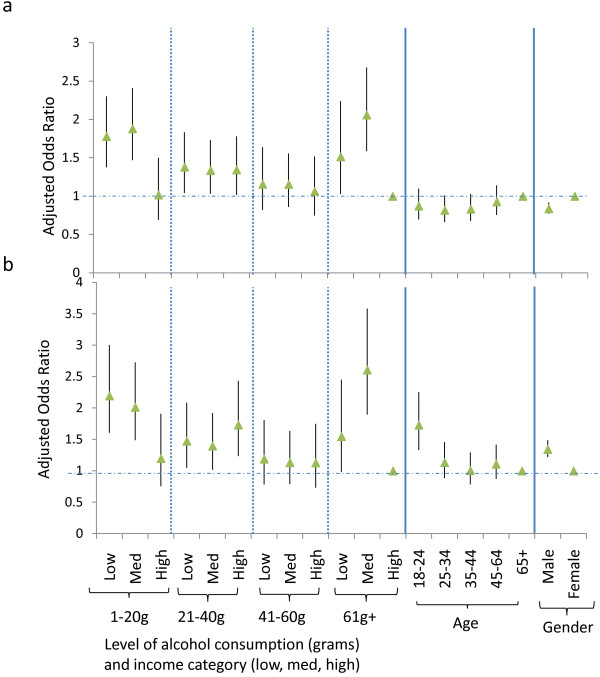
Of 22,780 drinkers surveyed, 80.3% considered lower alcohol prices and discounts would increase alcohol consumption, while 22.1% thought raising prices would decrease consumption, making lower price elasticity only (i.e. lower prices increase drinking, higher prices have no effect) the most common outcome (62%). Compared to a high income/high drinking category, the lightest drinkers with a low income (adjusted odds ratio AOR = 1.78, 95% confidence intervals CI 1.38-2.30) or medium income (AOR = 1.88, CI 1.47-2.41) were most likely to be lower price elastic. Females were more likely than males to be lower price elastic (65% vs 57%) while the reverse was true for complete elasticity (20% vs 26%, P < 0.001).
Lower pricing increases alcohol consumption, and the alcohol industry's continued focus on discounting sales encourages higher drinking levels. International evidence suggests increasing the price of alcohol reduces consumption, and one in five of the surveyed population agreed; more work is required to increase this agreement to achieve public support for policy change. Such policy should also recognise that alcohol is an addictive drug, and the population may be prepared to pay more to drink the amount they now feel they need.
2008 年,在英格兰西北部进行了一项大规模调查,该地区的酒精相关危害程度较高,正值区域性“大饮酒辩论”运动期间。本文旨在探讨人们对酒精价格上涨或下跌时饮酒行为变化的看法。
对英格兰西北部居民(≥18 岁)进行了一项便利调查,调查内容包括人口统计学、收入、前一周的饮酒量以及在两种定价条件下的饮酒行为意见:低价格和折扣以及提高酒精价格(“降低”、“不变”或“增加”)。使用多项逻辑回归分析了三种结果:“完全弹性”(认为低价格会增加饮酒量,高价格会减少饮酒量);“低价弹性”(低价格会增加饮酒量,高价格没有影响);和“价格无弹性”(无论价格高低,饮酒量都没有变化)。
在接受调查的 22780 名饮酒者中,80.3%的人认为降低酒精价格和折扣会增加饮酒量,而 22.1%的人认为提高价格会减少饮酒量,这使得低价弹性(即低价格增加饮酒量,高价格没有影响)成为最常见的结果(62%)。与高收入/高饮酒量类别相比,收入最低的轻度饮酒者(调整后的优势比 AOR = 1.78,95%置信区间 CI 1.38-2.30)或中等收入者(AOR = 1.88,CI 1.47-2.41)最有可能具有低价弹性。女性比男性更有可能具有低价弹性(65%对 57%),而完全弹性则相反(20%对 26%,P < 0.001)。
降低价格会增加饮酒量,而酒精行业持续关注折扣销售会鼓励更高的饮酒水平。国际证据表明,提高酒精价格会减少消费,五分之一的调查人群对此表示同意;为了提高这一比例以获得公众对政策变革的支持,还需要做更多的工作。此类政策还应认识到酒精是一种成瘾性药物,人们可能愿意支付更高的价格来饮用他们现在认为需要的量。