SHORE & Whāriki Research Centre, College of Health, Massey University, Auckland, New Zealand.
Health Promotion Policy Research Center, International Health Policy Program, Nonthaburi, Thailand.
Drug Alcohol Rev. 2018 Aug;37 Suppl 2(Suppl Suppl 2):S86-S95. doi: 10.1111/dar.12669. Epub 2018 Feb 21.
To investigate behaviours related to four alcohol policy variables (policy-relevant behaviours) and demographic variables in relation to typical quantities of alcohol consumed on-premise in six International Alcohol Control study countries.
General population surveys with drinkers using a comparable survey instrument and data analysed using path analysis in an overall model and for each country.
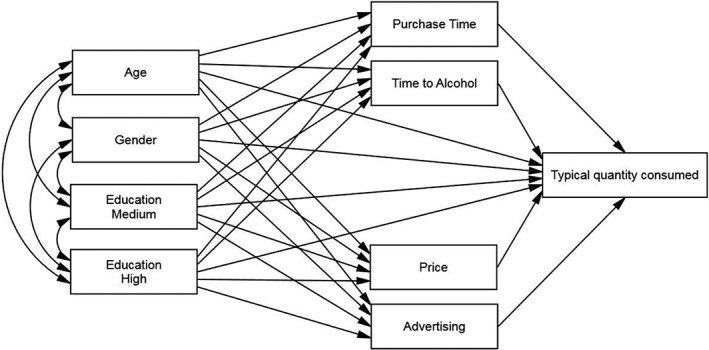
typical quantities per occasion consumed on-premise; gender, age; years of education, prices paid, time of purchase, time to access alcohol and liking for alcohol advertisements.
In the overall model younger people, males and those with fewer years of education consumed larger typical quantities. Overall lower prices paid, later time of purchase and liking for alcohol ads predicted consuming larger typical quantities; this was found in the high-income countries, less consistently in the high-middle-income countries and not in the low middle-income country. Three policy-relevant behaviours (prices paid, time of purchase, liking for alcohol ads) mediated the relationships between age, gender, education and consumption in high-income countries.
International Alcohol Control survey data showed a relationship between policy-relevant behaviours and typical quantities consumed and support the likely effect of policy change (trading hours, price and restrictions on marketing) on heavier drinking. The path analysis also revealed policy-relevant behaviours were significant mediating variables between the effect of age, gender and educational status on consumption. However, this relationship is clearest in high-income countries. Further research is required to understand better how circumstances in low-middle-income countries impact effects of policies.
调查与四项酒精政策变量(与政策相关的行为)和与六个国际酒精控制研究国家现场饮酒量相关的人口统计学变量有关的行为。
使用可比调查工具对一般人群进行调查,并在总体模型和每个国家中使用路径分析对数据进行分析。
现场消费的每场次典型数量;性别、年龄;受教育年限、支付价格、购买时间、获取酒精的时间和对酒精广告的喜好。
在总体模型中,年轻人、男性和受教育年限较少的人消费的典型数量较大。总体上较低的支付价格、较晚的购买时间和对酒精广告的喜爱预测了更大的典型数量;这在高收入国家中发现,在中高收入国家中不太一致,而在中低收入国家中则没有。在高收入国家中,三种与政策相关的行为(支付价格、购买时间、对酒精广告的喜爱)调节了年龄、性别、教育和消费之间的关系。
国际酒精控制调查数据显示,与政策相关的行为与消费的典型数量之间存在关系,并支持政策变化(营业时间、价格和营销限制)对酗酒的可能影响。路径分析还揭示了与政策相关的行为是年龄、性别和教育程度对消费影响的重要中介变量。然而,这种关系在高收入国家中最为明显。需要进一步研究,以更好地了解低中收入国家的情况如何影响政策的效果。