Department of Microbiology, University of Virginia Health Sciences Center Charlottesville, VA, USA.
Front Microbiol. 2011 Aug 1;2:162. doi: 10.3389/fmicb.2011.00162. eCollection 2011.
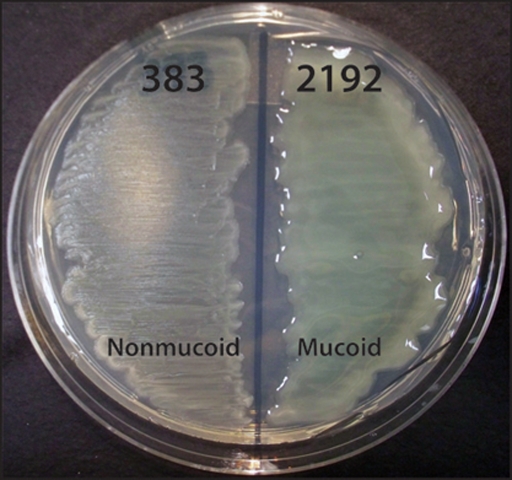
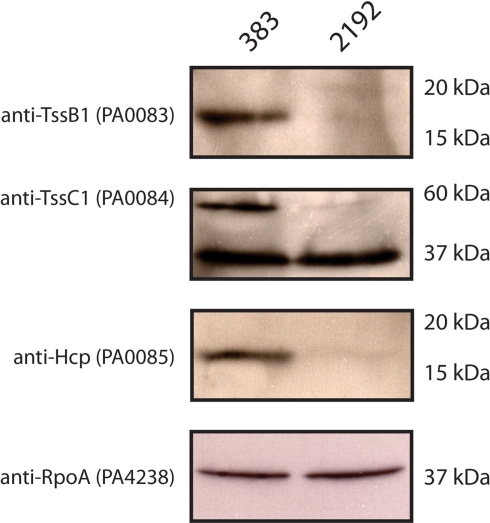
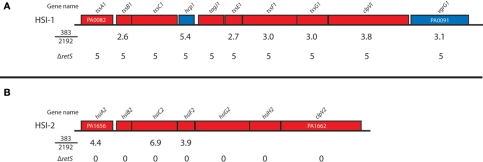
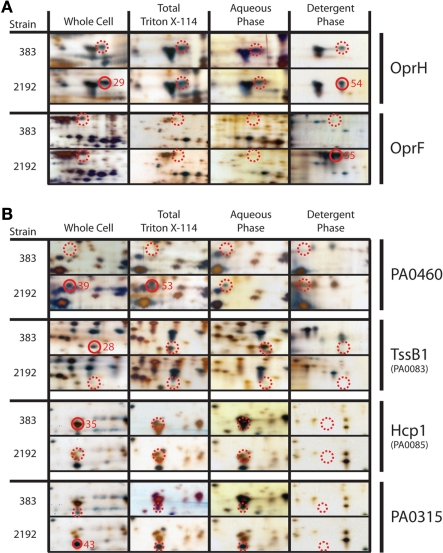
Pseudomonas aeruginosa chronically infects the lungs of cystic fibrosis (CF) patients. The conditions in the CF lung appear to select for P. aeruginosa with advantageous phenotypes for chronic infection. However, the mechanisms that allow the establishment of this chronic infection have not been fully characterized. We have previously reported the transcriptional analysis of two CF isolates strains 383 and 2192. Strain 2192 is a mucoid, alginate overproducing strain whereas strain 383 is non-mucoid. Mucoid strains are associated with chronic infection of the CF lung and non-mucoid strains are the typical initially infecting isolates. To elucidate novel differences between these two strains, we employed two methods of shotgun proteomics: isobaric tags for relative and absolute quantitation (iTRAQ) and two-dimensional gel electrophoresis (2-DE). iTRAQ compares the amount of protein between samples and relies on protein abundance, while 2-DE gel electrophoresis depends on selection of separated protein spots. For both these methods, mass spectrometry was then used to identify proteins differentially expressed between the two strains. The compilation of these two proteomic methods along with Western blot analysis revealed proteins of the HSI-I operon of the type 6 secretion system, showed increased expression in 383 compared to 2192, confirming the our previous transcriptional analysis. Proteomic analysis of other proteins did not fully correlate with the transcriptome but other differentially expressed proteins are discussed. Also, differences were noted between the results obtained for the two proteomic techniques. These shotgun proteomic analyses identified proteins that had been predicted only through gene identification; we now refer to these as "proteins of unknown functions" since their existence has now been established however their functional characterization remains to be elucidated.
铜绿假单胞菌会慢性感染囊性纤维化 (CF) 患者的肺部。CF 肺部的条件似乎选择了具有慢性感染优势表型的铜绿假单胞菌。然而,尚未完全阐明允许建立这种慢性感染的机制。我们之前已经报告了两个 CF 分离株 383 和 2192 的转录分析。株 2192 是一种粘液型、过度产生藻酸盐的菌株,而株 383 是非粘液型的。粘液型菌株与 CF 肺部的慢性感染有关,而非粘液型菌株是最初感染的典型菌株。为了阐明这两种菌株之间的新差异,我们采用了两种 shotgun 蛋白质组学方法:相对和绝对定量的同位素标记 (iTRAQ) 和二维凝胶电泳 (2-DE)。iTRAQ 比较样品之间的蛋白质含量,依赖于蛋白质丰度,而 2-DE 凝胶电泳依赖于分离蛋白质斑点的选择。对于这两种方法,然后使用质谱法鉴定两种菌株之间差异表达的蛋白质。这两种蛋白质组学方法的汇编以及 Western blot 分析显示,6 型分泌系统 HSI-I 操纵子的蛋白质在 383 中比在 2192 中表达增加,证实了我们之前的转录分析。其他蛋白质的蛋白质组学分析与转录组不完全相关,但讨论了其他差异表达的蛋白质。此外,两种蛋白质组学技术获得的结果也存在差异。这些 shotgun 蛋白质组学分析鉴定了仅通过基因识别预测的蛋白质;我们现在将这些称为“未知功能的蛋白质”,因为它们的存在已经确立,但它们的功能特征仍有待阐明。