Rehabilitation Ward, III General Hospital in Lodz, Milionowa 14, Lodz, Poland.
Eur J Appl Physiol. 2012 May;112(5):1645-52. doi: 10.1007/s00421-011-2122-x. Epub 2011 Aug 28.
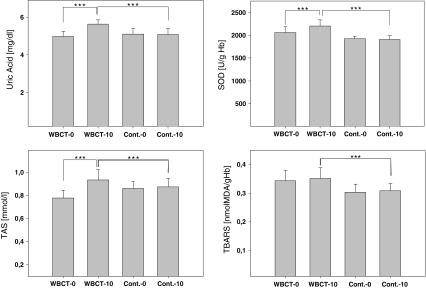
Whole body cryostimulation (WBCT) is becoming popular in medicine and sport as an adjuvant form of treatment since late 1970s. Only a few works concerning antioxidant protection after WBCT have been published. The aim of this study was to determine the effect of a ten 3-min-long exposures (one exposure per day) to cryogenic temperature (-130 °C) on the level of total antioxidant status (TAS), activity of selected antioxidant enzyme superoxide dismutase (SOD) and main non-enzymatic antioxidant-uric acid (UA) in WBCT study group (man n = 24; female n = 22) and non-WBCT control subjects (man n = 22; female n = 26). Moreover, we evaluated the lipid peroxidation measured as thiobarbituric acid reactive substances products. Their blood samples were collected twice at an interval of 10 days in both study group and control subjects. The activity of antioxidant enzyme and lipid peroxidation was assayed in erythrocytes, while the concentration of uric acid was measured in plasma. After completing a total of ten WBCT sessions a significant increase (p < 0.001) of TAS and UA levels in plasma (p < 0.001) in comparison to non-WBCT was observed. Our data showed that there was statistically significant increase of the activities of SOD in erythrocytes obtained from WBCT study group compared to non-WBCT controls after 10 days of treatment (p < 0.001). It was concluded that expositions to extremely low temperatures use in cryostimulation improve the antioxidant capacity of organism.
全身冷冻刺激(WBCT)自 20 世纪 70 年代末以来作为一种辅助治疗形式在医学和运动领域越来越受欢迎。只有少数关于 WBCT 后抗氧化保护的工作已经发表。本研究的目的是确定每天进行 3 分钟(每次暴露一次)的极低温(-130°C)对总抗氧化状态(TAS)、超氧化物歧化酶(SOD)等抗氧化酶活性和主要非酶抗氧化剂-尿酸(UA)水平的影响在 WBCT 研究组(男性 n = 24;女性 n = 22)和非-WBCT 对照组(男性 n = 22;女性 n = 26)。此外,我们还评估了作为硫代巴比妥酸反应物质产物测量的脂质过氧化。在研究组和对照组中,两次在 10 天的间隔内采集他们的血液样本。抗氧化酶的活性和脂质过氧化在红细胞中进行测定,而尿酸的浓度在血浆中测量。在完成总共十次 WBCT 疗程后,与非-WBCT 相比,血浆中的 TAS 和 UA 水平(p < 0.001)显著增加。我们的数据显示,与非-WBCT 对照组相比,在接受 10 天治疗后,来自 WBCT 研究组的红细胞中的 SOD 活性有统计学意义的显著增加(p < 0.001)。研究结果表明,极低温暴露在冷冻刺激中提高了机体的抗氧化能力。