Department of Medicine III, Nephrology and Rheumatology, Universitätsklinikum UKE, 20246 Hamburg, Germany.
Ann Rheum Dis. 2011 Nov;70(11):1986-90. doi: 10.1136/ard.2011.152678. Epub 2011 Aug 29.
Remission is the established goal in rheumatoid arthritis (RA) treatment. Although originally defined by a disease activity score in 28 joints (DAS28) <2.6, more stringent criteria may imply the absence of disease activity. The 2011 ACR/EULAR remission criteria provide the newest and most stringent definition of remission.
To evaluate post hoc the remission by ACR/EULAR criteria and compare the criteria with the conventional DAS28 in TAMARA, an open-label phase IIIb tocilizumab (TCZ) trial including patients with active RA receiving inadequate disease-modifying antirheumatic drugs (DMARDs) or tumour necrosis factor α (TNFα) inhibitor treatment.
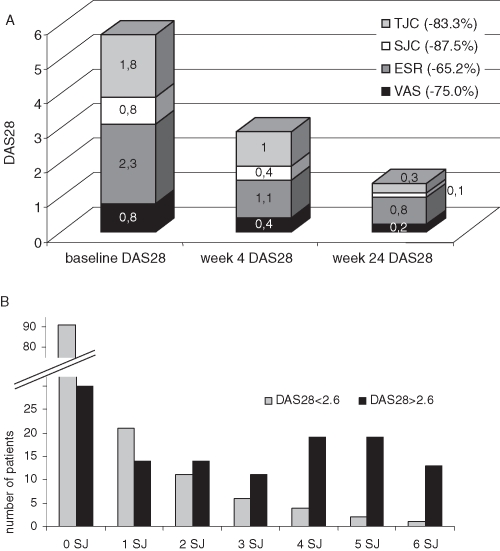
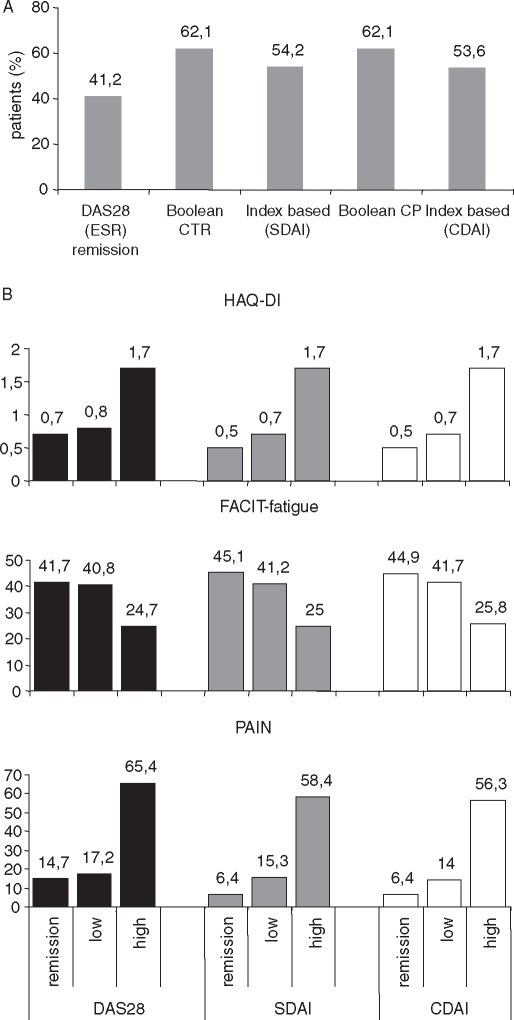
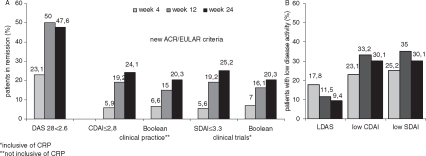
286 patients were enrolled, 99.7% of patients were receiving a conventional DMARD and 41.6% had TNFα inhibitor pretreatment. Baseline mean DAS28 of 6.0 ± 1.0 fell to 2.6 ± 1.5 at week 24. DAS28 <2.6 was achieved by 47.6% at week 24. Remission rates with the new ACR/EULAR Boolean-based criteria for clinical studies were 15.0% after 12 weeks and 20.3% after 24 weeks. Of note, 13.5% of patients with previous TNFα blocker inadequate response still achieved remission according to the new ACR/EULAR criteria after 24 weeks. Clinical Disease Activity Index and Simplified Disease Activity Index remission rates were 24.1% and 25.2%, respectively.
Under the definition of the new stringent 2011 ACR/EULAR remission criteria, patients with active RA despite DMARD treatment and even after inadequate response to TNFα inhibitors, receiving TCZ showed significant rates of remission. Similar remission rates were achieved, when clinical practice criteria, not inclusive of acute phase reactants, were used.
缓解是类风湿关节炎(RA)治疗的既定目标。虽然最初是通过 28 个关节疾病活动评分(DAS28)<2.6 来定义,但更严格的标准可能意味着没有疾病活动。2011 年 ACR/EULAR 缓解标准提供了缓解的最新和最严格的定义。
在 TAMARA 中,根据 ACR/EULAR 标准事后评估缓解情况,并将该标准与常规 DAS28 进行比较,这是一项包括接受不足疾病修饰抗风湿药物(DMARDs)或肿瘤坏死因子 α(TNFα)抑制剂治疗的活动性 RA 患者的开放标签 IIIb 期托珠单抗(TCZ)试验。
共纳入 286 例患者,99.7%的患者接受常规 DMARD 治疗,41.6%的患者有 TNFα 抑制剂预处理。基线时平均 DAS28 为 6.0±1.0,24 周时降至 2.6±1.5。24 周时 DAS28<2.6 的比例为 47.6%。新的 ACR/EULAR 基于临床研究的布尔标准的缓解率在 12 周时为 15.0%,24 周时为 20.3%。值得注意的是,24 周时,根据新的 ACR/EULAR 标准,13.5%的先前 TNFα 阻滞剂治疗反应不足的患者仍达到缓解。临床疾病活动指数和简化疾病活动指数的缓解率分别为 24.1%和 25.2%。
根据新的严格 2011 年 ACR/EULAR 缓解标准的定义,接受 TCZ 治疗的活动性 RA 患者尽管接受了 DMARD 治疗,甚至在对 TNFα 抑制剂反应不足后,仍显示出显著的缓解率。当使用不包括急性期反应物的临床实践标准时,达到了相似的缓解率。