Department of Chemical and Biomolecular Engineering, University of Illinois at Urbana-Champaign, Urbana, IL 61801, USA.
Biomaterials. 2011 Dec;32(34):8990-8. doi: 10.1016/j.biomaterials.2011.08.035. Epub 2011 Aug 30.
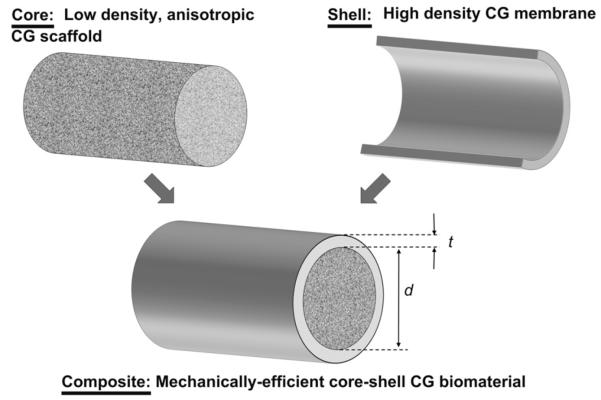
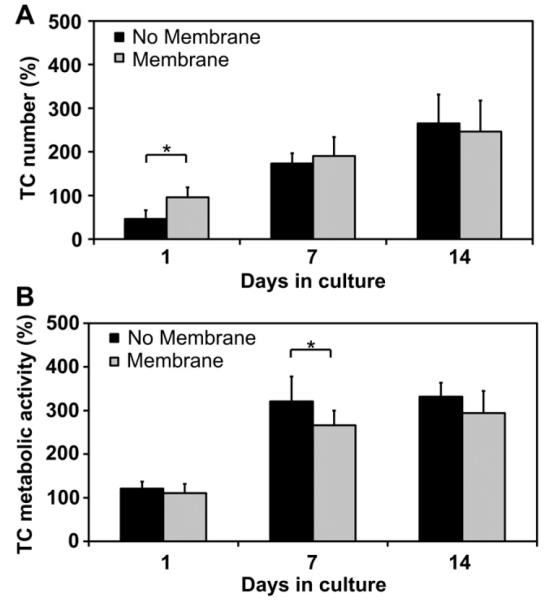
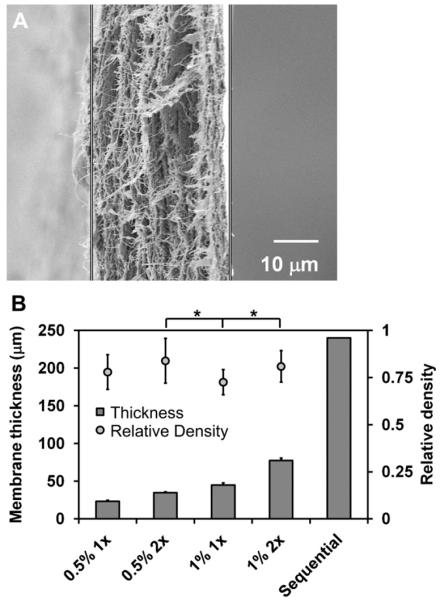
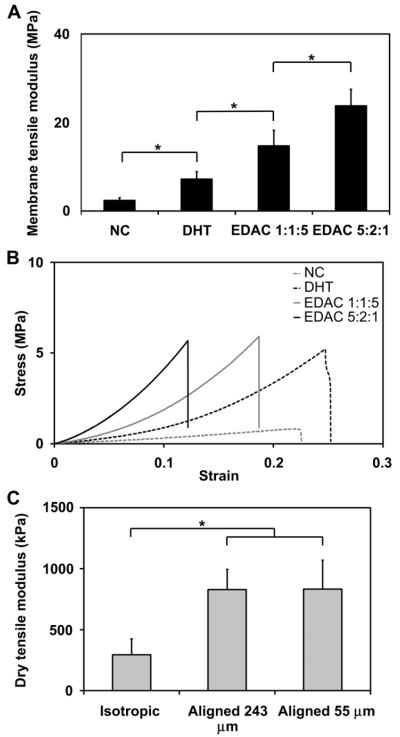
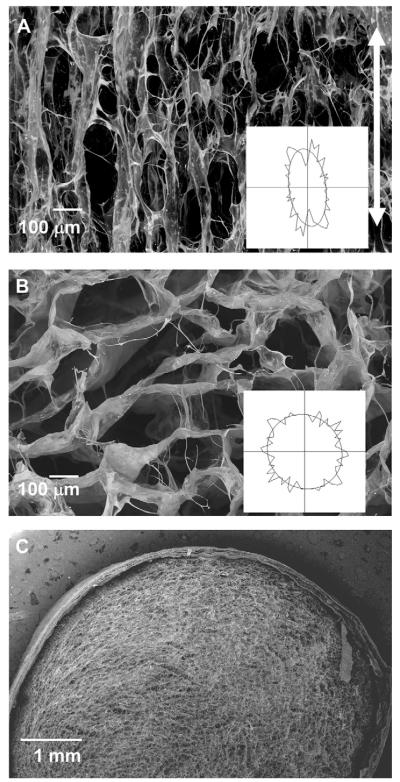
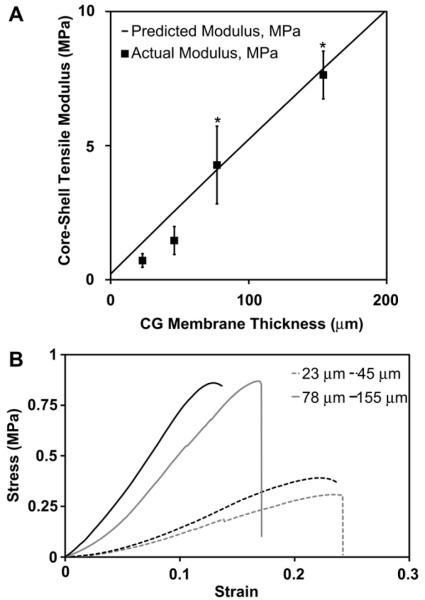
Current tissue engineering approaches for tendon defects require improved biomaterials to balance microstructural and mechanical design criteria. Collagen-glycosaminoglycan (CG) scaffolds have shown considerable success as in vivo regenerative templates and in vitro constructs to study cell behavior. While these scaffolds possess many advantageous qualities, their mechanical properties are typically orders of magnitude lower than orthopedic tissues such as tendon. Taking inspiration from mechanically efficient core-shell composites in nature such as plant stems and porcupine quills, we have created core-shell CG composites that display high bioactivity and improved mechanical integrity. These composites feature integration of a low density, anisotropic CG scaffold core with a high density, CG membrane shell. CG membranes were fabricated via an evaporative process that allowed separate tuning of membrane thickness and elastic moduli and were found to be isotropic in-plane. The membranes were then integrated with an anisotropic CG scaffold core via freeze-drying and subsequent crosslinking. Increasing the relative thickness of the CG membrane shell was shown to increase composite tensile elastic modulus by as much as a factor of 36 in a manner consistent with predictions from layered composites theory. CG scaffold-membrane composites were found to support tendon cell viability, proliferation, and metabolic activity in vitro, suggesting they maintain sufficient permeability while demonstrating improved mechanical strength. This work suggests an effective, biomimetic approach for balancing strength and bioactivity requirements of porous scaffolds for tissue engineering.
目前用于肌腱缺损的组织工程方法需要改进生物材料,以平衡微观结构和机械设计标准。胶原-糖胺聚糖(CG)支架已被证明是体内再生模板和体外构建的有很大的成功,用于研究细胞行为。虽然这些支架具有许多优点,但它们的机械性能通常比肌腱等骨科组织低几个数量级。受植物茎和豪猪刺等具有高效机械性能的核壳复合材料的启发,我们创造了具有高生物活性和改善机械完整性的核壳 CG 复合材料。这些复合材料的特点是将低密度各向异性 CG 支架核与高密度 CG 膜壳集成在一起。CG 膜是通过蒸发过程制造的,该过程允许单独调整膜厚度和弹性模量,并且被发现具有各向同性的面内性质。然后通过冷冻干燥和随后的交联将膜与各向异性 CG 支架核集成。结果表明,增加 CG 膜壳的相对厚度可以将复合材料的拉伸弹性模量提高多达 36 倍,这与分层复合材料理论的预测一致。CG 支架-膜复合材料在体外支持肌腱细胞的活力、增殖和代谢活性,表明它们在保持足够渗透性的同时表现出改善的机械强度。这项工作表明了一种有效的仿生方法,可以平衡组织工程多孔支架的强度和生物活性要求。