Department of Mathematics and Statistics, University of Guelph, Guelph, Ontario, Canada.
PLoS One. 2011;6(8):e23580. doi: 10.1371/journal.pone.0023580. Epub 2011 Aug 23.
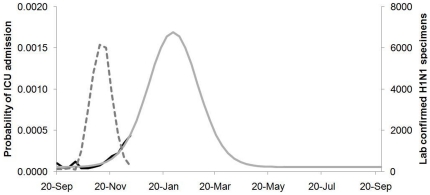
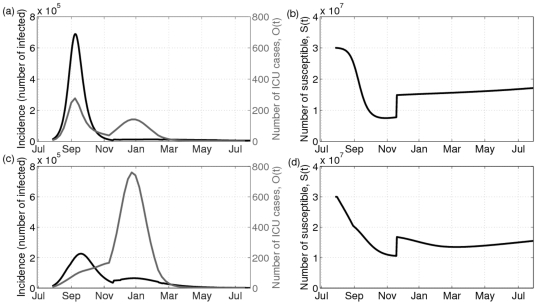
Vaccination can delay the peak of a pandemic influenza wave by reducing the number of individuals initially susceptible to influenza infection. Emerging evidence indicates that susceptibility to severe secondary bacterial infections following a primary influenza infection may vary seasonally, with peak susceptibility occurring in winter. Taken together, these two observations suggest that vaccinating to prevent a fall pandemic wave might delay it long enough to inadvertently increase influenza infections in winter, when primary influenza infection is more likely to cause severe outcomes. This could potentially cause a net increase in severe outcomes. Most pandemic models implicitly assume that the probability of severe outcomes does not vary seasonally and hence cannot capture this effect. Here we show that the probability of intensive care unit (ICU) admission per influenza infection in the 2009 H1N1 pandemic followed a seasonal pattern. We combine this with an influenza transmission model to investigate conditions under which a vaccination program could inadvertently shift influenza susceptibility to months where the risk of ICU admission due to influenza is higher. We find that vaccination in advance of a fall pandemic wave can actually increase the number of ICU admissions in situations where antigenic drift is sufficiently rapid or where importation of a cross-reactive strain is possible. Moreover, this effect is stronger for vaccination programs that prevent more primary influenza infections. Sensitivity analysis indicates several mechanisms that may cause this effect. We also find that the predicted number of ICU admissions changes dramatically depending on whether the probability of ICU admission varies seasonally, or whether it is held constant. These results suggest that pandemic planning should explore the potential interactions between seasonally varying susceptibility to severe influenza outcomes and the timing of vaccine-altered pandemic influenza waves.
疫苗接种可以通过减少最初易感染流感的个体数量来延迟大流行性流感波的高峰。新出现的证据表明,在原发性流感感染后对继发性严重细菌感染的易感性可能会随季节而变化,其峰值易感性出现在冬季。这两个观察结果表明,接种疫苗以预防秋季大流行波可能会使其延迟足够长的时间,从而无意中增加冬季原发性流感感染的可能性,而在冬季,原发性流感感染更有可能导致严重后果。这可能会导致严重后果的净增加。大多数大流行模型都隐含地假设严重后果的可能性不会随季节而变化,因此无法捕获这种影响。在这里,我们表明,2009 年 H1N1 大流行中每例流感感染的重症监护病房(ICU)入院率呈季节性模式。我们将其与流感传播模型相结合,以研究接种计划可能会在无意中将流感易感性转移到因流感而导致 ICU 入院风险更高的月份的条件。我们发现,在秋季大流行波之前进行疫苗接种实际上会增加 ICU 入院人数,在这种情况下,抗原漂移速度足够快或可能输入交叉反应性菌株。此外,对于可以预防更多原发性流感感染的疫苗接种计划,这种效果更强。敏感性分析表明,可能有几种机制会导致这种效果。我们还发现,ICU 入院人数的预测值会根据 ICU 入院率是否随季节变化而变化,或者是否保持不变而发生巨大变化。这些结果表明,大流行规划应探索严重流感后果的季节性易感性与疫苗改变的大流行性流感波的时间之间潜在的相互作用。