Google, Inc., New York, New York, United States of America.
PLoS One. 2011;6(8):e23610. doi: 10.1371/journal.pone.0023610. Epub 2011 Aug 19.
Google Flu Trends (GFT) uses anonymized, aggregated internet search activity to provide near-real time estimates of influenza activity. GFT estimates have shown a strong correlation with official influenza surveillance data. The 2009 influenza virus A (H1N1) pandemic [pH1N1] provided the first opportunity to evaluate GFT during a non-seasonal influenza outbreak. In September 2009, an updated United States GFT model was developed using data from the beginning of pH1N1.
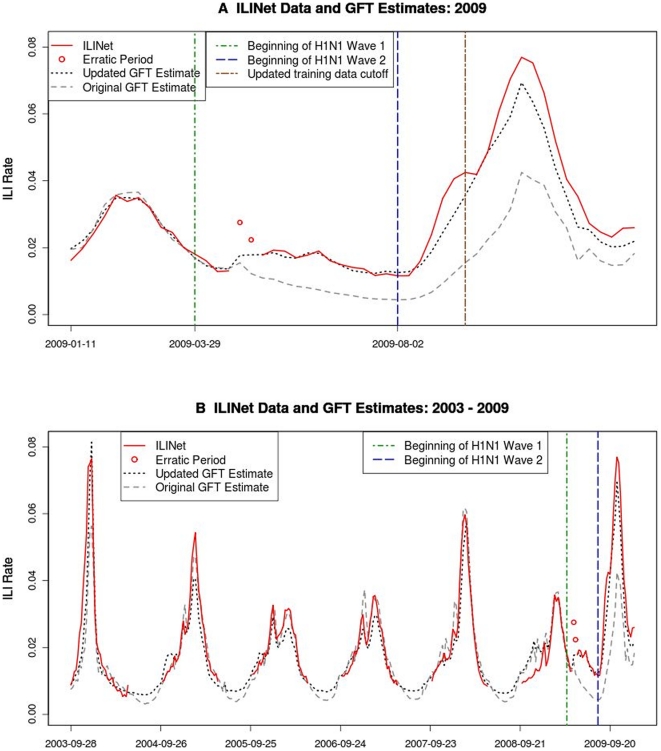
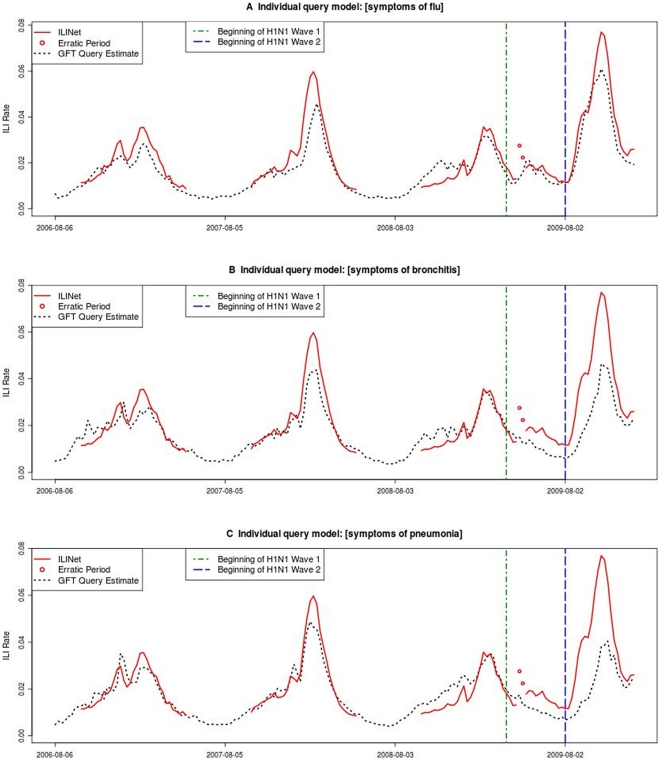
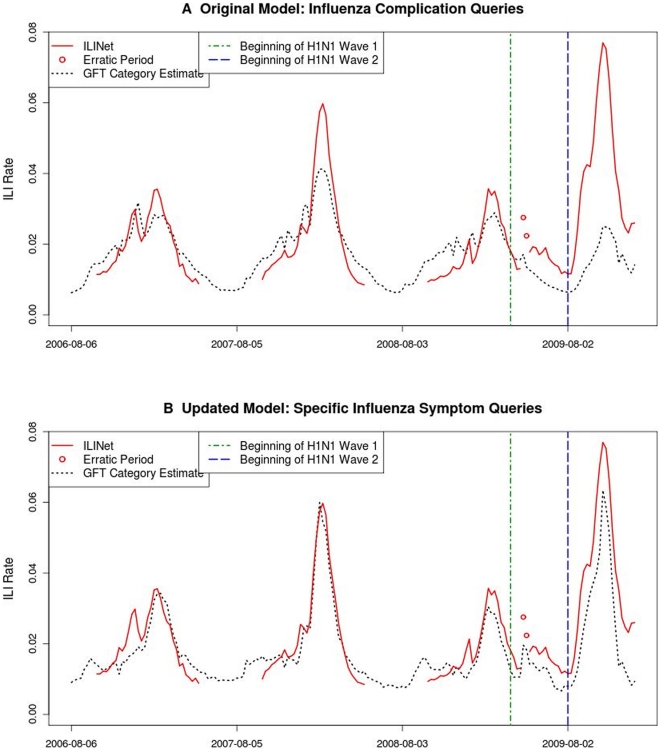
METHODOLOGY/PRINCIPAL FINDINGS: We evaluated the accuracy of each U.S. GFT model by comparing weekly estimates of ILI (influenza-like illness) activity with the U.S. Outpatient Influenza-like Illness Surveillance Network (ILINet). For each GFT model we calculated the correlation and RMSE (root mean square error) between model estimates and ILINet for four time periods: pre-H1N1, Summer H1N1, Winter H1N1, and H1N1 overall (Mar 2009-Dec 2009). We also compared the number of queries, query volume, and types of queries (e.g., influenza symptoms, influenza complications) in each model. Both models' estimates were highly correlated with ILINet pre-H1N1 and over the entire surveillance period, although the original model underestimated the magnitude of ILI activity during pH1N1. The updated model was more correlated with ILINet than the original model during Summer H1N1 (r = 0.95 and 0.29, respectively). The updated model included more search query terms than the original model, with more queries directly related to influenza infection, whereas the original model contained more queries related to influenza complications.
Internet search behavior changed during pH1N1, particularly in the categories "influenza complications" and "term for influenza." The complications associated with pH1N1, the fact that pH1N1 began in the summer rather than winter, and changes in health-seeking behavior each may have played a part. Both GFT models performed well prior to and during pH1N1, although the updated model performed better during pH1N1, especially during the summer months.
Google 流感趋势(GFT)使用匿名、聚合的互联网搜索活动来提供流感活动的近乎实时估计。GFT 的估计与官方流感监测数据显示出很强的相关性。2009 年甲型流感病毒 A(H1N1)大流行[pH1N1]为评估 GFT 在非季节性流感爆发期间的表现提供了首次机会。2009 年 9 月,使用 pH1N1 开始时的数据开发了一个更新的美国 GFT 模型。
方法/主要发现:我们通过比较每周 ILI(流感样疾病)活动的估计值与美国门诊流感样疾病监测网络(ILINet)来评估每个美国 GFT 模型的准确性。对于每个 GFT 模型,我们计算了模型估计值与 ILINet 在四个时间段之间的相关性和 RMSE(均方根误差):H1N1 之前、夏季 H1N1、冬季 H1N1 和 H1N1 整体(2009 年 3 月至 2009 年 12 月)。我们还比较了每个模型中的查询数量、查询量和查询类型(例如流感症状、流感并发症)。尽管原始模型低估了 pH1N1 期间 ILI 活动的规模,但两个模型的估计值与 ILINet 在 H1N1 之前和整个监测期间都高度相关。在夏季 H1N1 期间,更新后的模型与 ILINet 的相关性高于原始模型(分别为 0.95 和 0.29)。更新后的模型包含的搜索查询词比原始模型多,更多的查询与流感感染直接相关,而原始模型包含更多与流感并发症相关的查询。
在 pH1N1 期间,互联网搜索行为发生了变化,特别是在“流感并发症”和“流感术语”类别中。与 pH1N1 相关的并发症、pH1N1 始于夏季而不是冬季以及寻求健康行为的变化可能都发挥了作用。在 pH1N1 之前和期间,两个 GFT 模型都表现良好,尽管更新后的模型在 pH1N1 期间表现更好,尤其是在夏季。