Nelson Darin A, Burgansky-Eliash Zvia, Barash Hila, Loewenstein Anat, Barak Adiel, Bartov Elisha, Rock Tali, Grinvald Amiram
Optical Imaging Ltd, Rehovot, Israel;
Clin Ophthalmol. 2011;5:1095-106. doi: 10.2147/OPTH.S20103. Epub 2011 Aug 9.
Assessment of capillary abnormalities facilitates early diagnosis, treatment, and follow-up of common retinal pathologies. Injected contrast agents like fluorescein are widely used to image retinal capillaries, but this highly effective procedure has a few disadvantages, such as untoward side effects, inconvenience of injection, and brevity of the time window for clear visualization. The retinal function imager (RFI) is a tool for monitoring retinal functions, such as blood velocity and oximetry, based on intrinsic signals. Here we describe the clinical use of hemoglobin in red blood cells (RBCs) as an intrinsic motion-contrast agent in the generation of detailed noninvasive capillary-perfusion maps (nCPMs).
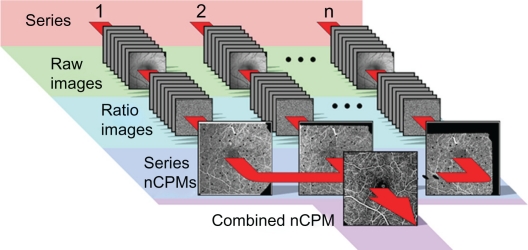
Multiple series of nCPM images were acquired from 130 patients with diabetic retinopathy, vein occlusion, central serous retinopathy, age-related macular degeneration, or metabolic syndrome, as well as from 37 healthy subjects. After registration, pixel value distribution parameters were analyzed to locate RBC motion.
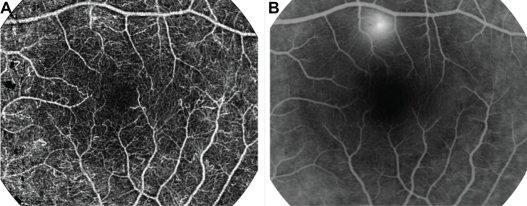
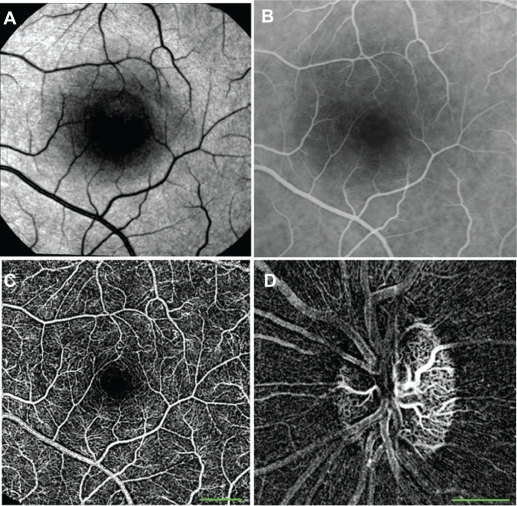
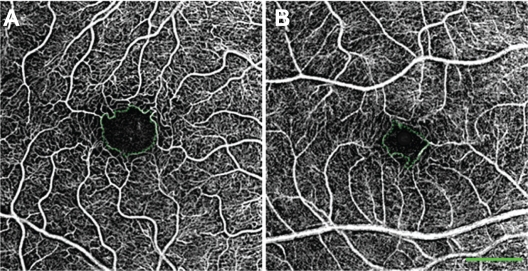
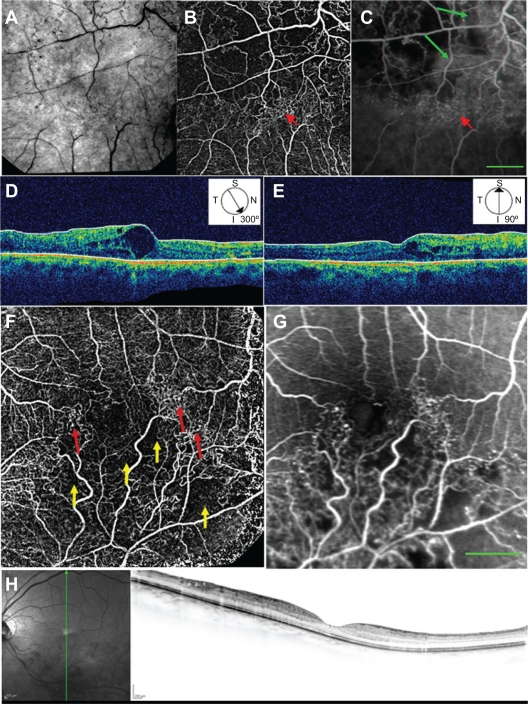
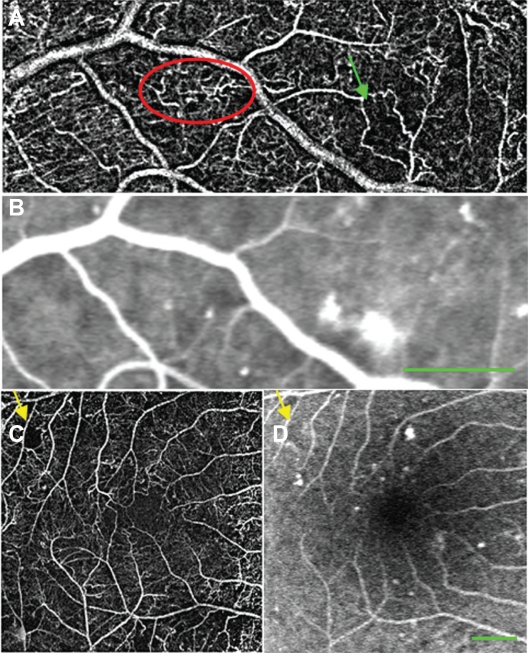
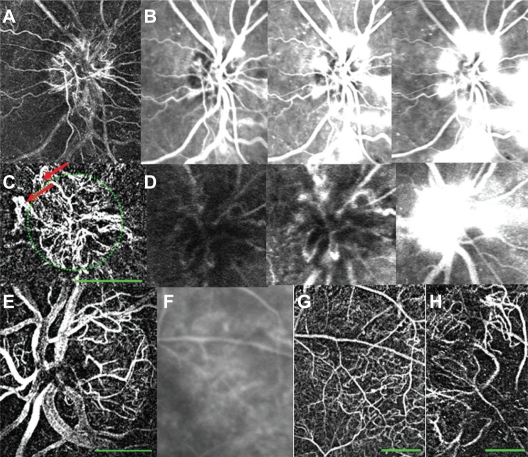
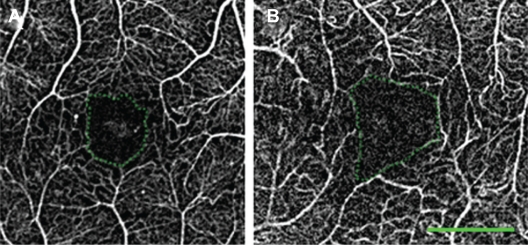
The RFI yielded nCPMs demonstrating microvascular morphology including capillaries in exquisite detail. Maps from the same subject were highly reproducible in repeated measurements, in as much detail and often better than that revealed by the very best fluorescein angiography. In patients, neovascularization and capillary nonperfusion areas were clearly observed. Foveal avascular zones (FAZ) were sharply delineated and were larger in patients with diabetic retinopathy than in controls (FAZ diameter: 641.5 ± 82.3 versus 463.7 ± 105 μm; P < 0.001). Also visible were abnormal vascular patterns, such as shunts and vascular loops.
Optical imaging of retinal capillaries in human patients based on motion contrast is noninvasive, comfortable, safe, and can be repeated as often as required for early diagnosis, treatment guidance, and follow up of retinal disease progression.
评估毛细血管异常有助于常见视网膜病变的早期诊断、治疗及随访。像荧光素这样的注射用造影剂被广泛用于视网膜毛细血管成像,但这种高效的方法存在一些缺点,如不良副作用、注射不便以及清晰可视化的时间窗较短。视网膜功能成像仪(RFI)是一种基于内在信号监测视网膜功能(如血流速度和血氧饱和度)的工具。在此,我们描述了红细胞(RBC)中的血红蛋白作为一种内在运动造影剂在生成详细的无创毛细血管灌注图(nCPM)中的临床应用。
从130例患有糖尿病性视网膜病变、静脉阻塞、中心性浆液性视网膜病变、年龄相关性黄斑变性或代谢综合征的患者以及37名健康受试者中获取了多组nCPM图像。配准后,分析像素值分布参数以定位红细胞运动。
RFI生成的nCPM能够极其详细地显示包括毛细血管在内的微血管形态。同一受试者的图像在重复测量中具有高度可重复性,其细节程度与最好的荧光素血管造影相当,甚至常常更好。在患者中,可清晰观察到新生血管形成和毛细血管无灌注区域。黄斑无血管区(FAZ)清晰可辨,糖尿病性视网膜病变患者的FAZ比对照组更大(FAZ直径:641.5±82.3对463.7±105μm;P<0.001)。还可见到异常血管模式,如分流和血管环。
基于运动对比的人体视网膜毛细血管光学成像具有无创、舒适、安全的特点,并且可根据需要多次重复,用于视网膜疾病进展的早期诊断、治疗指导及随访。