University of Wolverhampton, School of Applied Sciences, Wulfruna Street, WV1 1SB, Wolverhampton, UK.
AMB Express. 2011 Jun 10;1(1):11. doi: 10.1186/2191-0855-1-11.
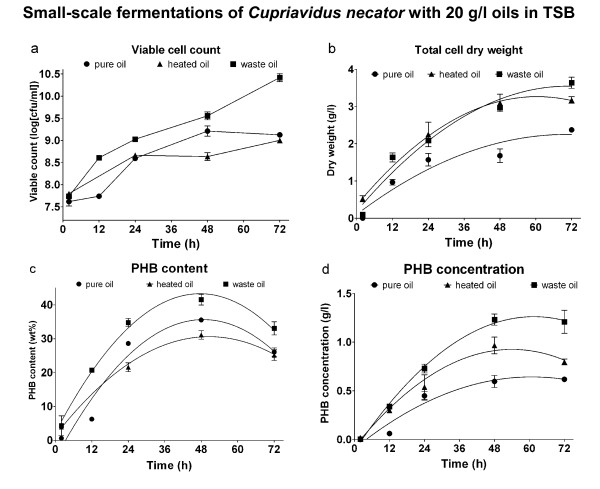
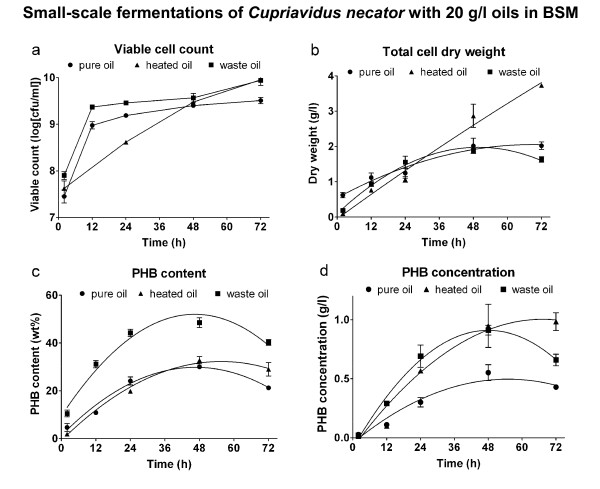
Polyhydroxyalkanoates (PHAs) are biopolymers, which can replace petrochemical plastics in many applications. However, these bioplastics are currently far more expensive than petrochemical plastics. Many researchers are investigating the use of inexpensive substrates derived from waste streams. Waste frying oil is abundant and can be used in PHA production without filtration.Cupriavidus necator (formerly known as Ralstonia eutropha) is a versatile organism for the production of PHAs. Small-scale batch fermentation studies have been set up, using different concentrations of pure vegetable oil, heated vegetable oil and waste frying oil. These oils are all rapeseed oils.It has been shown that Cupriavidus necator produced the homopolymer polyhydroxybutyrate (PHB) from the rapeseed oils. The achieved PHB concentration from waste frying oil was 1.2 g/l, which is similar to a concentration that can be obtained from glucose. The PHB harvest from pure oil and heated oil was 0.62 g/l and 0.9 g/l respectively. A feed of waste frying oil could thus achieve more biopolymer than pure vegetable oil. While the use of a waste product is beneficial from a life-cycle perspective, PHB is not the only product that can be made from waste oil. The collection of waste frying oil is becoming more widespread, making waste oil a good alternative to purified oil or glucose for PHB production.
聚羟基脂肪酸酯(PHA)是一种生物聚合物,可以在许多应用中替代石油化工塑料。然而,这些生物塑料目前的价格远远高于石油化工塑料。许多研究人员正在研究利用来自废物流的廉价底物。废食用油丰富,可以在不经过过滤的情况下用于 PHA 生产。恶臭假单胞菌(以前称为腐生拉氏菌)是生产 PHAs 的多功能生物。已经建立了小规模分批发酵研究,使用不同浓度的纯植物油、加热的植物油和废食用油。这些油都是菜籽油。已经表明,恶臭假单胞菌可以从菜籽油中生产出均聚物聚羟基丁酸酯(PHB)。从废食用油中获得的 PHB 浓度为 1.2 g/L,与从葡萄糖中获得的浓度相似。从纯油和加热油中获得的 PHB 产量分别为 0.62 g/L 和 0.9 g/L。因此,废食用油的进料可以比纯植物油生产更多的生物聚合物。虽然从生命周期的角度来看,使用废物是有益的,但 PHB 并不是唯一可以从废油中制造的产品。废食用油的收集越来越广泛,使得废油成为生产 PHB 的一种很好的替代物,而不是纯化油或葡萄糖。