Agricultural and Biosystems Engineering Department, Iowa State University, Ames, 50011, USA.
AMB Express. 2011 Jul 15;1(1):18. doi: 10.1186/2191-0855-1-18.
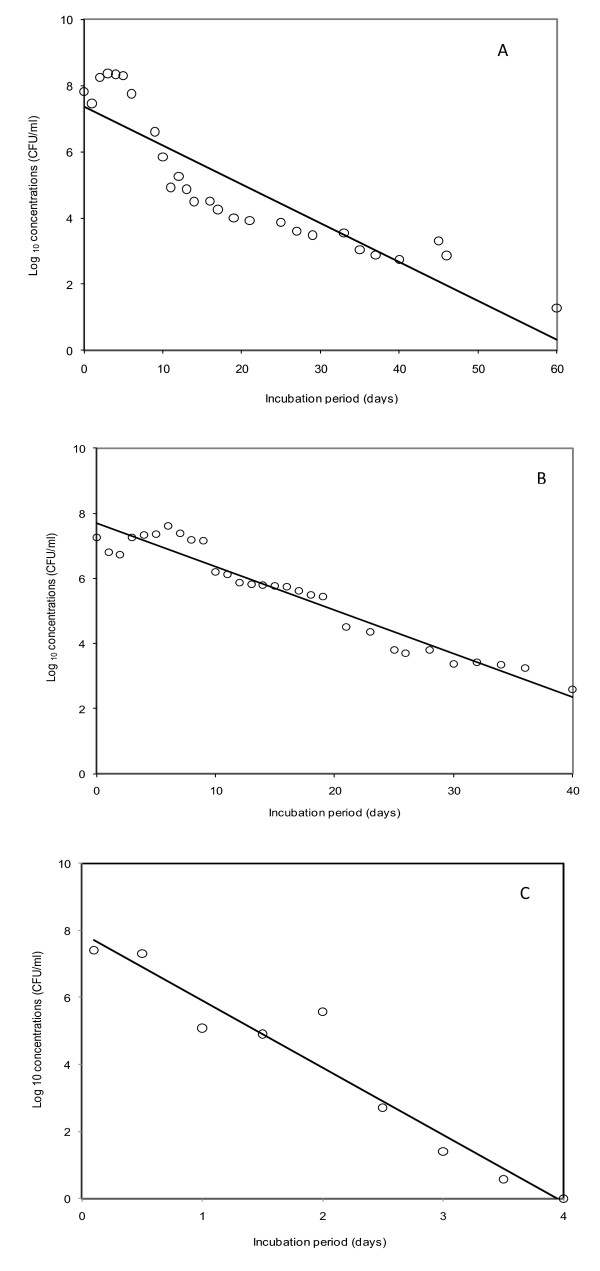
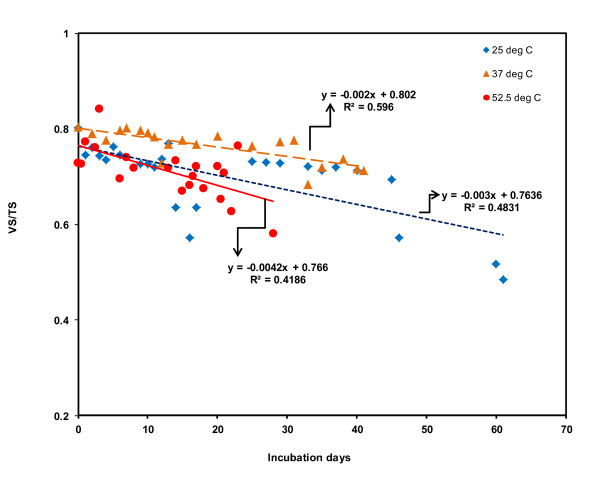
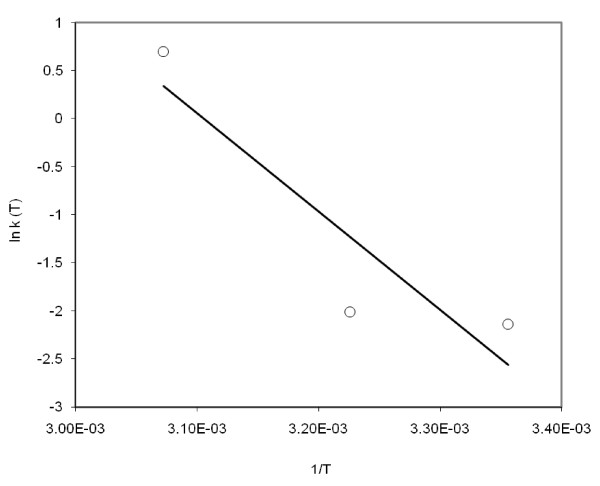
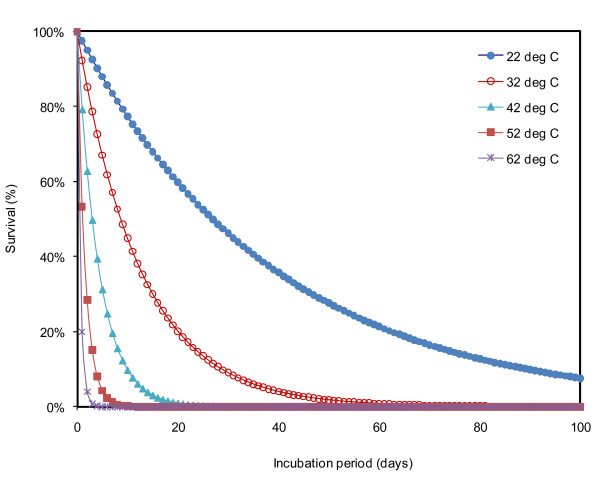
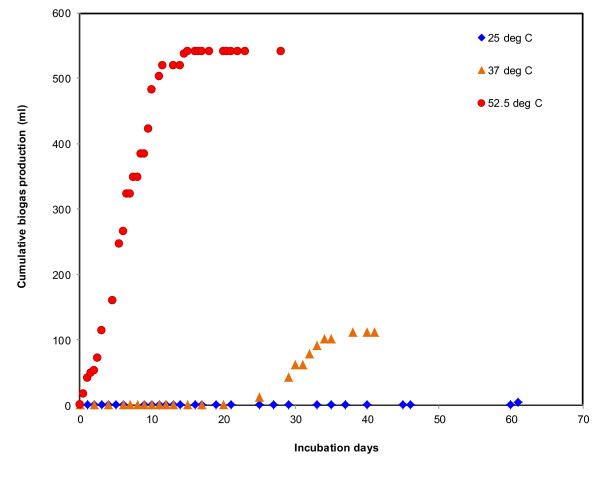
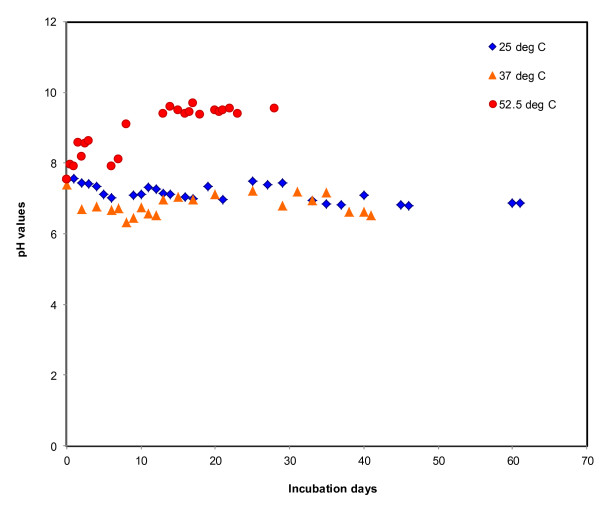
Batch anaerobic digestion experiments using dairy manure as feedstocks were performed at moderate (25°C), mesophilic (37°C), and thermophilic (52.5°C) temperatures to understand E. coli, an indicator organism for pathogens, inactivation in dairy manure. Incubation periods at 25, 37, and 52.5°C, were 61, 41, and 28 days respectively. Results were used to develop models for predicting E. coli inactivation and survival in anaerobic digestion. For modeling we used the decay of E. coli at each temperature to calculate the first-order inactivation rate coefficients, and these rates were used to formulate the time - temperature - E. coli survival relationships. We found the inactivation rate coefficient at 52.5°C was 17 and 15 times larger than the inactivation rate coefficients at 25 and 37°C, respectively. Decimal reduction times (D10; time to achieve one log removal) at 25, 37, and 52.5°C, were 9 -10, 7 - 8 days, and < 1 day, respectively. The Arrhenius correlation between inactivation rate coefficients and temperatures over the range 25 -52.5°C was developed to understand the impacts of temperature on E. coli inactivation rate. Using this correlation, the time - temperature - E. coli survival relationships were derived. Besides E. coli inactivation, impacts of temperature on biogas production, methane content, pH change, ORP, and solid reduction were also studied. At higher temperatures, biogas production and methane content was greater than that at low temperatures. While at thermophilic temperature pH was increased, at mesophilic and moderate temperatures pH were reduced over the incubation period. These results can be used to understand pathogen inactivation during anaerobic digestion of dairy manure, and impacts of temperatures on performance of anaerobic digesters treating dairy manure.
采用中温(25°C)、中温(37°C)和高温(52.5°C)进行了以奶牛粪便为原料的分批厌氧消化实验,以了解大肠埃希氏菌(一种病原体指示生物)在奶牛粪便中的失活情况。在 25°C、37°C 和 52.5°C 的培养期分别为 61、41 和 28 天。结果用于开发预测厌氧消化中大肠埃希氏菌失活和存活的模型。对于建模,我们使用每个温度下大肠埃希氏菌的衰减来计算一级失活率系数,并用这些速率来制定时间-温度-大肠埃希氏菌存活关系。我们发现 52.5°C 的失活率系数分别是 25°C 和 37°C 的 17 倍和 15 倍。25°C、37°C 和 52.5°C 的十进制减少时间(D10;实现一个对数去除所需的时间)分别为 9-10、7-8 天和<1 天。在 25-52.5°C 范围内建立了失活率系数与温度之间的阿累尼乌斯关系,以了解温度对大肠埃希氏菌失活率的影响。使用该相关性,推导出了时间-温度-大肠埃希氏菌存活关系。除了大肠埃希氏菌失活外,还研究了温度对沼气产量、甲烷含量、pH 值变化、氧化还原电位和固体减少的影响。在较高温度下,沼气产量和甲烷含量大于低温下的沼气产量和甲烷含量。而在高温下 pH 值增加,在中温和中温条件下,pH 值在培养期间降低。这些结果可用于了解奶牛粪便厌氧消化过程中病原体的失活情况,以及温度对处理奶牛粪便的厌氧消化器性能的影响。