Department of Cardiology, University Medical Center Groningen, Groningen, The Netherlands.
Heart Fail Rev. 2012 May;17(3):411-20. doi: 10.1007/s10741-011-9279-6.
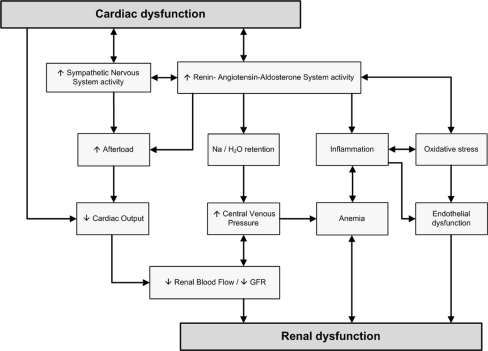
The incidence of heart failure and renal failure is increasing and is associated with poor prognosis. Moreover, these conditions do often coexist and this coexistence results in worsened outcome. Various mechanisms have been proposed as an explanation of this interrelation, including changes in hemodynamics, endothelial dysfunction, inflammation, activation of renin-angiotensin-aldosterone system, and/or sympathetic nervous system. However, the exact mechanisms initializing and maintaining this interaction are still unknown. In many experimental studies on cardiac or renal dysfunction, the function of the other organ was either not addressed or the authors failed to show any decline in its function despite histological changes. There are few studies in which the dysfunction of both heart and kidney function has been described. In this review, we discuss animal models of combined cardiorenal dysfunction. We show that translation of the results from animal studies is limited, and there is a need for new and better models of the cardiorenal interaction to improve our understanding of this syndrome. Finally, we propose several requirements that a new animal model should meet to serve as a tool for studies on the cardiorenal syndrome.
心力衰竭和肾衰竭的发病率正在上升,且与预后不良相关。此外,这些情况通常同时存在,且并存会导致预后更差。已经提出了多种机制来解释这种相互关系,包括血流动力学改变、内皮功能障碍、炎症、肾素-血管紧张素-醛固酮系统和/或交感神经系统的激活。然而,引发和维持这种相互作用的确切机制尚不清楚。在许多关于心或肾功能障碍的实验研究中,要么没有涉及另一个器官的功能,要么作者尽管观察到了组织学变化,却未能显示其功能有任何下降。只有少数研究描述了心肾功能的双重障碍。在这篇综述中,我们讨论了心肾功能障碍的动物模型。我们表明,将动物研究的结果转化具有局限性,需要新的和更好的心肾相互作用模型来增进我们对该综合征的理解。最后,我们提出了新的动物模型应满足的几个要求,以作为心肾综合征研究的工具。