Department of Infectious and Parasitic Diseases, University of São Paulo (FMUSP), Brazil.
PLoS Negl Trop Dis. 2011 Aug;5(8):e1277. doi: 10.1371/journal.pntd.0001277. Epub 2011 Aug 30.
Reactivation of chronic Chagas disease, which occurs in approximately 20% of patients coinfected with HIV/Trypanosoma cruzi (T. cruzi), is commonly characterized by severe meningoencephalitis and myocarditis. The use of quantitative molecular tests to monitor Chagas disease reactivation was analyzed.
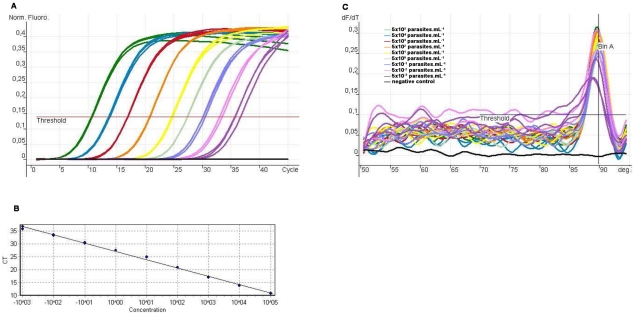
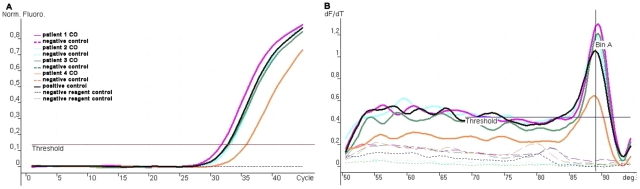
Polymerase chain reaction (PCR) of kDNA sequences, competitive (C-) PCR and real-time quantitative (q) PCR were compared with blood cultures and xenodiagnosis in samples from 91 patients (57 patients with chronic Chagas disease and 34 with HIV/T. cruzi coinfection), of whom 5 had reactivation of Chagas disease and 29 did not.
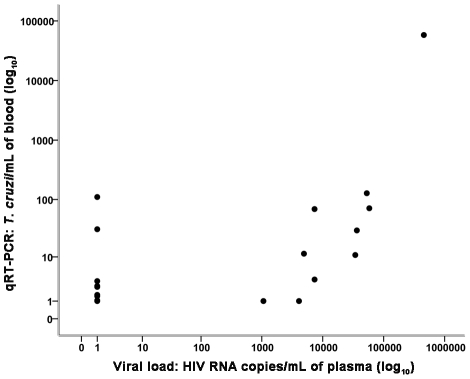
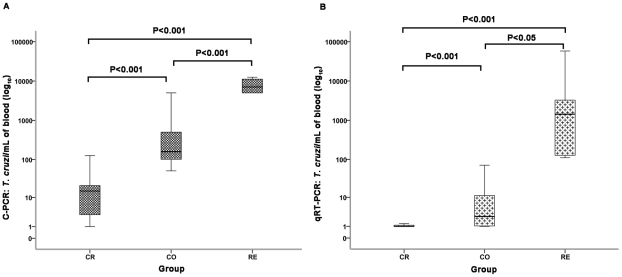
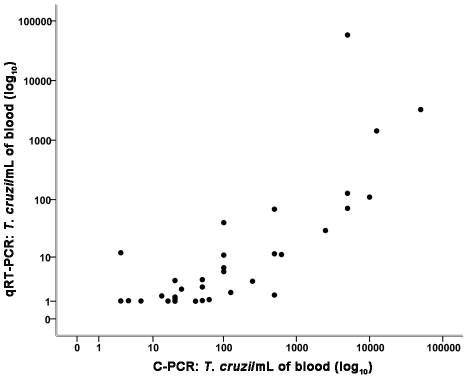
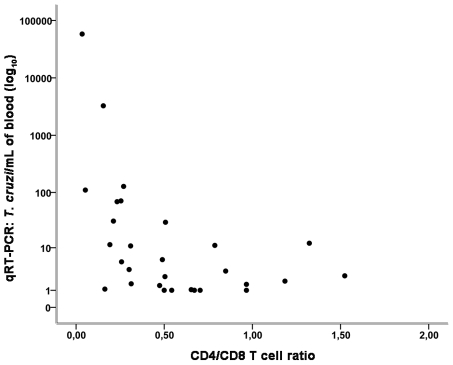
qRT-PCR showed significant differences between groups; the highest parasitemia was observed in patients infected with HIV/T. cruzi with Chagas disease reactivation (median 1428.90 T. cruzi/mL), followed by patients with HIV/T. cruzi infection without reactivation (median 1.57 T. cruzi/mL) and patients with Chagas disease without HIV (median 0.00 T. cruzi/mL). Spearman's correlation coefficient showed that xenodiagnosis was correlated with blood culture, C-PCR and qRT-PCR. A stronger Spearman correlation index was found between C-PCR and qRT-PCR, the number of parasites and the HIV viral load, expressed as the number of CD4(+) cells or the CD4(+)/CD8(+) ratio.
qRT-PCR distinguished the groups of HIV/T. cruzi coinfected patients with and without reactivation. Therefore, this new method of qRT-PCR is proposed as a tool for prospective studies to analyze the importance of parasitemia (persistent and/or increased) as a criterion for recommending pre-emptive therapy in patients with chronic Chagas disease with HIV infection or immunosuppression. As seen in this study, an increase in HIV viral load and decreases in the number of CD4(+) cells/mm(3) and the CD4(+)/CD8(+) ratio were identified as cofactors for increased parasitemia that can be used to target the introduction of early, pre-emptive therapy.
在约 20%合并感染 HIV/克氏锥虫(T. cruzi)的慢性恰加斯病患者中,慢性恰加斯病会复发,其通常表现为严重的脑膜脑炎和心肌炎。本研究分析了定量分子检测在监测恰加斯病复发中的应用。
对 91 例患者(57 例慢性恰加斯病患者和 34 例合并感染 HIV/T. cruzi 的患者)的样本进行了 kDNA 序列聚合酶链反应(PCR)、竞争(C-)PCR 和实时定量(q)PCR 检测,并与血液培养和皮内接种试验进行了比较,其中 5 例患者出现了恰加斯病复发,29 例患者未出现复发。
qRT-PCR 结果显示各组间存在显著差异;恰加斯病复发合并 HIV/T. cruzi 感染患者的寄生虫血症水平最高(中位数为 1428.90 T. cruzi/mL),其次是合并 HIV/T. cruzi 感染但无复发的患者(中位数为 1.57 T. cruzi/mL)和无 HIV 感染的恰加斯病患者(中位数为 0.00 T. cruzi/mL)。Spearman 相关系数显示皮内接种试验与血液培养、C-PCR 和 qRT-PCR 相关。C-PCR 和 qRT-PCR 与寄生虫数量和 HIV 病毒载量(用 CD4+细胞数或 CD4+/CD8+比值表示)的相关性更强。
qRT-PCR 可区分合并感染 HIV/T. cruzi 的患者中有无复发的患者。因此,该新的 qRT-PCR 方法可作为前瞻性研究的工具,分析寄生虫血症(持续存在或增加)作为合并 HIV 感染或免疫抑制的慢性恰加斯病患者推荐抢先治疗的标准的重要性。正如本研究中所见,HIV 病毒载量增加以及 CD4+细胞/mm3 数量和 CD4+/CD8+比值降低被确定为寄生虫血症增加的伴随因素,可用于确定抢先治疗的时机。