Department of Veterinary Integrative Biosciences, College of Veterinary Medicine and Biomedical Sciences, Texas A&M University, College Station, TX 77843-4458, USA.
J Biol Rhythms. 2011 Oct;26(5):412-22. doi: 10.1177/0748730411414170.
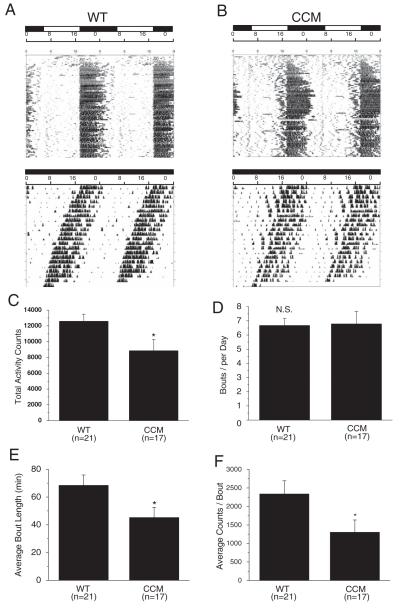
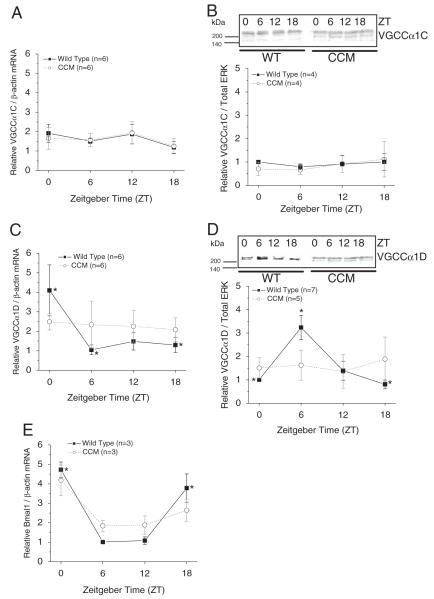
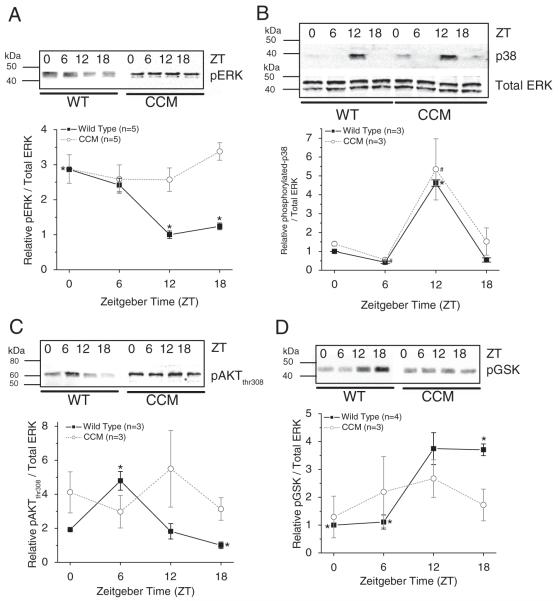
Even though peripheral circadian oscillators in the cardiovascular system are known to exist, the daily rhythms of the cardiovascular system are mainly attributed to autonomic or hormonal inputs under the control of the central oscillator, the suprachiasmatic nucleus (SCN). In order to examine the role of peripheral oscillators in the cardiovascular system, we used a transgenic mouse where the Clock gene is specifically disrupted in cardiomyocytes. In this cardiomyocyte-specific CLOCK mutant (CCM) mouse model, the circadian input from the SCN remains intact. Both CCM and wild-type (WT) littermates displayed circadian rhythms in wheel-running behavior. However, the overall wheel-running activities were significantly lower in CCM mice compared to WT over the course of 5 weeks, indicating that CCM mice either have lower baseline physical activities or they have lower physical adaptation abilities because daily wheel running, like routine exercise, induces physical adaptation over a period of time. Upon further biochemical analysis, it was revealed that the diurnal oscillations of phosphorylation states of several kinases and protein expression of the L-type voltage-gated calcium channel (L-VGCC) α1D subunit found in WT hearts were abolished in CCM hearts, indicating that in mammalian hearts, the daily oscillations of the activities of these kinases and L-VGCCs were downstream elements of the cardiac core oscillators. However, the phosphorylation of p38 MAPK exhibited robust diurnal rhythms in both WT and CCM hearts, indicating that cardiac p38 could be under the influence of the central clock through neurohormonal signals or be part of the circadian input pathway in cardiomyocytes. Taken together, these results indicate that the cardiac core oscillators have an impact in regulating circadian rhythmicities and cardiac function.
尽管已知心血管系统中存在外周昼夜节律振荡器,但心血管系统的日常节律主要归因于中央振荡器(视交叉上核,SCN)控制下的自主或激素输入。为了研究外周振荡器在心血管系统中的作用,我们使用了一种转基因小鼠,其中 Clock 基因在心肌细胞中特异性缺失。在这种心肌细胞特异性 CLOCK 突变(CCM)小鼠模型中,来自 SCN 的昼夜节律输入仍然完整。CCM 和野生型(WT)同窝仔鼠均表现出轮式行为的昼夜节律。然而,与 WT 相比,在 5 周的过程中,CCM 小鼠的整体轮式活动明显较低,这表明 CCM 小鼠要么基础体力活动较低,要么体力适应能力较低,因为日常轮式运动,就像常规运动一样,会在一段时间内引起身体适应。进一步的生化分析表明,WT 心脏中几种激酶的磷酸化状态和 L 型电压门控钙通道(L-VGCC)α1D 亚基的蛋白表达的昼夜节律波动在 CCM 心脏中被消除,表明在哺乳动物心脏中,这些激酶和 L-VGCC 的日常波动是心脏核心振荡器的下游元件。然而,WT 和 CCM 心脏中的 p38 MAPK 磷酸化均表现出强烈的昼夜节律,表明心脏 p38 可能通过神经激素信号受到中央时钟的影响,或者是心肌细胞中昼夜输入途径的一部分。综上所述,这些结果表明心脏核心振荡器在调节昼夜节律和心脏功能方面具有重要作用。