Bremell Daniel, Säll Christer, Gisslén Magnus, Hagberg Lars
Institute of Biomedicine, the Sahlgrenska Academy, University of Gothenburg, Sweden.
J Med Case Rep. 2011 Sep 19;5:465. doi: 10.1186/1752-1947-5-465.
Lyme neuroborreliosis is the most common bacterial central nervous system infection in the temperate parts of the northern hemisphere. Even though human immunodeficiency virus (HIV) -1 infection is common in Lyme borreliosis endemic areas, only five cases of co-infection have previously been published. Four of these cases presented with typical Lyme neuroborreliosis symptoms such as meningoradiculitis and facial palsy, while a fifth case had more severe symptoms of encephalomyelitis. All five were treated with intravenous cephalosporins and clinical outcome was good for all but the fifth case
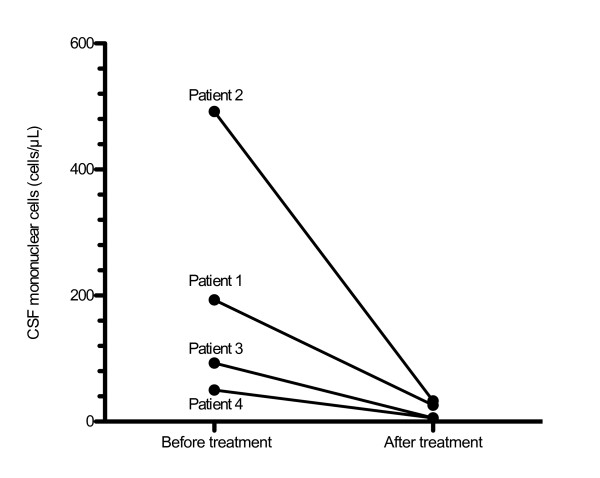
We present four patients with concomitant presence of HIV-1 infection and Lyme neuroborreliosis diagnosed in Western Sweden. Patient 1 was a 60-year-old Caucasian man with radicular pain and cognitive impairment. Patient 2 was a 39-year-old Caucasian man with headaches, leg weakness, and pontine infarction. Patient 3 was a 62-year-old Caucasian man with headaches, tremor, vertigo, and normal-pressure hydrocephalus. Patient 4 was a 50-year-old Caucasian man with radicular pain and peripheral facial palsy. Patients one, two, and three all had subnormal levels of CD4 cells, indicating impaired immunity. All patients were treated with oral doxycycline with good clinical outcome and normalization of CSF pleocytosis.
Given the low HIV-1 prevalence and medium incidence of Lyme neuroborreliosis in Western Sweden where these four cases were diagnosed, co-infection with HIV-1 and Borrelia is probably more common than previously thought. The three patients that were the most immunocompromised suffered from more severe and rather atypical neurological symptoms than are usually described among patients with Lyme neuroborreliosis. It is therefore important for doctors treating HIV patients to consider Lyme neuroborreliosis in a patient presenting with atypical neurological symptoms. All four patients were treated with oral doxycycline with a good outcome, further proving the efficacy of this regime.
莱姆病神经疏螺旋体病是北半球温带地区最常见的细菌性中枢神经系统感染。尽管人类免疫缺陷病毒(HIV)-1感染在莱姆病流行地区很常见,但此前仅发表过5例合并感染的病例。其中4例表现出典型的莱姆病神经疏螺旋体病症状,如脑脊神经根炎和面神经麻痹,而第5例则有更严重的脑脊髓炎症状。所有5例均接受静脉注射头孢菌素治疗,除第5例患者外,其他患者临床预后良好。
我们报告了在瑞典西部诊断出的4例同时感染HIV-1和莱姆病神经疏螺旋体病的患者。患者1是一名60岁的白人男性,患有神经根性疼痛和认知障碍。患者2是一名39岁的白人男性,患有头痛、腿部无力和脑桥梗死。患者3是一名62岁的白人男性,患有头痛、震颤、眩晕和正常压力脑积水。患者4是一名50岁的白人男性,患有神经根性疼痛和周围性面神经麻痹。患者1、2和3的CD4细胞水平均低于正常,表明免疫功能受损。所有患者均接受口服强力霉素治疗,临床预后良好,脑脊液细胞增多症恢复正常。
鉴于在诊断出这4例病例的瑞典西部,HIV-1感染率较低,莱姆病神经疏螺旋体病发病率中等,HIV-1与疏螺旋体的合并感染可能比以前认为的更为常见。免疫功能受损最严重的3例患者出现了比莱姆病神经疏螺旋体病患者通常描述的更为严重和非典型的神经症状。因此,对于治疗HIV患者的医生来说,当患者出现非典型神经症状时,考虑莱姆病神经疏螺旋体病很重要。所有4例患者均接受口服强力霉素治疗,预后良好,进一步证明了该治疗方案的有效性。