Basel Institute for Clinical Epidemiology and Biostatistics, University Hospital Basel, Switzerland.
Stat Med. 2012 May 20;31(11-12):1089-97. doi: 10.1002/sim.4384. Epub 2011 Sep 23.
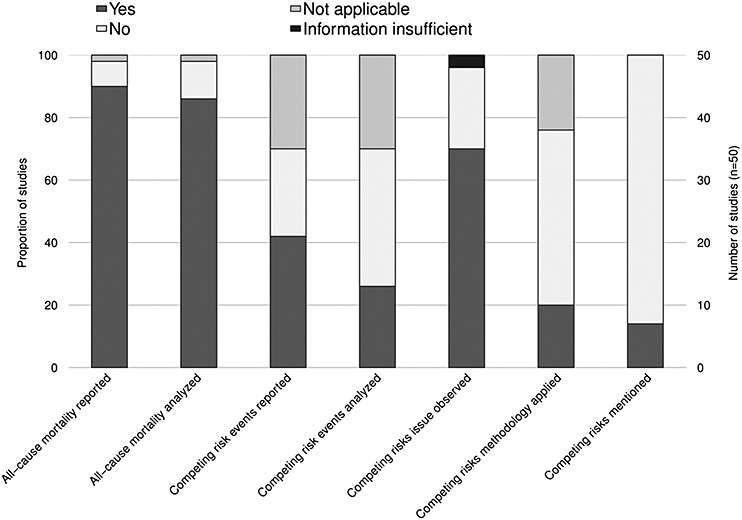
Life expectancy has dramatically increased in industrialized nations over the last 200 hundred years. The aging of populations carries over to clinical research and leads to an increasing representation of elderly and multimorbid individuals in study populations. Clinical research in these populations is complicated by the fact that individuals are likely to experience several potential disease endpoints that prevent some disease-specific endpoint of interest from occurrence. Large developments in competing risks methodology have been achieved over the last decades, but we assume that recognition of competing risks in the clinical community is still marginal. It is the aim of this article to address translational aspects of competing risks to the clinical community. We describe clinical populations where competing risks issues may arise. We then discuss the importance of agreement between the competing risks methodology and the study aim, in particular the distinction between etiologic and prognostic research questions. In a review of 50 clinical studies performed in individuals susceptible to competing risks published in high-impact clinical journals, we found competing risks issues in 70% of all articles. Better recognition of issues related to competing risks and of statistical methods that deal with competing risks in accordance with the aim of the study is needed.
在过去的 200 年里,工业化国家的预期寿命显著延长。人口老龄化问题延伸到临床研究中,导致研究人群中老年人和多病共存患者的比例不断增加。由于这些人群中个体可能经历多个潜在的疾病终点,从而使某些感兴趣的特定疾病终点不会发生,因此此类人群的临床研究变得更加复杂。过去几十年中,竞争风险方法学取得了重大进展,但我们认为,临床界对竞争风险的认识仍然有限。本文旨在向临床界介绍竞争风险的转化方面。我们描述了可能出现竞争风险问题的临床人群。然后,我们讨论了竞争风险方法学与研究目的之间的一致性的重要性,特别是病因学和预后研究问题之间的区别。在对在高影响力临床期刊上发表的、易发生竞争风险的 50 项临床研究进行的综述中,我们发现所有文章中有 70%存在竞争风险问题。需要更好地认识与竞争风险相关的问题,并根据研究目的使用处理竞争风险的统计方法。