Kaufman Annette, Augustson Erik M, Patrick Heather
Cancer Prevention Fellowship Program, Office of the Associate Director, Behavioral Research Program, Division of Cancer Control and Population Sciences, National Cancer Institute, Bethesda, MD 20852, USA.
J Obes. 2012;2012:735465. doi: 10.1155/2012/735465. Epub 2011 Sep 27.
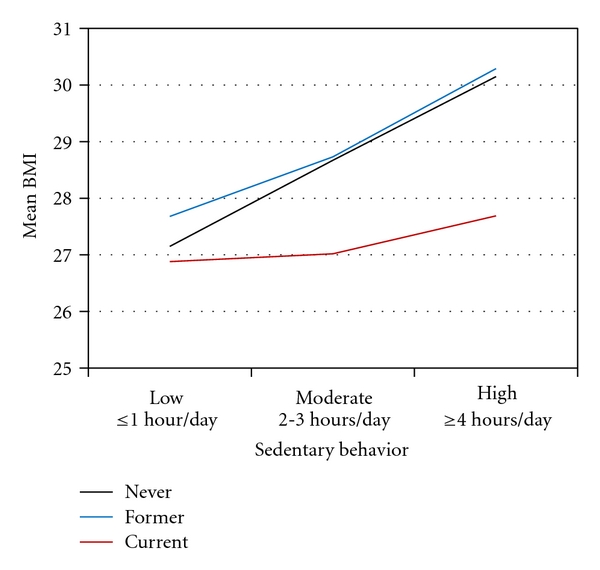
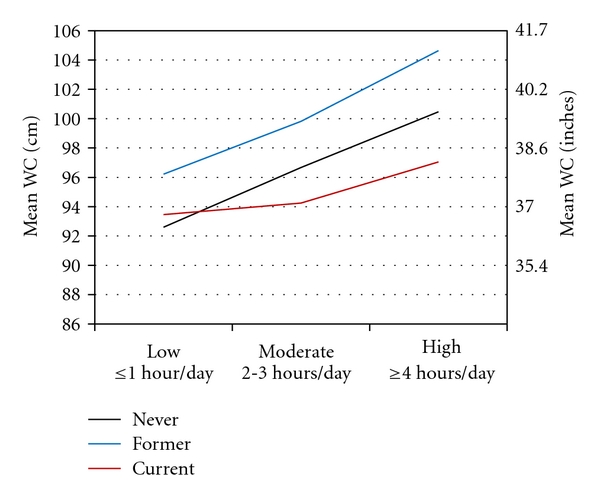
Research has shown that current smokers have a lower mean body mass index (BMI) than never and former smokers, with former smokers having the highest mean BMI. A number of physiological mechanisms have been hypothesized to explain this pattern, but few studies have explored the possible role of behavioral factors. Using data from the cross-sectional National Health and Nutrition Examination Survey 1999-2006, this descriptive study explored the associations among smoking status, sedentary behavior, and two anthropometric measures (BMI and waist circumference (WC)). Sedentary behavior was significantly higher among current smokers compared to never and former smokers; former smokers had higher levels of sedentary behavior compared to never smokers. The association between smoking status and anthropometric outcomes was moderated by sedentary behavior, with current smokers evidencing higher BMI and WC at higher levels of sedentary behavior compared to lower levels of sedentary behavior. Results are discussed in terms of their implications for interventions, particularly with respect to postcessation weight gain.
研究表明,当前吸烟者的平均体重指数(BMI)低于从不吸烟和曾经吸烟的人,曾经吸烟的人平均BMI最高。人们已经假设了多种生理机制来解释这种模式,但很少有研究探讨行为因素的可能作用。本描述性研究利用1999 - 2006年横断面全国健康与营养检查调查的数据,探讨了吸烟状况、久坐行为以及两种人体测量指标(BMI和腰围(WC))之间的关联。与从不吸烟和曾经吸烟的人相比,当前吸烟者的久坐行为明显更高;与从不吸烟的人相比,曾经吸烟的人久坐行为水平更高。吸烟状况与人体测量结果之间的关联受到久坐行为的调节,与久坐行为水平较低相比,当前吸烟者在久坐行为水平较高时表现出更高的BMI和WC。将根据研究结果对干预措施的影响进行讨论,特别是关于戒烟后体重增加方面。