Department of Public Health, Erasmus MC, University Medical Centre, Rotterdam, The Netherlands.
PLoS One. 2011;6(9):e25325. doi: 10.1371/journal.pone.0025325. Epub 2011 Sep 22.
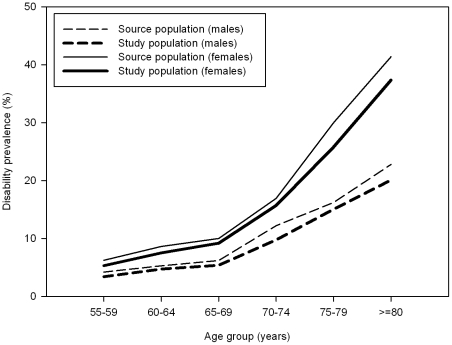
Population ageing is expected to lead to strong increases in the number of persons with one or more disabilities, which may result in substantial declines in the quality of life. To reduce the burden of disability and to prevent concomitant declines in the quality of life, one of the first steps is to establish which diseases contribute most to the burden. Therefore, this paper aims to determine the contribution of specific diseases to the prevalence of disability and to years lived with disability, and to assess whether large contributions are due to a high disease prevalence or a high disabling impact.
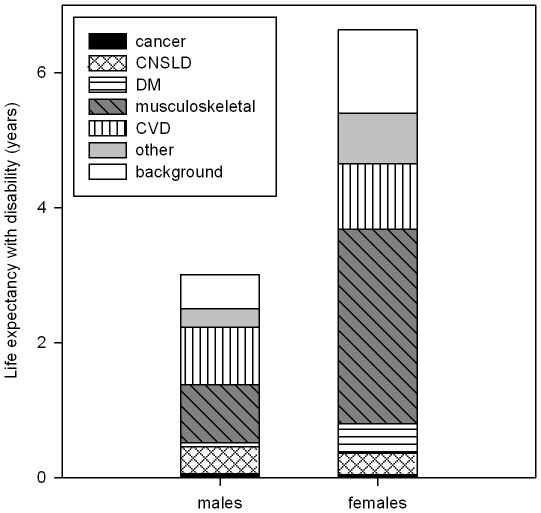
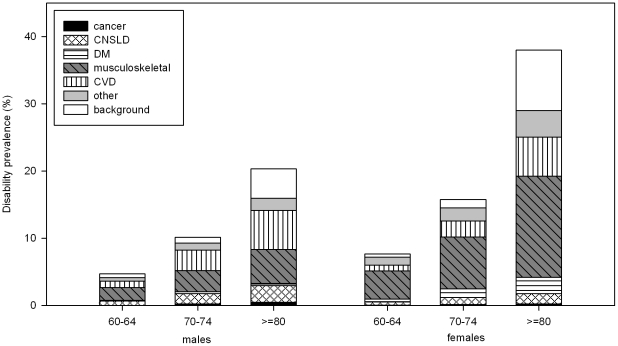
METHODOLOGY/PRINCIPAL FINDINGS: Data from the Dutch POLS-survey (Permanent Onderzoek Leefsituatie, 2001-2007) were analyzed. Using additive regression and accounting for co-morbidity, the disabling impact of selected chronic diseases was calculated, and the prevalence and years lived with ADL and mobility disabilities were partitioned into contributions of specific disease. Musculoskeletal and cardiovascular disease contributed most to the burden of disability, but chronic non-specific lung disease (males) and diabetes (females) also contributed much. Within the musculoskeletal and cardiovascular disease groups, back pain, peripheral vascular disease and stroke contributed particularly by their high disabling impact. Arthritis and heart disease were less disabling but contributed substantially because of their high prevalence. The disabling impact of diseases was particularly high among persons older than 80.
CONCLUSIONS/SIGNIFICANCE: To reduce the burden of disability, the extent diseases such as back pain, peripheral vascular disease and stroke lead to disability should be reduced, particularly among the oldest old. But also moderately disabling diseases with a high prevalence, such as arthritis and heart disease, should be targeted.
人口老龄化预计会导致残疾人数的大幅增加,这可能会导致生活质量的显著下降。为了减轻残疾负担,防止生活质量的相应下降,第一步是确定哪些疾病对残疾负担的贡献最大。因此,本文旨在确定特定疾病对残疾发生率和残疾年限的贡献,并评估大的贡献是否归因于高疾病发病率或高致残影响。
方法/主要发现:分析了荷兰 POLS 调查(Permanent Onderzoek Leefsituatie,2001-2007 年)的数据。使用加法回归并考虑合并症,计算了选定慢性疾病的致残影响,并将日常生活活动和移动能力残疾的患病率和残疾年限分为特定疾病的贡献。肌肉骨骼和心血管疾病对残疾负担的贡献最大,但慢性非特异性肺部疾病(男性)和糖尿病(女性)也有很大贡献。在肌肉骨骼和心血管疾病组中,腰痛、外周血管疾病和中风的致残影响特别高。关节炎和心脏病的致残程度较低,但由于其高发病率,也有很大的影响。疾病的致残影响在 80 岁以上的人群中尤其高。
结论/意义:为了减轻残疾负担,应减少腰痛、外周血管疾病和中风等疾病导致残疾的程度,尤其是在最年长的老年人中。但也应针对发病率较高但致残程度中等的疾病,如关节炎和心脏病。