University of California, San Diego, La Jolla, CA 92039, USA.
Dis Model Mech. 2012 Jan;5(1):48-61. doi: 10.1242/dmm.000406. Epub 2011 Oct 6.
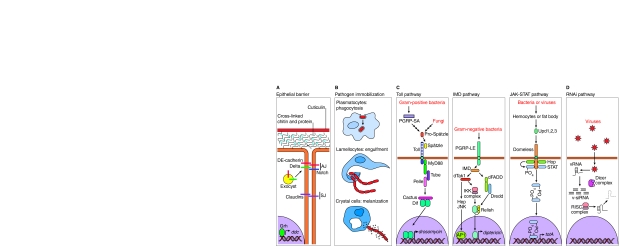
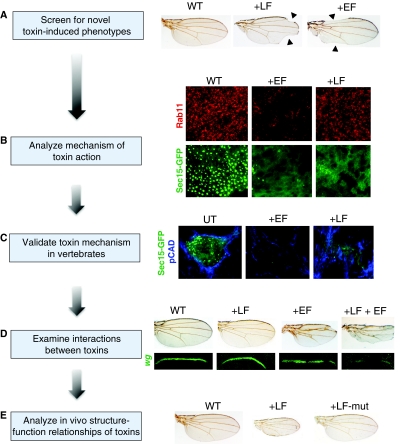
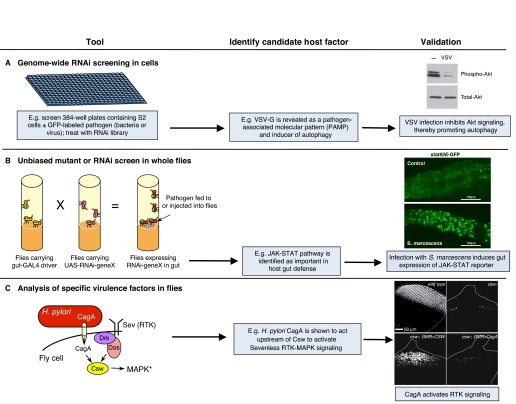
Many of the cellular mechanisms underlying host responses to pathogens have been well conserved during evolution. As a result, Drosophila can be used to deconstruct many of the key events in host-pathogen interactions by using a wealth of well-developed molecular and genetic tools. In this review, we aim to emphasize the great leverage provided by the suite of genomic and classical genetic approaches available in flies for decoding details of host-pathogen interactions; these findings can then be applied to studies in higher organisms. We first briefly summarize the general strategies by which Drosophila resists and responds to pathogens. We then focus on how recently developed genome-wide RNA interference (RNAi) screens conducted in cells and flies, combined with classical genetic methods, have provided molecular insight into host-pathogen interactions, covering examples of bacteria, fungi and viruses. Finally, we discuss novel strategies for how flies can be used as a tool to examine how specific isolated virulence factors act on an intact host.
在进化过程中,宿主对病原体的反应的许多细胞机制得到了很好的保守。因此,通过使用大量成熟的分子和遗传工具,果蝇可用于剖析宿主-病原体相互作用中的许多关键事件。在这篇综述中,我们旨在强调基因组和经典遗传方法在果蝇中提供的巨大优势,这些方法可用于解码宿主-病原体相互作用的细节;然后可以将这些发现应用于高等生物的研究。我们首先简要总结了果蝇抵抗和响应病原体的一般策略。然后,我们重点介绍了最近在细胞和果蝇中进行的全基因组 RNA 干扰 (RNAi) 筛选,以及结合经典遗传方法,如何为宿主-病原体相互作用提供分子见解,涵盖了细菌、真菌和病毒的例子。最后,我们讨论了如何利用果蝇作为工具来研究特定的孤立毒力因子如何作用于完整宿主的新策略。