Key Laboratory of Molecular Biology of Crop Pathogens and Insects, Institute of Biotechnology, Zhejiang University, Hangzhou, China.
PLoS One. 2011;6(9):e25311. doi: 10.1371/journal.pone.0025311. Epub 2011 Sep 28.
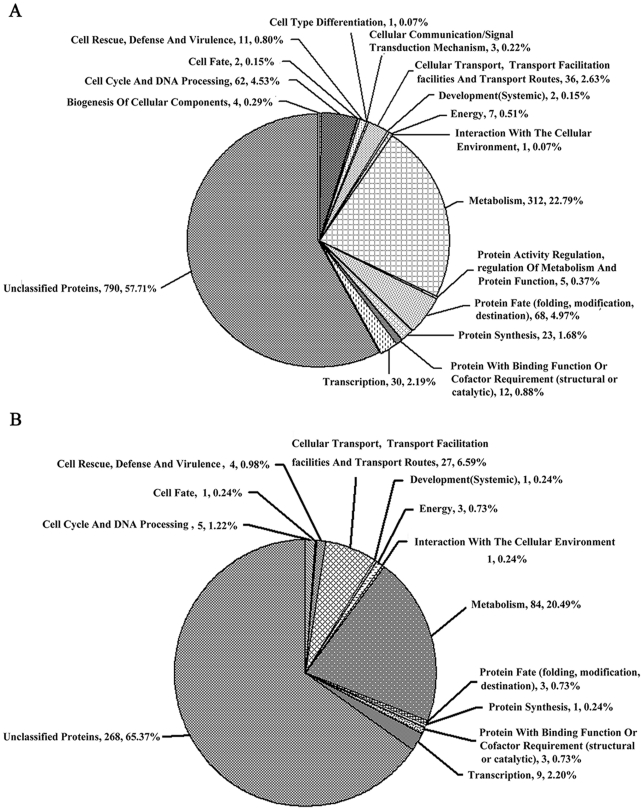
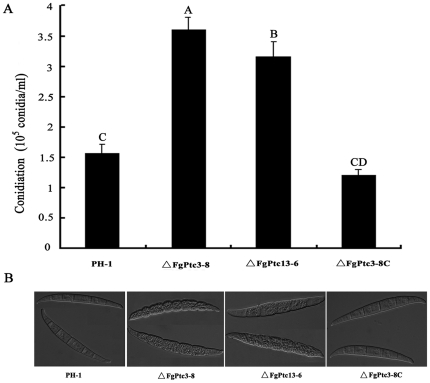
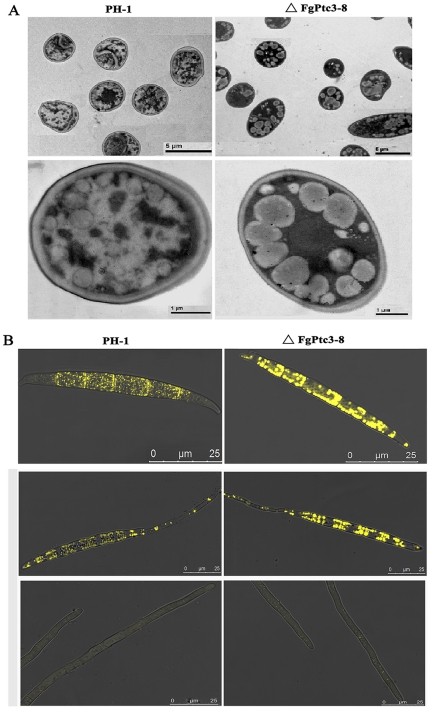
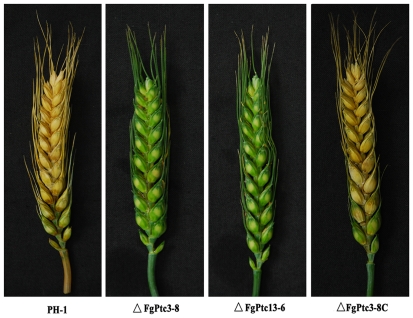
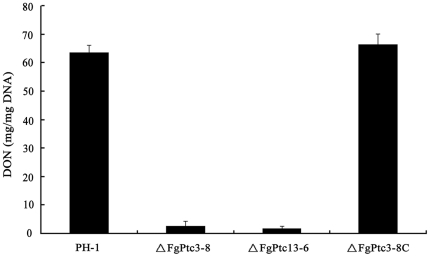
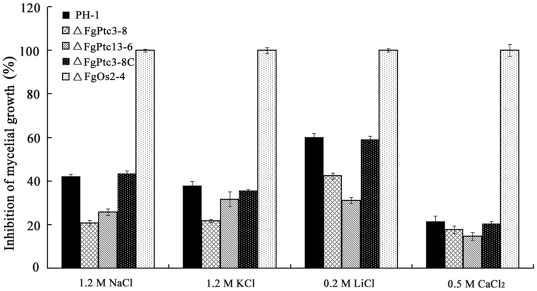
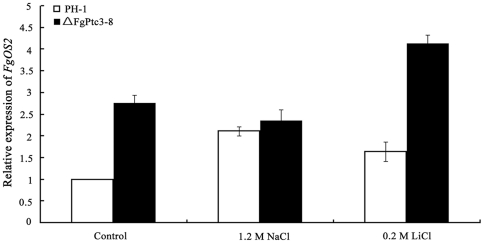
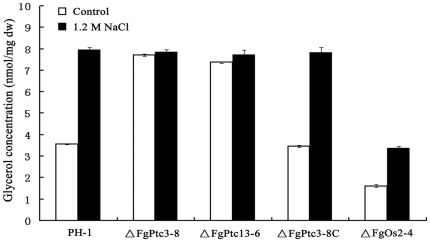
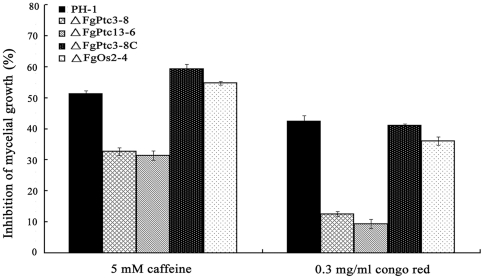
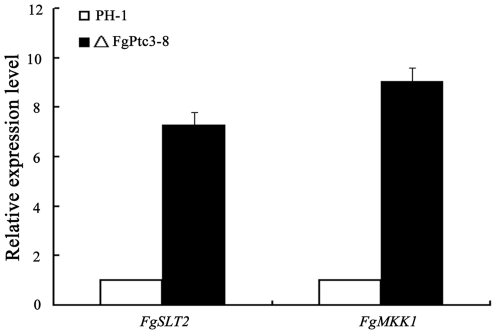
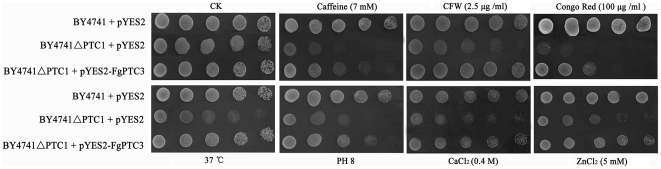
Type 2C protein phosphatases (PP2Cs) play important roles in regulating many biological processes in eukaryotes. Currently, little is known about functions of PP2Cs in filamentous fungi. The causal agent of wheat head blight, Fusarium graminearum, contains seven putative PP2C genes, FgPTC1, -3, -5, -5R, -6, -7 and -7R. In order to investigate roles of these PP2Cs, we constructed deletion mutants for all seven PP2C genes in this study. The FgPTC3 deletion mutant (ΔFgPtc3-8) exhibited reduced aerial hyphae formation and deoxynivalenol (DON) production, but increased production of conidia. The mutant showed increased resistance to osmotic stress and cell wall-damaging agents on potato dextrose agar plates. Pathogencity assays showed that ΔFgPtc3-8 is unable to infect flowering wheat head. All of the defects were restored when ΔFgPtc3-8 was complemented with the wild-type FgPTC3 gene. Additionally, the FgPTC3 partially rescued growth defect of a yeast PTC1 deletion mutant under various stress conditions. Ultrastructural and histochemical analyses showed that conidia of ΔFgPtc3-8 contained an unusually high number of large lipid droplets. Furthermore, the mutant accumulated a higher basal level of glycerol than the wild-type progenitor. Quantitative real-time PCR assays showed that basal expression of FgOS2, FgSLT2 and FgMKK1 in the mutant was significantly higher than that in the wild-type strain. Serial analysis of gene expression in ΔFgPtc3-8 revealed that FgPTC3 is associated with various metabolic pathways. In contrast to the FgPTC3 mutant, the deletion mutants of FgPTC1, FgPTC5, FgPTC5R, FgPTC6, FgPTC7 or FgPTC7R did not show aberrant phenotypic features when grown on PDA medium or inoculated on wheat head. These results indicate FgPtc3 is the key PP2C that plays a critical role in a variety of cellular and biological functions, including cell wall integrity, lipid and secondary metabolisms, and virulence in F. graminearum.
2C 型蛋白磷酸酶(PP2Cs)在真核生物中调节许多生物学过程中发挥重要作用。目前,丝状真菌中 PP2C 的功能知之甚少。小麦赤霉病的病原体禾谷镰刀菌含有七个推定的 PP2C 基因,FgPTC1、-3、-5、-5R、-6、-7 和 -7R。为了研究这些 PP2Cs 的作用,本研究构建了这七个 PP2C 基因的缺失突变体。FgPTC3 缺失突变体(ΔFgPtc3-8)表现出减少气生菌丝形成和脱氧雪腐镰刀菌烯醇(DON)产生,但增加分生孢子的产生。该突变体在马铃薯葡萄糖琼脂平板上对渗透压胁迫和细胞壁破坏剂的抗性增加。致病性测定表明,ΔFgPtc3-8 无法感染开花小麦头部。当 ΔFgPtc3-8 用野生型 FgPTC3 基因互补时,所有缺陷都得到恢复。此外,FgPTC3 在各种应激条件下部分挽救了酵母 PTC1 缺失突变体的生长缺陷。超微结构和组织化学分析表明,ΔFgPtc3-8 的分生孢子含有异常数量的大脂质滴。此外,突变体比野生型亲本体积累了更高的基础甘油水平。定量实时 PCR 测定表明,突变体中 FgOS2、FgSLT2 和 FgMKK1 的基础表达明显高于野生型菌株。ΔFgPtc3-8 的基因表达序列分析显示,FgPTC3 与各种代谢途径有关。与 FgPTC3 突变体相反,FgPTC1、FgPTC5、FgPTC5R、FgPTC6、FgPTC7 或 FgPTC7R 的缺失突变体在 PDA 培养基上生长或接种在小麦头部时没有表现出异常表型特征。这些结果表明,FgPtc3 是关键的 PP2C,在禾谷镰刀菌的各种细胞和生物学功能中发挥关键作用,包括细胞壁完整性、脂质和次生代谢以及毒力。