GIS CRVOI, Centre de Recherche et de Veille sur les Maladies Emergentes dans l'Océan Indien, Saint-Denis, La Réunion.
PLoS One. 2011;6(9):e25738. doi: 10.1371/journal.pone.0025738. Epub 2011 Sep 29.
To date, there is little information that reflects the true extent of spread of the pH1N1/2009v influenza pandemic at the community level as infection often results in mild or no clinical symptoms. This study aimed at assessing through a prospective study, the attack rate of pH1N1/2009 virus in Reunion Island and risk factors of infection, during the 2009 season.
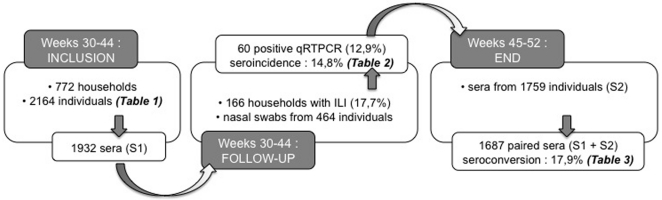
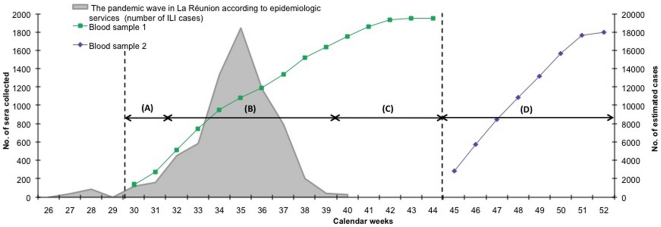
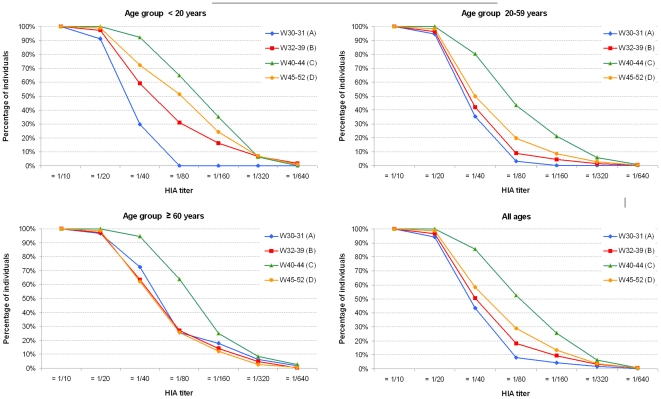
METHODOLOGY/PRINCIPAL FINDINGS: A serosurvey was conducted during the 2009 austral winter, in the frame of a prospective population study. Pairs of sera were collected from 1687 individuals belonging to 772 households, during and after passage of the pandemic wave. Antibodies to pH1N1/2009v were titered using the hemagglutination inhibition assay (HIA) with titers ≥ 1/40 being considered positive. Seroprevalence during the first two weeks of detection of pH1N1/2009v in Reunion Island was 29.8% in people under 20 years of age, 35.6% in adults (20-59 years) and 73.3% in the elderly (≥ 60 years) (P<0.0001). Baseline corrected cumulative incidence rates, were 42.9%, 13.9% and 0% in these age groups respectively (P<0.0001). A significant decline in antibody titers occurred soon after the passage of the epidemic wave. Seroconversion rates to pH1N1/2009 correlated negatively with age: 63.2%, 39.4% and 16.7%, in each age group respectively (P<0.0001). Seroconversion occurred in 65.2% of individuals who were seronegative at inclusion compared to 6.8% in those who were initially seropositive.
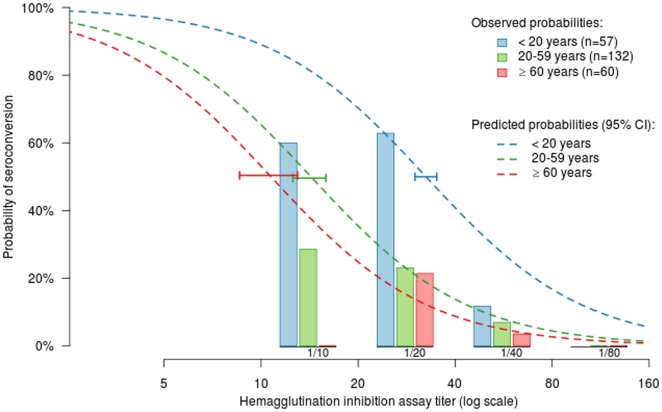
Seroincidence of pH1N1/2009v infection was three times that estimated from clinical surveillance, indicating that almost two thirds of infections occurring at the community level have escaped medical detection. People under 20 years of age were the most affected group. Pre-epidemic titers ≥ 1/40 prevented seroconversion and are likely protective against infection. A concern was raised about the long term stability of the antibody responses.
迄今为止,由于感染通常导致轻微或无临床症状,因此很少有信息反映 pH1N1/2009v 流感大流行在社区层面的真实传播范围。本研究旨在通过前瞻性研究评估 2009 年在留尼汪岛 pH1N1/2009 病毒的发病率和感染的危险因素。
方法/主要发现:在 2009 年的澳大利亚冬季,在一项前瞻性人群研究中进行了血清学调查。在大流行波通过期间和之后,从属于 772 个家庭的 1687 个人中收集了血清对。使用血凝抑制测定法(HIA)滴定 pH1N1/2009v 的抗体,滴度≥1/40 被认为是阳性。在留尼汪岛首次发现 pH1N1/2009v 的前两周,20 岁以下人群的血清阳性率为 29.8%,成年人(20-59 岁)为 35.6%,老年人(≥60 岁)为 73.3%(P<0.0001)。在这些年龄组中,基线校正累积发病率分别为 42.9%、13.9%和 0%(P<0.0001)。在大流行波通过后不久,抗体滴度显著下降。血清转化率与年龄呈负相关:每个年龄组分别为 63.2%、39.4%和 16.7%(P<0.0001)。与最初呈血清阳性的人相比,在纳入时呈血清阴性的人中有 65.2%发生血清转换,而有 6.8%发生血清转换。
pH1N1/2009v 感染的血清发生率是临床监测估计的三倍,表明在社区层面发生的感染中,近三分之二未被医学检测到。20 岁以下的人群是受影响最严重的群体。流行前滴度≥1/40 可防止血清转换,可能对感染具有保护作用。对抗体反应的长期稳定性提出了关注。