Pennsylvania State University, University Park, PA, USA.
Prev Sci. 2012 Feb;13(1):96-105. doi: 10.1007/s11121-011-0250-5.
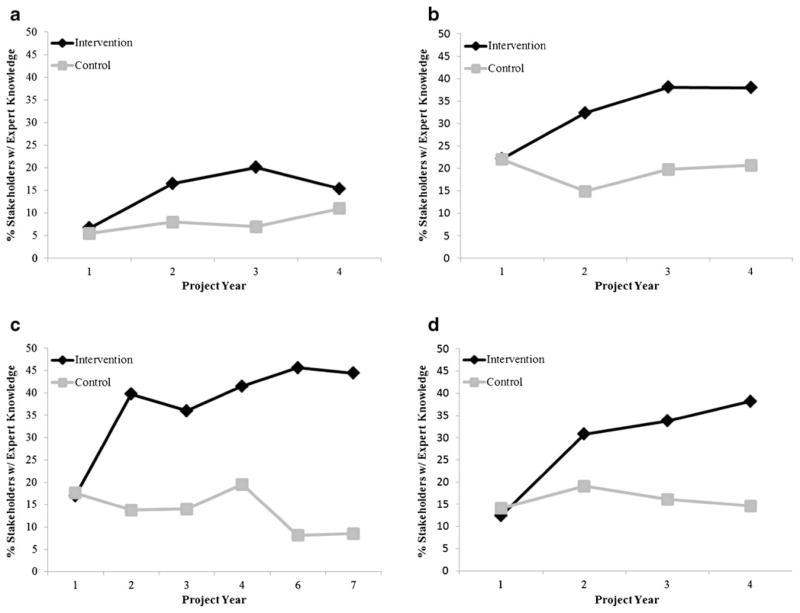
A substantial challenge in improving public health is how to facilitate the local adoption of evidence-based interventions (EBIs). To do so, an important step is to build local stakeholders' knowledge and decision-making skills regarding the adoption and implementation of EBIs. One EBI delivery system, called PROSPER (PROmoting School-community-university Partnerships to Enhance Resilience), has effectively mobilized community prevention efforts, implemented prevention programming with quality, and consequently decreased youth substance abuse. While these results are encouraging, another objective is to increase local stakeholder knowledge of best practices for adoption, implementation and evaluation of EBIs. Using a mixed methods approach, we assessed local stakeholder knowledge of these best practices over 5 years, in 28 intervention and control communities. Results indicated that the PROSPER partnership model led to significant increases in expert knowledge regarding the selection, implementation, and evaluation of evidence-based interventions. Findings illustrate the limited programming knowledge possessed by members of local prevention efforts, the difficulty of complete knowledge transfer, and highlight one method for cultivating that knowledge.
提高公众健康水平的一个重大挑战是如何促进地方采用基于证据的干预措施(EBIs)。为此,重要的一步是增强地方利益相关者在采用和实施 EBIs 方面的知识和决策技能。一种名为 PROSPER(促进学校-社区-大学伙伴关系以增强适应力)的 EBI 提供系统有效地调动了社区预防工作,高质量地实施了预防方案,从而减少了青少年的药物滥用。尽管这些结果令人鼓舞,但另一个目标是提高地方利益相关者对 EBI 采用、实施和评估的最佳实践的了解。我们使用混合方法,在 28 个干预和对照社区中,在 5 年内评估了地方利益相关者对这些最佳实践的了解。结果表明,PROSPER 伙伴关系模式导致对选择、实施和评估基于证据的干预措施的专家知识显著增加。研究结果表明,地方预防工作成员所掌握的方案编制知识有限,完全知识转移存在困难,并强调了培养这种知识的一种方法。