Tashkova Katerina, Korošec Peter, Silc Jurij, Todorovski Ljupčo, Džeroski Sašo
Computer Systems Department, JoŽef Stefan Institute, Jamova cesta 39, SI-1000 Ljubljana, Slovenia.
BMC Syst Biol. 2011 Oct 11;5:159. doi: 10.1186/1752-0509-5-159.
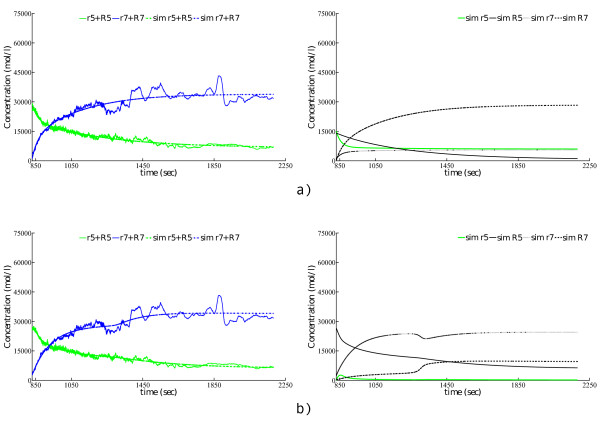
We address the task of parameter estimation in models of the dynamics of biological systems based on ordinary differential equations (ODEs) from measured data, where the models are typically non-linear and have many parameters, the measurements are imperfect due to noise, and the studied system can often be only partially observed. A representative task is to estimate the parameters in a model of the dynamics of endocytosis, i.e., endosome maturation, reflected in a cut-out switch transition between the Rab5 and Rab7 domain protein concentrations, from experimental measurements of these concentrations. The general parameter estimation task and the specific instance considered here are challenging optimization problems, calling for the use of advanced meta-heuristic optimization methods, such as evolutionary or swarm-based methods.
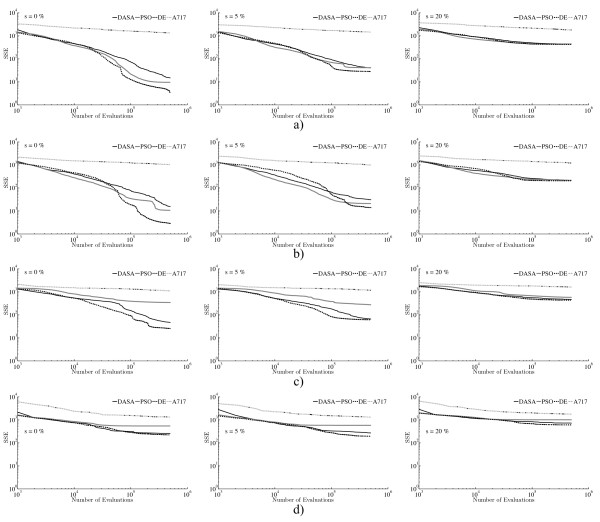
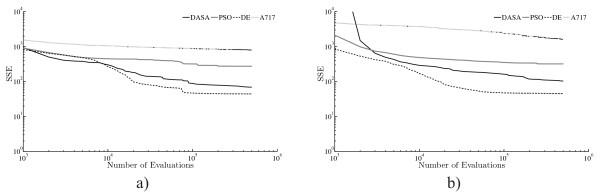
We apply three global-search meta-heuristic algorithms for numerical optimization, i.e., differential ant-stigmergy algorithm (DASA), particle-swarm optimization (PSO), and differential evolution (DE), as well as a local-search derivative-based algorithm 717 (A717) to the task of estimating parameters in ODEs. We evaluate their performance on the considered representative task along a number of metrics, including the quality of reconstructing the system output and the complete dynamics, as well as the speed of convergence, both on real-experimental data and on artificial pseudo-experimental data with varying amounts of noise. We compare the four optimization methods under a range of observation scenarios, where data of different completeness and accuracy of interpretation are given as input.
Overall, the global meta-heuristic methods (DASA, PSO, and DE) clearly and significantly outperform the local derivative-based method (A717). Among the three meta-heuristics, differential evolution (DE) performs best in terms of the objective function, i.e., reconstructing the output, and in terms of convergence. These results hold for both real and artificial data, for all observability scenarios considered, and for all amounts of noise added to the artificial data. In sum, the meta-heuristic methods considered are suitable for estimating the parameters in the ODE model of the dynamics of endocytosis under a range of conditions: With the model and conditions being representative of parameter estimation tasks in ODE models of biochemical systems, our results clearly highlight the promise of bio-inspired meta-heuristic methods for parameter estimation in dynamic system models within system biology.
我们致力于基于常微分方程(ODE),从测量数据中估计生物系统动力学模型中的参数。这些模型通常是非线性的,且具有许多参数,测量数据因噪声而存在误差,并且所研究的系统往往只能部分被观测到。一个具有代表性的任务是从这些浓度的实验测量值中,估计内吞作用动力学模型(即内体成熟模型)中的参数,该模型反映在Rab5和Rab7结构域蛋白浓度之间的切换转变中。一般的参数估计任务以及这里所考虑的具体实例都是具有挑战性的优化问题,需要使用先进的元启发式优化方法,如进化算法或基于群体的方法。
我们将三种用于数值优化的全局搜索元启发式算法,即差分蚁群算法(DASA)、粒子群优化算法(PSO)和差分进化算法(DE),以及一种基于局部搜索导数的算法717(A717)应用于ODE参数估计任务。我们沿着多个指标评估它们在考虑的代表性任务上的性能,包括重建系统输出和完整动力学的质量,以及收敛速度,这些评估是在真实实验数据和具有不同噪声量的人工伪实验数据上进行的。我们在一系列观测场景下比较这四种优化方法,在这些场景中,将不同完整性和解释准确性的数据作为输入。
总体而言,全局元启发式方法(DASA、PSO和DE)明显且显著优于基于局部导数的方法(A717)。在这三种元启发式方法中,差分进化算法(DE)在目标函数(即重建输出)和收敛方面表现最佳。这些结果适用于真实数据和人工数据,适用于所有考虑的可观测性场景,以及添加到人工数据中的所有噪声量。总之,所考虑的元启发式方法适用于在一系列条件下估计内吞作用动力学ODE模型中的参数:由于该模型和条件代表了生化系统ODE模型中的参数估计任务,我们的结果清楚地凸显了受生物启发的元启发式方法在系统生物学中动态系统模型参数估计方面的前景。