Department of Food Science and Technology, University of Nebraska-Lincoln, Lincoln, Nebraska 68583, USA.
Microb Cell Fact. 2011 Aug 30;10 Suppl 1(Suppl 1):S22. doi: 10.1186/1475-2859-10-S1-S22.
Streptococcus thermophilus represents the only species among the streptococci that has "Generally Regarded As Safe" status and that plays an economically important role in the fermentation of yogurt and cheeses. We conducted comparative genome analysis of S. thermophilus LMD-9 to identify unique gene features as well as features that contribute to its adaptation to the dairy environment. In addition, we investigated the transcriptome response of LMD-9 during growth in milk in the presence of Lactobacillus delbrueckii ssp. bulgaricus, a companion culture in yogurt fermentation, and during lytic bacteriophage infection.
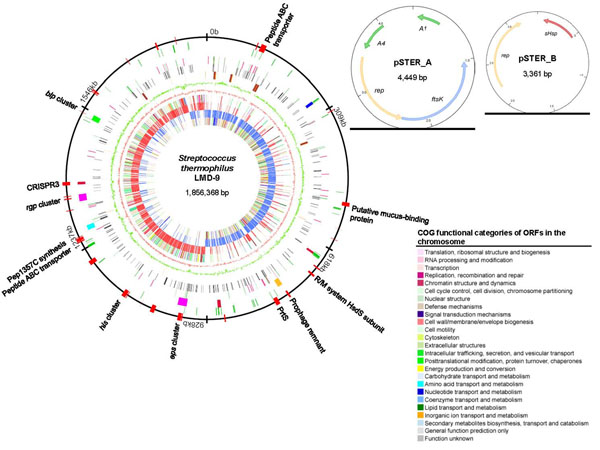
The S. thermophilus LMD-9 genome is comprised of a 1.8 Mbp circular chromosome (39.1% GC; 1,834 predicted open reading frames) and two small cryptic plasmids. Genome comparison with the previously sequenced LMG 18311 and CNRZ1066 strains revealed 114 kb of LMD-9 specific chromosomal region, including genes that encode for histidine biosynthetic pathway, a cell surface proteinase, various host defense mechanisms and a phage remnant. Interestingly, also unique to LMD-9 are genes encoding for a putative mucus-binding protein, a peptide transporter, and exopolysaccharide biosynthetic proteins that have close orthologs in human intestinal microorganisms. LMD-9 harbors a large number of pseudogenes (13% of ORFeome), indicating that like LMG 18311 and CNRZ1066, LMD-9 has also undergone major reductive evolution, with the loss of carbohydrate metabolic genes and virulence genes found in their streptococcal counterparts. Functional genome distribution analysis of ORFeomes among streptococci showed that all three S. thermophilus strains formed a distinct functional cluster, further establishing their specialized adaptation to the nutrient-rich milk niche. An upregulation of CRISPR1 expression in LMD-9 during lytic bacteriophage DT1 infection suggests its protective role against phage invasion. When co-cultured with L. bulgaricus, LMD-9 overexpressed genes involved in amino acid transport and metabolism as well as DNA replication.
The genome of S. thermophilus LMD-9 is shaped by its domestication in the dairy environment, with gene features that conferred rapid growth in milk, stress response mechanisms and host defense systems that are relevant to its industrial applications. The presence of a unique exopolysaccharide gene cluster and cell surface protein orthologs commonly associated with probiotic functionality revealed potential probiotic applications of LMD-9.
嗜热链球菌是链球菌属中唯一具有“一般认为安全”地位并在酸奶和奶酪发酵中具有重要经济作用的物种。我们对嗜热链球菌 LMD-9 进行了比较基因组分析,以确定其独特的基因特征以及有助于其适应乳品环境的特征。此外,我们还研究了 LMD-9 在存在乳杆菌保加利亚亚种(酸奶发酵中的伴生培养物)时在牛奶中生长以及在裂解噬菌体感染期间的转录组反应。
嗜热链球菌 LMD-9 基因组由一个 1.8 Mbp 圆形染色体(39.1%GC;1834 个预测的开放阅读框)和两个小型隐秘质粒组成。与先前测序的 LMG 18311 和 CNRZ1066 菌株的基因组比较显示,LMD-9 具有 114 kb 的特定染色体区域,包括编码组氨酸生物合成途径、细胞表面蛋白酶、各种宿主防御机制和噬菌体残余物的基因。有趣的是,LMD-9 特有的基因还编码一种假定的粘蛋白结合蛋白、一种肽转运蛋白和胞外多糖生物合成蛋白,这些蛋白在人类肠道微生物中具有密切的同源物。LMD-9 拥有大量的假基因(ORFeome 的 13%),表明与 LMG 18311 和 CNRZ1066 一样,LMD-9 也经历了主要的还原进化,丧失了在其链球菌对应物中发现的碳水化合物代谢基因和毒力基因。在链球菌中对 ORFeome 的功能基因组分布分析表明,三种嗜热链球菌菌株都形成了一个独特的功能群,进一步证实了它们对富含营养的牛奶生态位的特殊适应。在裂解噬菌体 DT1 感染期间,LMD-9 中 CRISPR1 表达的上调表明其对噬菌体入侵具有保护作用。当与保加利亚乳杆菌共培养时,LMD-9 过表达与氨基酸运输和代谢以及 DNA 复制相关的基因。
嗜热链球菌 LMD-9 的基因组由其在乳品环境中的驯化所塑造,具有在牛奶中快速生长、应激反应机制和宿主防御系统的基因特征,这些特征与它的工业应用相关。存在独特的胞外多糖基因簇和与益生菌功能相关的细胞表面蛋白同源物,揭示了 LMD-9 的潜在益生菌应用。