Department of Public Health and Clinical Medicine, Occupational and Environmental Medicine, Umeå University, S-90187 Umeå, Sweden.
Environ Health. 2011 Oct 13;10:91. doi: 10.1186/1476-069X-10-91.
An association between traffic air pollution and respiratory symptoms among children has been reported. However, the effects of traffic air pollution on asthma and wheeze have been very sparsely studied in areas with low traffic intensity in cold climate with poor dispersion. We evaluated the impact of vehicle traffic on childhood asthma and wheeze by objective exposure assessment.
As a part of the Obstructive Lung Disease in Northern Sweden (OLIN) studies, a questionnaire was sent to the families of all children attending first or second grade in Luleå (72,000 inhabitants) in Northern Sweden in 2006. The age of the children was 7-8 years and the participation rate was 98% (n = 1357). Skin prick tests were performed in 1224 (89%) children. The home addresses were given geographical coordinates and traffic counts were obtained from the local traffic authorities. A proximity model of average daily traffic and average daily heavy vehicle traffic within 200 meters from each participant's home address was used. The associations between traffic exposure and asthma and wheeze, respectively, were analysed in an adjusted multiple logistic regression model.
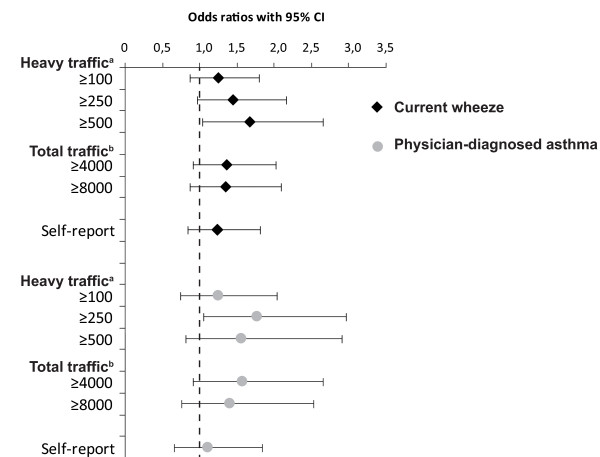
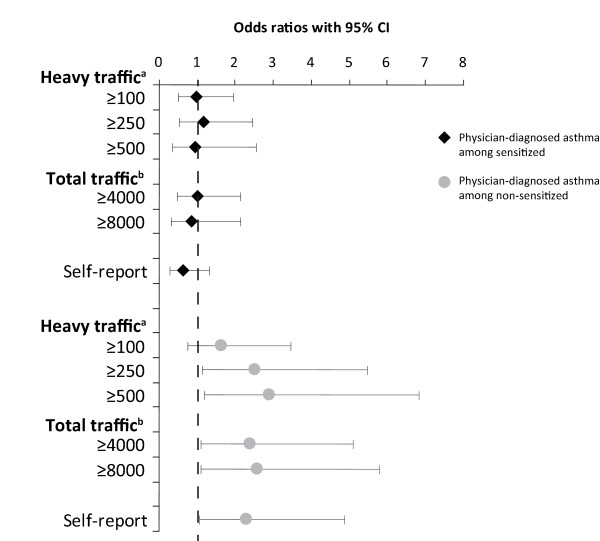
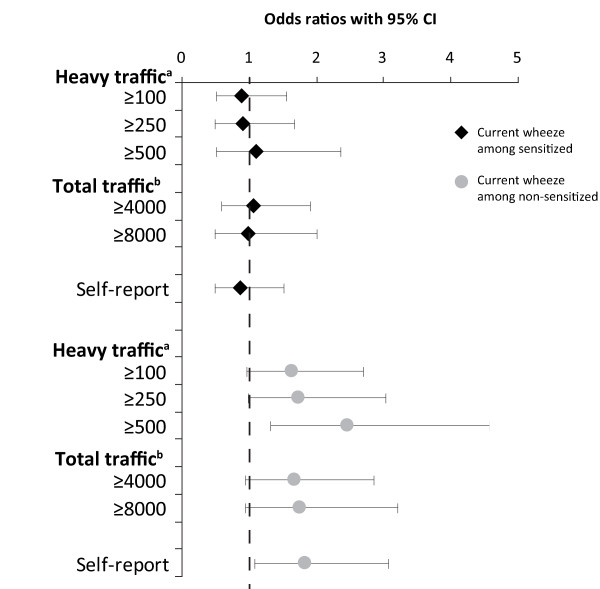
Exposure to high traffic flows was uncommon in the study area; only 15% of the children lived within 200 meters from a road with a traffic flow of ≥8000 vehicles per day. Living closer than 200 meters from a road with ≥500 heavy vehicles daily was associated with current wheeze, odds ratio 1.7 (confidence interval 1.0-2.7). A dose-response relation was indicated. An increased risk of asthma was also seen, however not significant, odds ratio 1.5 (confidence interval 0.8-2.9). Stratified analyses revealed that the effect of traffic exposure was restricted to the non-sensitized phenotype of asthma and wheeze. The agreement between self-reported traffic exposure and objective measurements of exposure was moderate.
This study showed that already at low levels of exposure, vehicle traffic is related to an increased risk of wheeze among children. Thus, the global burden of traffic air pollution may be underestimated.
已有报告显示,交通空气污染与儿童呼吸道症状之间存在关联。然而,在交通强度低、气候寒冷且扩散条件差的地区,有关交通空气污染对哮喘和喘息影响的研究非常少。我们通过客观暴露评估来评估车辆交通对儿童哮喘和喘息的影响。
作为瑞典北部阻塞性肺病研究(OLIN)的一部分,2006 年向瑞典北部吕勒奥(拥有 72000 名居民)所有上一年级或二年级的儿童的家庭寄发了调查问卷。儿童年龄为 7-8 岁,参与率为 98%(n=1357)。1224 名(89%)儿童进行了皮肤点刺试验。家庭住址被赋予了地理坐标,交通流量则从当地交通部门获取。使用参与者家庭住址 200 米范围内平均每日交通量和平均每日重型车辆交通量的临近模型。在调整后的多变量逻辑回归模型中分析交通暴露与哮喘和喘息的关联。
在研究区域,高交通流量的暴露并不常见;只有 15%的儿童居住在距离日交通量≥8000 辆的道路 200 米以内。距离日重型车辆流量≥500 辆的道路不足 200 米与当前喘息有关,比值比为 1.7(95%置信区间 1.0-2.7)。表明存在剂量-反应关系。也观察到哮喘的风险增加,但无统计学意义,比值比为 1.5(95%置信区间 0.8-2.9)。分层分析显示,交通暴露的影响仅限于哮喘和喘息的非致敏表型。自我报告的交通暴露与客观测量的暴露之间的一致性为中等。
本研究表明,即使在低暴露水平下,车辆交通也与儿童喘息风险增加有关。因此,交通空气污染的全球负担可能被低估了。