Plant Genome Research Unit, National Institute of Agrobiological Sciences, Tsukuba 305-8602, Japan.
J Exp Bot. 2012 Jan;63(2):773-84. doi: 10.1093/jxb/err299. Epub 2011 Oct 20.
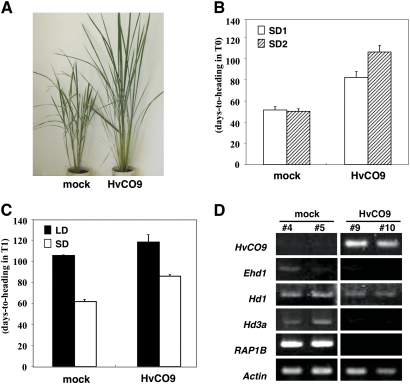
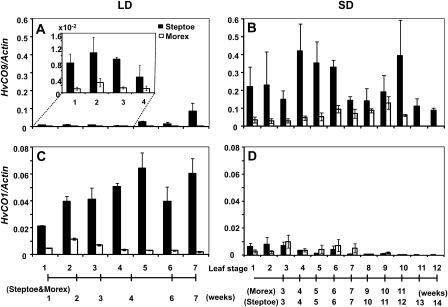
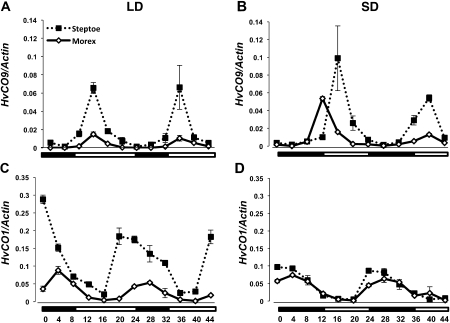
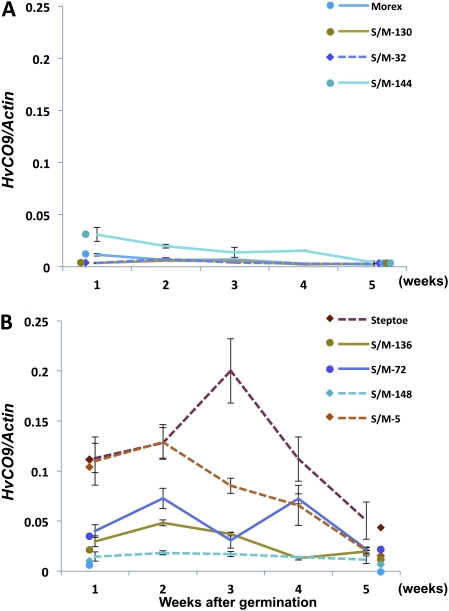
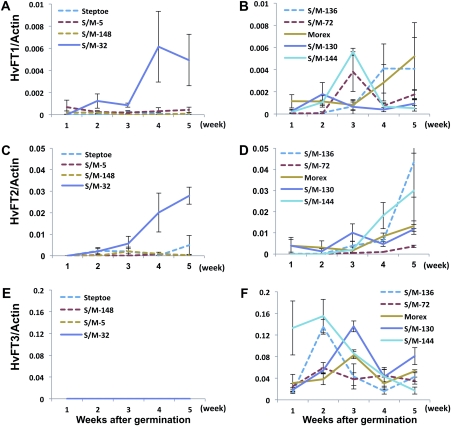
HvCO9 was characterized to elucidate the barley flowering control mechanisms and to investigate the functional diversification of the barley CONSTANS-like (CO-like) genes in flowering. HvCO9 was located on the same chromosome, 1HL, as Ppd-H2 (HvFT3), which is a positive regulator of short-day (SD) flowering. A phylogenetic analysis showed that HvCO9 was located on the same branch of the CO-like gene tree as rice Ghd7 and the barley and wheat VRN2 genes, which are all negative regulators of flowering. High level HvCO9 expressions were observed under SD conditions, whereas its expression levels were quite low under long-day (LD) conditions. HvCO9 expression correlated with HvFT1 and HvFT2 expression under SD conditions, although no clear effect of HvCO9 on HvFT3 expression, or vice versa, under SD conditions was observed. The over-expression of HvCO9 in rice plants produced a remarkable delay in flowering. In transgenic rice, the expression levels of the flowering-related Ehd1 gene, which is a target gene of Ghd7, and its downstream genes were suppressed, causing a delay in flowering. These results suggest that HvCO9 may act as a negative regulator of flowering under non-inductive SD conditions in barley; this activity is similar to that of rice Ghd7 under non-inductive LD conditions, but the functional targets of these genes may be different. Our results indicate that barley has developed its own pathways to control flowering by using homologous genes with modifications for the timing of expression. Further, it is hypothesized that each pathway may target different genes after gene duplication or species diversification.
HvCO9 的特征在于阐明大麦开花控制机制,并研究大麦 CONSTANS 样(CO 样)基因在开花中的功能多样化。HvCO9 位于与 Ppd-H2(HvFT3)相同的染色体 1HL 上,Ppd-H2 是短日(SD)开花的正调控因子。系统发育分析表明,HvCO9 位于 CO 样基因树的同一分支上,与水稻 Ghd7 以及大麦和小麦 VRN2 基因位于同一分支上,这些基因都是开花的负调控因子。在 SD 条件下观察到 HvCO9 的高水平表达,而在 LD 条件下其表达水平相当低。在 SD 条件下,HvCO9 的表达与 HvFT1 和 HvFT2 的表达相关,尽管在 SD 条件下没有观察到 HvCO9 对 HvFT3 表达或反之的明显影响。HvCO9 在水稻植株中的过表达导致开花显著延迟。在转基因水稻中,开花相关基因 Ehd1 的表达水平受到抑制,Ehd1 是 Ghd7 的靶基因,其下游基因的表达也受到抑制,导致开花延迟。这些结果表明,HvCO9 可能在大麦非诱导 SD 条件下作为开花的负调控因子发挥作用;这种活性类似于水稻 Ghd7 在非诱导 LD 条件下的活性,但这些基因的功能靶标可能不同。我们的结果表明,大麦通过使用同源基因并对其表达时间进行修饰,已经开发出自己的开花控制途径。此外,假设在基因复制或物种多样化后,每个途径可能针对不同的基因。