Department of Genetics and Plant Production, Aula Dei Experimental Station, CSIC, Avda. Montañana 1005, E-50059 Zaragoza, Spain.
J Exp Bot. 2011 Mar;62(6):1939-49. doi: 10.1093/jxb/erq382. Epub 2010 Dec 3.
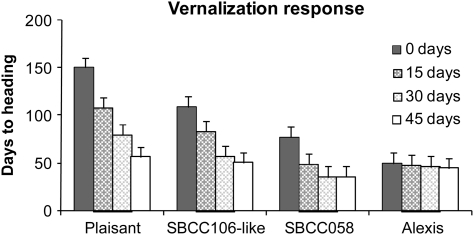
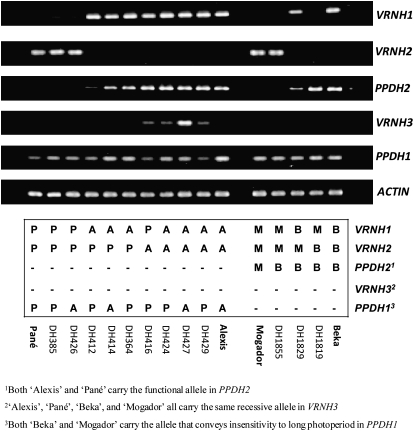
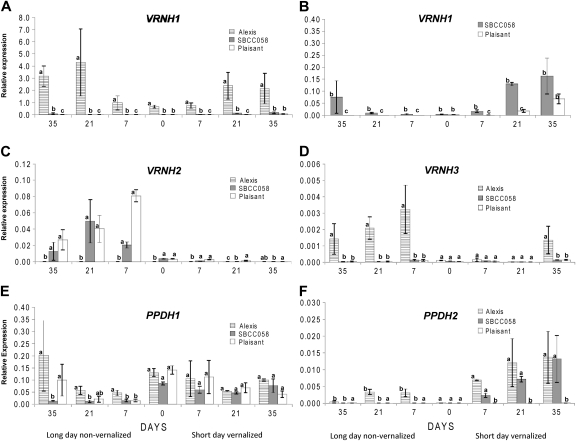
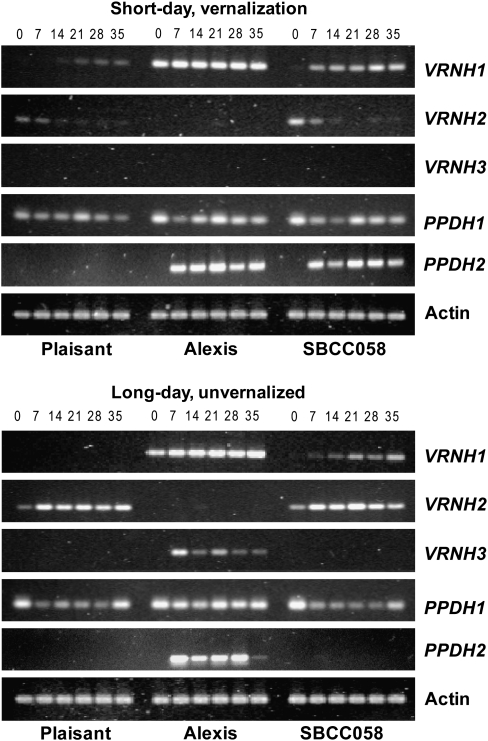
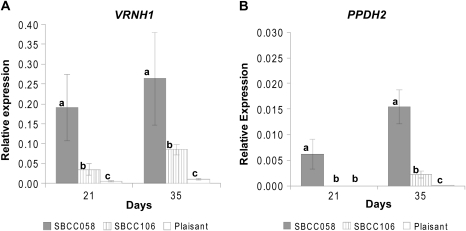
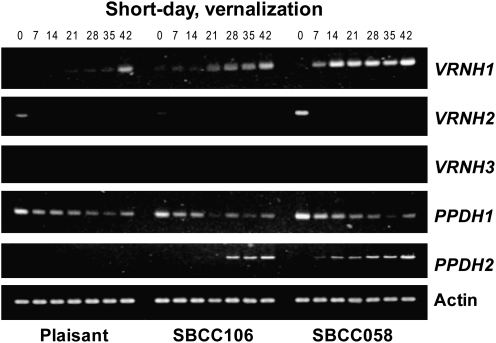
The response to vernalization and the expression of genes associated with responses to vernalization (VRNH1, VRNH2, and VRNH3) and photoperiod (PPDH1 and PPDH2) were analysed in four barley (Hordeum vulgare L.) lines: 'Alexis' (spring), 'Plaisant' (winter), SBCC058, and SBCC106 (Spanish inbred lines), grown under conditions of vernalization and short days (VSD) or no vernalization and long days (NVLD). The four genotypes differ in VRNH1. Their growth habits and responses to vernalization correlated with the level of expression of VRNH1 and the length of intron 1. 'Alexis' and 'Plaisant' behaved as expected. SBCC058 and SBCC106 showed an intermediate growth habit and flowered relatively late in the absence of vernalization. VRNH1 expression was induced by cold for all genotypes. Under VSD, VRNH1 expression was detected in the SBCC genotypes later than in 'Alexis' but earlier than in 'Plaisant'. VRNH2 was repressed under short days while VRNH1 expression increased in parallel. VRNH3 was detected only in 'Alexis' under NVLD, whereas it was not expressed in plants with the active allele of VRNH2 (SBCC058 and 'Plaisant'). Under VSD, PPDH2 was expressed in 'Alexis', SBCC058, and SBCC106, but it was only expressed weakly in 'Alexis' under NVLD. Further analysis of PPDH2 expression in two barley doubled haploid populations revealed that, under long days, HvFT3 and VRNH2 expression levels were related inversely. The timing of VRNH2 expression under a long photoperiod suggests that this gene might be involved in repression of PPDH2 and, indirectly, in the regulation of flowering time through an interaction with the day-length pathway.
在四个大麦(Hordeum vulgare L.)品系中:“Alexis”(春性)、“Plaisant”(冬性)、SBCC058 和 SBCC106(西班牙自交系),分析了春化和短日照(VSD)或无春化和长日照(NVLD)条件下对 Vernalization 和与 Vernalization 相关基因表达(VRNH1、VRNH2 和 VRNH3)和光周期(PPDH1 和 PPDH2)的响应。这四个基因型在 VRNH1 上存在差异。它们的生长习性和对春化的反应与 VRNH1 的表达水平和内含子 1 的长度有关。“Alexis”和“Plaisant”的表现符合预期。SBCC058 和 SBCC106 表现出中间的生长习性,在没有春化的情况下相对较晚开花。VRNH1 的表达在所有基因型中都被低温诱导。在 VSD 下,SBCC 基因型中 VRNH1 的表达比“Alexis”晚,但比“Plaisant”早。VRNH2 在短日照下被抑制,而 VRNH1 的表达则与之平行增加。只有在 NVLD 下,“Alexis”中才能检测到 VRNH3,而在 VRNH2 活性等位基因的植株(SBCC058 和“Plaisant”)中则没有表达。在 VSD 下,“Alexis”、SBCC058 和 SBCC106 中都表达了 PPDH2,但在 NVLD 下,“Alexis”中仅表达微弱。对两个大麦加倍单倍体群体中 PPDH2 表达的进一步分析表明,在长日照下,HvFT3 和 VRNH2 的表达水平呈负相关。在长光照下 VRNH2 表达的时间表明,该基因可能参与了 PPDH2 的抑制,并通过与光周期途径的相互作用间接参与了开花时间的调节。