• 文献检索
  • 文档翻译
  • 深度研究
  • 学术资讯
  • Suppr Zotero 插件Zotero 插件
  • 邀请有礼
  • 套餐&价格
  • 历史记录
应用&插件
Suppr Zotero 插件Zotero 插件浏览器插件Mac 客户端Windows 客户端微信小程序
定价
高级版会员购买积分包购买API积分包
服务
文献检索文档翻译深度研究API 文档MCP 服务
关于我们
关于 Suppr公司介绍联系我们用户协议隐私条款
关注我们

Suppr 超能文献

核心技术专利:CN118964589B侵权必究
粤ICP备2023148730 号-1Suppr @ 2026

文献检索

告别复杂PubMed语法,用中文像聊天一样搜索,搜遍4000万医学文献。AI智能推荐,让科研检索更轻松。

立即免费搜索

文件翻译

保留排版,准确专业,支持PDF/Word/PPT等文件格式,支持 12+语言互译。

免费翻译文档

深度研究

AI帮你快速写综述,25分钟生成高质量综述,智能提取关键信息,辅助科研写作。

立即免费体验

重复经颅磁刺激治疗抑郁症:一项随机、双盲、安慰剂对照试验

Repetitive Transcranial Magnetic Stimulation in the Treatment of depression: A Randomized, Double-blind, Placebo-controlled Trial.

作者信息

Lingeswaran Anand

机构信息

Department of Psychiatry, Indira Gandhi Medical College and Research Institute, Kathirkamam, Pondicherry, India.

出版信息

Indian J Psychol Med. 2011 Jan;33(1):35-44. doi: 10.4103/0253-7176.85393.

DOI:10.4103/0253-7176.85393
PMID:22021951
原文链接:https://pmc.ncbi.nlm.nih.gov/articles/PMC3195152/
Abstract

BACKGROUND

The efficacy of repetitive transcranial magnetic stimulation (rTMS) in the treatment of depression has never been reported as yet in the Indian literature.

AIMS

To study the efficacy of rTMS in the treatment of depression and to evaluate its safety and tolerability.

SETTINGS AND DESIGN

A randomized, double-blind, sham-controlled trial was conducted at the Department of Psychiatry, National Institute of Mental Health and Neurosciences, Bangalore.

MATERIALS AND METHODS

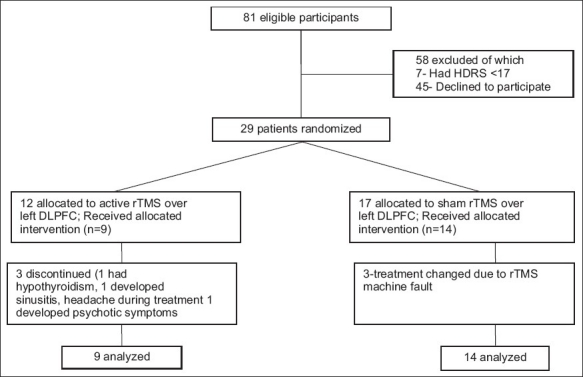
23 patients with depression were randomized to receive either active (n=9) or sham (n=14) treatment with rTMS. Treatment consisted of six sessions of rTMS for 2 weeks (10 trains of pulses, intensity equal to motor threshold, 10 Hz frequency, train duration of 5 seconds, 1 minute inter-train duration). Response was assessed using Hamilton Depression Rating Scale (HDRS), Montgomery Åsberg Depression Rating Scale (MADRS) and Clinical Global Index (CGI). The safety and tolerability was assessed with side-effect checklist for electroconvulsive therapy. 50% reduction in HDRS scores from baseline was defined as treatment response. Outcome measures were analyzed by repeated measures analysis of variance. Chi-square test was used to analyze the categorical variables.

RESULTS

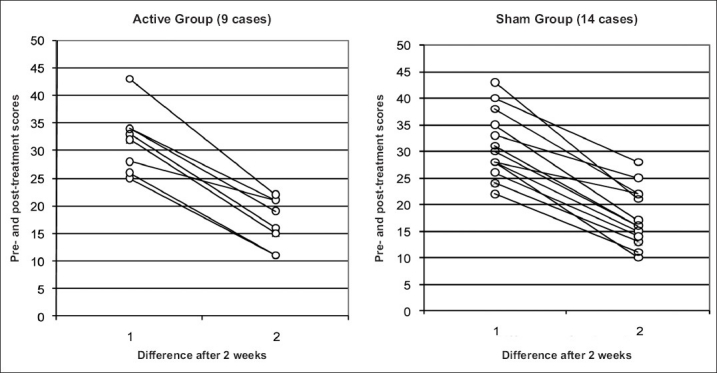
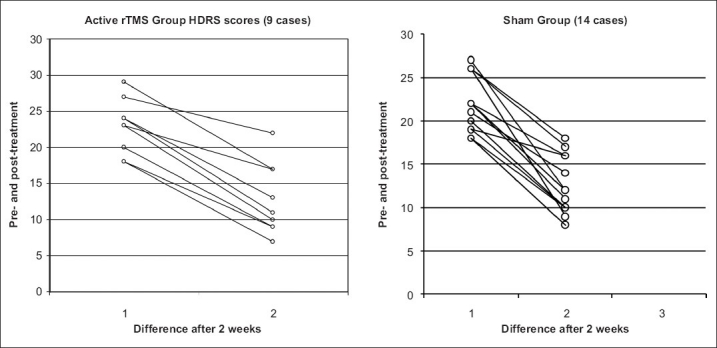
No statistical significance was seen on the baseline socio-demographic and illness characteristics (Pearson's Chi-square=0.5). Although HDRS (sham 22.0-12.4; active 22.8-12.7) and MADRS (sham 30.7-17.3; active 31.8-16.7) scores reduced by the end of 2 weeks treatment, it was not statistically significant. One patient developed manic symptoms early in the treatment.

CONCLUSIONS

Treatment with rTMS did not show improvement at the end of 2 weeks. More studies with larger sample size and with higher rTMS dosages need to be done.

摘要

背景

在印度文献中,重复经颅磁刺激(rTMS)治疗抑郁症的疗效尚未见报道。

目的

研究rTMS治疗抑郁症的疗效,并评估其安全性和耐受性。

设置与设计

在班加罗尔国家心理健康和神经科学研究所精神病科进行了一项随机、双盲、假刺激对照试验。

材料与方法

23例抑郁症患者被随机分为接受rTMS的活性治疗组(n = 9)或假刺激治疗组(n = 14)。治疗包括为期2周的6次rTMS治疗(10串脉冲,强度等于运动阈值,频率10Hz,每串持续时间5秒,串间间隔1分钟)。使用汉密尔顿抑郁量表(HDRS)、蒙哥马利-阿斯伯格抑郁量表(MADRS)和临床总体印象量表(CGI)评估反应。通过电休克治疗副作用清单评估安全性和耐受性。将HDRS评分较基线降低50%定义为治疗反应。采用重复测量方差分析对结果指标进行分析。使用卡方检验分析分类变量。

结果

在基线社会人口统计学和疾病特征方面未见统计学意义(Pearson卡方=0.5)。尽管在2周治疗结束时HDRS(假刺激组从22.0降至12.4;活性治疗组从22.8降至12.7)和MADRS(假刺激组从30.7降至17.3;活性治疗组从31.8降至16.7)评分有所降低,但差异无统计学意义。1例患者在治疗早期出现躁狂症状。

结论

rTMS治疗在2周结束时未显示出改善。需要进行更多样本量更大、rTMS剂量更高的研究。
https://cdn.ncbi.nlm.nih.gov/pmc/blobs/4a77/3195152/3d323539cb1a/IJPsyM-33-35-g006.jpg
https://cdn.ncbi.nlm.nih.gov/pmc/blobs/4a77/3195152/97cf27634e14/IJPsyM-33-35-g001.jpg
https://cdn.ncbi.nlm.nih.gov/pmc/blobs/4a77/3195152/e8b9b18a30db/IJPsyM-33-35-g004.jpg
https://cdn.ncbi.nlm.nih.gov/pmc/blobs/4a77/3195152/3d323539cb1a/IJPsyM-33-35-g006.jpg
https://cdn.ncbi.nlm.nih.gov/pmc/blobs/4a77/3195152/97cf27634e14/IJPsyM-33-35-g001.jpg
https://cdn.ncbi.nlm.nih.gov/pmc/blobs/4a77/3195152/e8b9b18a30db/IJPsyM-33-35-g004.jpg
https://cdn.ncbi.nlm.nih.gov/pmc/blobs/4a77/3195152/3d323539cb1a/IJPsyM-33-35-g006.jpg

相似文献

1
Repetitive Transcranial Magnetic Stimulation in the Treatment of depression: A Randomized, Double-blind, Placebo-controlled Trial.重复经颅磁刺激治疗抑郁症:一项随机、双盲、安慰剂对照试验
Indian J Psychol Med. 2011 Jan;33(1):35-44. doi: 10.4103/0253-7176.85393.
2
Transcranial magnetic stimulation accelerates the antidepressant effect of amitriptyline in severe depression: a double-blind placebo-controlled study.经颅磁刺激可加速阿米替林对重度抑郁症的抗抑郁作用:一项双盲安慰剂对照研究。
Biol Psychiatry. 2005 Jan 15;57(2):162-6. doi: 10.1016/j.biopsych.2004.10.029.
3
Repetitive Transcranial Magnetic Stimulation at Different Frequencies for Postherpetic Neuralgia: A Double-Blind, Sham-Controlled, Randomized Trial.不同频率重复经颅磁刺激治疗带状疱疹后神经痛的双盲、假刺激随机对照试验。
Pain Physician. 2019 Jul;22(4):E303-E313.
4
Two Versus One High-Frequency Repetitive Transcranial Magnetic Stimulation Session per Day for Treatment-Resistant Depression: A Randomized Sham-Controlled Trial.每天一次与每天两次高频重复经颅磁刺激治疗难治性抑郁症:一项随机假刺激对照试验
J ECT. 2017 Sep;33(3):190-197. doi: 10.1097/YCT.0000000000000387.
5
Low frequency (1-Hz), right prefrontal repetitive transcranial magnetic stimulation (rTMS) compared with venlafaxine ER in the treatment of resistant depression: a double-blind, single-centre, randomized study.低频(1赫兹)右侧前额叶重复经颅磁刺激(rTMS)与文拉法辛缓释剂治疗难治性抑郁症的比较:一项双盲、单中心、随机研究
J Affect Disord. 2009 Nov;118(1-3):94-100. doi: 10.1016/j.jad.2009.01.032. Epub 2009 Feb 26.
6
Repetitive transcranial magnetic stimulation (rTMS) in pharmacotherapy-refractory major depression: comparative study of fast, slow and sham rTMS.重复经颅磁刺激(rTMS)治疗药物难治性重度抑郁症:快速、慢速和假rTMS的比较研究
Psychiatry Res. 1999 Nov 29;88(3):163-71. doi: 10.1016/s0165-1781(99)00092-x.
7
[Efficacy of repetitive transcranial magnetic stimulation (rTMS) in major depression: a review].[重复经颅磁刺激(rTMS)治疗重度抑郁症的疗效:综述]
Encephale. 2007 Mar-Apr;33(2):126-34. doi: 10.1016/s0013-7006(07)91542-0.
8
The clinical effectiveness and cost of repetitive transcranial magnetic stimulation versus electroconvulsive therapy in severe depression: a multicentre pragmatic randomised controlled trial and economic analysis.重复经颅磁刺激与电休克治疗重度抑郁症的临床疗效及成本:一项多中心实用随机对照试验及经济分析
Health Technol Assess. 2007 Jul;11(24):1-54. doi: 10.3310/hta11240.
9
Repetitive transcranial magnetic stimulation in combination with citalopram in young patients with first-episode major depressive disorder: a double-blind, randomized, sham-controlled trial.重复经颅磁刺激联合西酞普兰治疗首发未用药的青少年抑郁症患者的双盲随机假刺激对照研究
Aust N Z J Psychiatry. 2012 Mar;46(3):257-64. doi: 10.1177/0004867411433216. Epub 2012 Jan 5.
10
Antidepressant effects of different schedules of repetitive transcranial magnetic stimulation vs. clomipramine in patients with major depression: relationship to changes in cortical excitability.不同重复经颅磁刺激方案与氯米帕明对重度抑郁症患者的抗抑郁作用:与皮质兴奋性变化的关系
Int J Neuropsychopharmacol. 2005 Jun;8(2):223-33. doi: 10.1017/S1461145704004912. Epub 2004 Nov 30.

引用本文的文献

1
Patient characteristics, validity of clinical diagnoses and Outcomes Associated with Suicidality in Inpatients with Symptoms of Depression (OASIS-D): design, procedures and outcomes.伴有抑郁症状住院患者的自杀相关特征、临床诊断有效性及结局(OASIS-D):设计、程序及结局。
BMC Psychiatry. 2023 Oct 13;23(1):744. doi: 10.1186/s12888-023-05230-9.
2
Evidence from Indian studies on safety and efficacy of therapeutic transcranial magnetic stimulation across neuropsychiatric disorders- A systematic review and meta-analysis.关于治疗性经颅磁刺激在神经精神疾病中的安全性和有效性的印度研究证据——一项系统评价和荟萃分析。
Indian J Psychiatry. 2023 Jan;65(1):18-35. doi: 10.4103/indianjpsychiatry.indianjpsychiatry_572_22. Epub 2023 Jan 13.
3

本文引用的文献

1
Efficacy of high frequency (rapid) suprathreshold repetitive transcranial magnetic stimulation of right prefrontal cortex in bipolar mania: a randomized sham controlled study.高频(快速)阈上重复经颅磁刺激右侧前额叶皮质治疗双相躁狂症的疗效:一项随机假刺激对照研究。
J Affect Disord. 2009 Oct;117(3):146-50. doi: 10.1016/j.jad.2008.12.020. Epub 2009 Jan 28.
2
Efficacy of adjuvant high frequency repetitive transcranial magnetic stimulation on negative and positive symptoms of schizophrenia: preliminary results of a double-blind sham-controlled study.辅助高频重复经颅磁刺激对精神分裂症阴性和阳性症状的疗效:一项双盲假对照研究的初步结果。
J Neuropsychiatry Clin Neurosci. 2007 Fall;19(4):464-7. doi: 10.1176/jnp.2007.19.4.464.
3
Efficacy of transcranial magnetic stimulation in treatment-resistant depression.经颅磁刺激治疗抵抗性抑郁症的疗效。
Turk J Med Sci. 2022 Aug;52(4):1344-1354. doi: 10.55730/1300-0144.5441. Epub 2022 Aug 10.
4
Hypomanic/manic switch after transcranial magnetic stimulation in mood disorders: A systematic review and meta-analysis.情绪障碍经颅磁刺激后轻躁狂/躁狂转换:一项系统评价和荟萃分析。
World J Psychiatry. 2021 Aug 19;11(8):477-490. doi: 10.5498/wjp.v11.i8.477.
5
The Investigation of the Effects of Repetitive Transcranialmagnetic Stimulation Treatment on Taste and Smell Sensations in Depressed Patients.重复经颅磁刺激治疗对抑郁症患者味觉和嗅觉影响的研究
Noro Psikiyatr Ars. 2021 Jan 16;58(1):26-33. doi: 10.29399/npa.25087. eCollection 2021 Mar.
6
Effectiveness of adjunctive repetitive transcranial magnetic stimulation in management of treatment-resistant depression: A retrospective analysis.辅助性重复经颅磁刺激治疗难治性抑郁症的有效性:一项回顾性分析。
Indian J Psychiatry. 2018 Jul-Sep;60(3):329-333. doi: 10.4103/psychiatry.IndianJPsychiatry_182_16.
7
Meta-analysis of the Efficacy and Safety of Repetitive Transcranial Magnetic Stimulation (rTMS) in the Treatment of Depression.重复经颅磁刺激(rTMS)治疗抑郁症疗效与安全性的荟萃分析
Shanghai Arch Psychiatry. 2017 Dec 25;29(6):328-342. doi: 10.11919/j.issn.1002-0829.217106.
8
More female patients and fewer stimuli per session are associated with the short-term antidepressant properties of repetitive transcranial magnetic stimulation (rTMS): a meta-analysis of 54 sham-controlled studies published between 1997-2013.更多女性患者和每次治疗中更少的刺激与重复经颅磁刺激(rTMS)的短期抗抑郁作用有关:对 1997-2013 年间发表的 54 项假刺激对照研究的荟萃分析。
Neuropsychiatr Dis Treat. 2014 May 7;10:727-56. doi: 10.2147/NDT.S58405. eCollection 2014.
9
A systematic review and meta-analysis of trials of treatment of depression from India.对印度抑郁症治疗试验的系统评价和荟萃分析。
Indian J Psychiatry. 2014 Jan;56(1):29-38. doi: 10.4103/0019-5545.124711.
10
Repetitive transcranial magnetic stimulation in depression: studies from India.抑郁症中的重复经颅磁刺激:来自印度的研究
Indian J Psychol Med. 2011 Jul;33(2):216-7. doi: 10.4103/0253-7176.92041.
Treatment of negative symptoms of schizophrenia using repetitive transcranial magnetic stimulation in a double-blind, randomized controlled study.
在一项双盲、随机对照研究中使用重复经颅磁刺激治疗精神分裂症的阴性症状。
Schizophr Res. 2007 Sep;95(1-3):151-7. doi: 10.1016/j.schres.2007.06.019. Epub 2007 Aug 8.
4
Long-lasting effects of high frequency repetitive transcranial magnetic stimulation in major depressed patients.高频重复经颅磁刺激对重度抑郁症患者的长期影响。
Psychiatry Res. 2007 Mar 30;150(2):181-6. doi: 10.1016/j.psychres.2006.04.010. Epub 2007 Feb 14.
5
Tranylcypromine versus venlafaxine plus mirtazapine following three failed antidepressant medication trials for depression: a STAR*D report.对于抑郁症,在三次抗抑郁药物试验失败后,反苯环丙胺与文拉法辛加米氮平的比较:一项STAR*D报告。
Am J Psychiatry. 2006 Sep;163(9):1531-41; quiz 1666. doi: 10.1176/ajp.2006.163.9.1531.
6
A comparison of lithium and T(3) augmentation following two failed medication treatments for depression: a STAR*D report.抑郁症两种药物治疗失败后锂盐与T(3)增效治疗的比较:一项STAR*D报告
Am J Psychiatry. 2006 Sep;163(9):1519-30; quiz 1665. doi: 10.1176/ajp.2006.163.9.1519.
7
Nonpharmacological, somatic treatments of depression: electroconvulsive therapy and novel brain stimulation modalities.抑郁症的非药物躯体治疗:电休克疗法和新型脑刺激方式。
Dialogues Clin Neurosci. 2006;8(2):241-58. doi: 10.31887/DCNS.2006.8.2/reitan.
8
A comparison of mirtazapine and nortriptyline following two consecutive failed medication treatments for depressed outpatients: a STAR*D report.米氮平与去甲替林对门诊抑郁症患者连续两次药物治疗失败后的疗效比较:一项STAR*D报告
Am J Psychiatry. 2006 Jul;163(7):1161-72. doi: 10.1176/ajp.2006.163.7.1161.
9
Medication augmentation after the failure of SSRIs for depression.5-羟色胺再摄取抑制剂治疗抑郁症失败后的药物增效治疗。
N Engl J Med. 2006 Mar 23;354(12):1243-52. doi: 10.1056/NEJMoa052964.
10
Bupropion-SR, sertraline, or venlafaxine-XR after failure of SSRIs for depression.对于抑郁症患者,在选择性5-羟色胺再摄取抑制剂(SSRI)治疗失败后使用安非他酮缓释片、舍曲林或文拉法辛缓释片。
N Engl J Med. 2006 Mar 23;354(12):1231-42. doi: 10.1056/NEJMoa052963.