Biomedical Image Analysis Group, Department of Computing, Imperial College London, London, United Kingdom.
PLoS One. 2011;6(10):e25446. doi: 10.1371/journal.pone.0025446. Epub 2011 Oct 13.
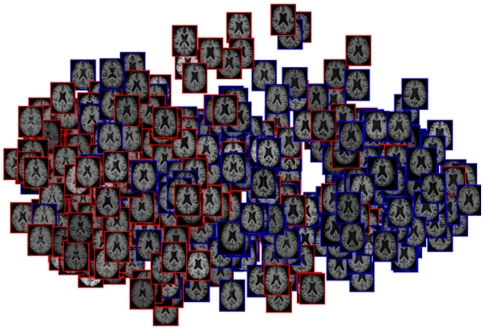
The role of structural brain magnetic resonance imaging (MRI) is becoming more and more emphasized in the early diagnostics of Alzheimer's disease (AD). This study aimed to assess the improvement in classification accuracy that can be achieved by combining features from different structural MRI analysis techniques. Automatically estimated MR features used are hippocampal volume, tensor-based morphometry, cortical thickness and a novel technique based on manifold learning. Baseline MRIs acquired from all 834 subjects (231 healthy controls (HC), 238 stable mild cognitive impairment (S-MCI), 167 MCI to AD progressors (P-MCI), 198 AD) from the Alzheimer's Disease Neuroimaging Initiative (ADNI) database were used for evaluation. We compared the classification accuracy achieved with linear discriminant analysis (LDA) and support vector machines (SVM). The best results achieved with individual features are 90% sensitivity and 84% specificity (HC/AD classification), 64%/66% (S-MCI/P-MCI) and 82%/76% (HC/P-MCI) with the LDA classifier. The combination of all features improved these results to 93% sensitivity and 85% specificity (HC/AD), 67%/69% (S-MCI/P-MCI) and 86%/82% (HC/P-MCI). Compared with previously published results in the ADNI database using individual MR-based features, the presented results show that a comprehensive analysis of MRI images combining multiple features improves classification accuracy and predictive power in detecting early AD. The most stable and reliable classification was achieved when combining all available features.
结构性脑磁共振成像(MRI)在阿尔茨海默病(AD)的早期诊断中的作用越来越受到重视。本研究旨在评估通过结合来自不同结构 MRI 分析技术的特征可以提高分类准确性。自动估计的 MR 特征包括海马体积、基于张量的形态计量学、皮质厚度和基于流形学习的新技术。本研究使用了来自阿尔茨海默病神经影像学倡议(ADNI)数据库的 834 名受试者(231 名健康对照(HC)、238 名稳定轻度认知障碍(S-MCI)、167 名 MCI 向 AD 进展者(P-MCI)、198 名 AD)的基线 MRI 进行评估。我们比较了线性判别分析(LDA)和支持向量机(SVM)的分类准确性。使用个体特征实现的最佳结果是 90%的敏感性和 84%的特异性(HC/AD 分类)、64%/66%(S-MCI/P-MCI)和 82%/76%(HC/P-MCI),使用 LDA 分类器。所有特征的组合将这些结果提高到 93%的敏感性和 85%的特异性(HC/AD)、67%/69%(S-MCI/P-MCI)和 86%/82%(HC/P-MCI)。与 ADNI 数据库中使用个体基于 MRI 的特征的先前发表结果相比,本研究结果表明,结合多种特征对 MRI 图像进行全面分析可提高早期 AD 的分类准确性和预测能力。当结合所有可用特征时,实现了最稳定和可靠的分类。