Inserm U1018 Epidemiology of Occupational and Social Determinants of Health-Centre for Research in Epidemiology and Population Health, Vilejuif, France.
PLoS One. 2011;6(10):e26531. doi: 10.1371/journal.pone.0026531. Epub 2011 Oct 20.
Little is known about the effect of retirement on alcohol consumption. The objectives were to examine changes in alcohol consumption following retirement, and whether these patterns differ by gender and socioeconomic status.
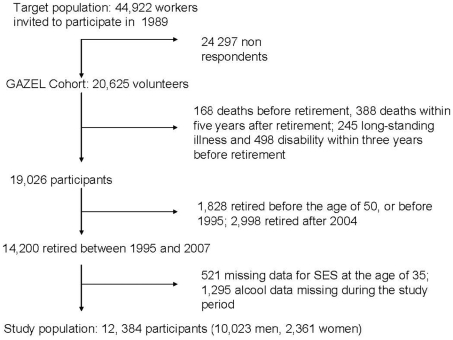
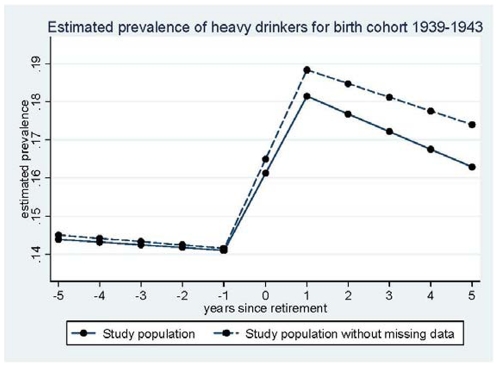
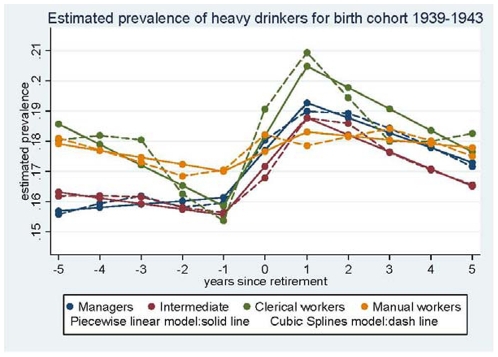
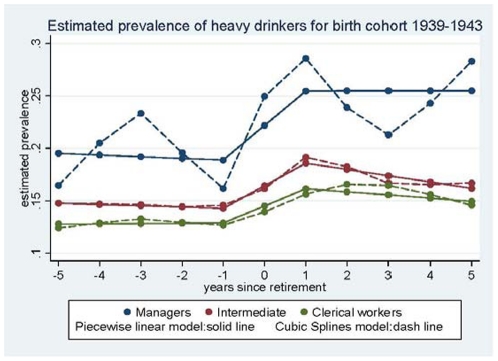
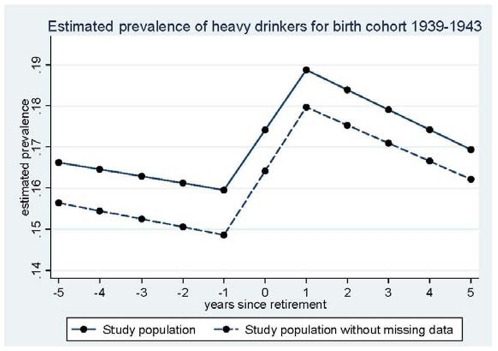
We assessed alcohol consumption annually from 5 years before to 5 years after retirement among 10,023 men and 2,361 women of the French Gazel study. Data were analyzed separately for men and women, using repeated-measures logistic regression analysis with generalized estimating equations. Five years prior to retirement, the prevalence of heavy drinking was about 16% among men, and not patterned by socioeconomic status. Among women, this prevalence was 19.5% in managers, 14.7% in intermediate occupations, and 12.8% in clerical workers. Around retirement, the estimated prevalence of heavy drinking increased in both sexes. In men, this increase was 3.1 percentage points for managers, 3.2 in intermediate occupations, 4.6 in clerical workers, and 1.3 in manual workers. In women, this increase was 6.6 percentage points among managers, 4.3 in intermediate occupations, and 3.3 among clerical workers. In men the increase around retirement was followed by a decrease over the following four years, not significant among manual workers; among women such a decrease was also observed in the non-managerial occupations. It is difficult to assess the extent to which the results observed in this cohort would hold for other working populations, other conditions of employment, or in other cultural settings. A plausible explanation for the increase in heavy drinking around retirement could be that increased leisure time after retirement provides more opportunities for drinking, and not having to work during the day after may decrease constraints on drinking.
Our findings of increased consumption around retirement suggest that information about negative effects of alcohol consumption should be included in pre-retirement planning programs.
关于退休对饮酒的影响知之甚少。本研究旨在探讨退休后饮酒行为的变化,以及这些变化是否因性别和社会经济地位而异。
我们评估了法国 Gazel 研究中 10023 名男性和 2361 名女性在退休前 5 年至退休后 5 年内的饮酒情况。数据分别进行了男性和女性的分析,采用广义估计方程的重复测量逻辑回归分析。在退休前 5 年,男性重度饮酒的患病率约为 16%,且与社会经济地位无关。而在女性中,这一患病率在管理人员中为 19.5%,在中级职业中为 14.7%,在文书人员中为 12.8%。在接近退休时,两性的重度饮酒患病率都有所增加。在男性中,这一增长在管理人员中为 3.1 个百分点,在中级职业中为 3.2 个百分点,在文书人员中为 4.6 个百分点,在体力劳动者中为 1.3 个百分点。在女性中,这一增长在管理人员中为 6.6 个百分点,在中级职业中为 4.3 个百分点,在文书人员中为 3.3 个百分点。在男性中,退休前后的增加之后是接下来四年的下降,但体力劳动者中并不显著;在女性中,非管理人员职业中也观察到了这种下降。对于其他工作人群、就业条件或其他文化环境,很难评估本研究队列中观察到的结果的适用程度。退休前后饮酒量增加的一个合理解释可能是退休后闲暇时间的增加为饮酒提供了更多机会,而且白天不用工作可能会减少对饮酒的限制。
我们发现退休前后饮酒量增加,这表明在退休前规划方案中应纳入关于饮酒负面影响的信息。