de Mas Igor Marin, Selivanov Vitaly A, Marin Silvia, Roca Josep, Orešič Matej, Agius Loranne, Cascante Marta
Department of Biochemistry and Molecular Biology, Faculty of Biology, Universitat de Barcelona, Av Diagonal 643, 08028 Barcelona, Spain.
BMC Syst Biol. 2011 Oct 28;5:175. doi: 10.1186/1752-0509-5-175.
Stable isotope tracers are used to assess metabolic flux profiles in living cells. The existing methods of measurement average out the isotopic isomer distribution in metabolites throughout the cell, whereas the knowledge of compartmental organization of analyzed pathways is crucial for the evaluation of true fluxes. That is why we accepted a challenge to create a software tool that allows deciphering the compartmentation of metabolites based on the analysis of average isotopic isomer distribution.
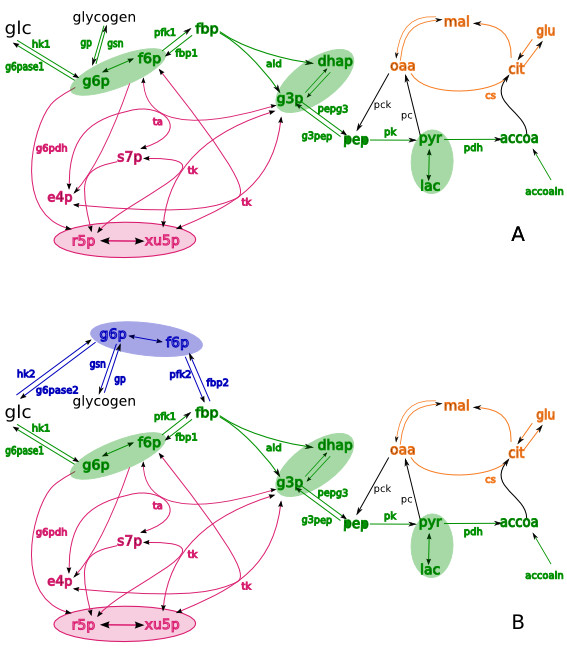
The software Isodyn, which simulates the dynamics of isotopic isomer distribution in central metabolic pathways, was supplemented by algorithms facilitating the transition between various analyzed metabolic schemes, and by the tools for model discrimination. It simulated 13C isotope distributions in glucose, lactate, glutamate and glycogen, measured by mass spectrometry after incubation of hepatocytes in the presence of only labeled glucose or glucose and lactate together (with label either in glucose or lactate). The simulations assumed either a single intracellular hexose phosphate pool, or also channeling of hexose phosphates resulting in a different isotopic composition of glycogen. Model discrimination test was applied to check the consistency of both models with experimental data. Metabolic flux profiles, evaluated with the accepted model that assumes channeling, revealed the range of changes in metabolic fluxes in liver cells.
The analysis of compartmentation of metabolic networks based on the measured 13C distribution was included in Isodyn as a routine procedure. The advantage of this implementation is that, being a part of evaluation of metabolic fluxes, it does not require additional experiments to study metabolic compartmentation. The analysis of experimental data revealed that the distribution of measured 13C-labeled glucose metabolites is inconsistent with the idea of perfect mixing of hexose phosphates in cytosol. In contrast, the observed distribution indicates the presence of a separate pool of hexose phosphates that is channeled towards glycogen synthesis.
稳定同位素示踪剂用于评估活细胞中的代谢通量分布。现有的测量方法会对整个细胞内代谢物的同位素异构体分布进行平均,而分析途径的区室组织知识对于评估真实通量至关重要。这就是为什么我们接受了一项挑战,要创建一个软件工具,能够基于对平均同位素异构体分布的分析来解读代谢物的区室化情况。
软件Isodyn可模拟中心代谢途径中同位素异构体分布的动态变化,通过促进不同分析代谢方案之间转换的算法以及模型判别工具进行了补充。它模拟了在仅存在标记葡萄糖或葡萄糖与乳酸一起(标记在葡萄糖或乳酸中)孵育肝细胞后,通过质谱测量的葡萄糖、乳酸、谷氨酸和糖原中的13C同位素分布。模拟假设要么是单个细胞内己糖磷酸池,要么是己糖磷酸的通道化导致糖原具有不同的同位素组成。应用模型判别测试来检查两个模型与实验数据的一致性。采用假设通道化的公认模型评估的代谢通量分布揭示了肝细胞中代谢通量的变化范围。
基于测量的13C分布对代谢网络区室化的分析已作为常规程序纳入Isodyn。这种实现方式的优点是,作为代谢通量评估的一部分,它不需要额外的实验来研究代谢区室化。对实验数据的分析表明,测量的13C标记葡萄糖代谢物的分布与胞质溶胶中己糖磷酸完美混合的观点不一致。相反,观察到的分布表明存在一个单独的己糖磷酸池,其被导向糖原合成。