
从大肠杆菌突变体 13C 标记数据到核心动力学模型:一个动力学模型参数化管道。
From Escherichia coli mutant 13C labeling data to a core kinetic model: A kinetic model parameterization pipeline.
机构信息
Department of Chemical Engineering, The Pennsylvania State University, University Park, Pennsylvania, United States of America.
Department of Chemical and Biomolecular Engineering, University of Delaware. Newark, Delaware, United States of America.
出版信息
PLoS Comput Biol. 2019 Sep 10;15(9):e1007319. doi: 10.1371/journal.pcbi.1007319. eCollection 2019 Sep.
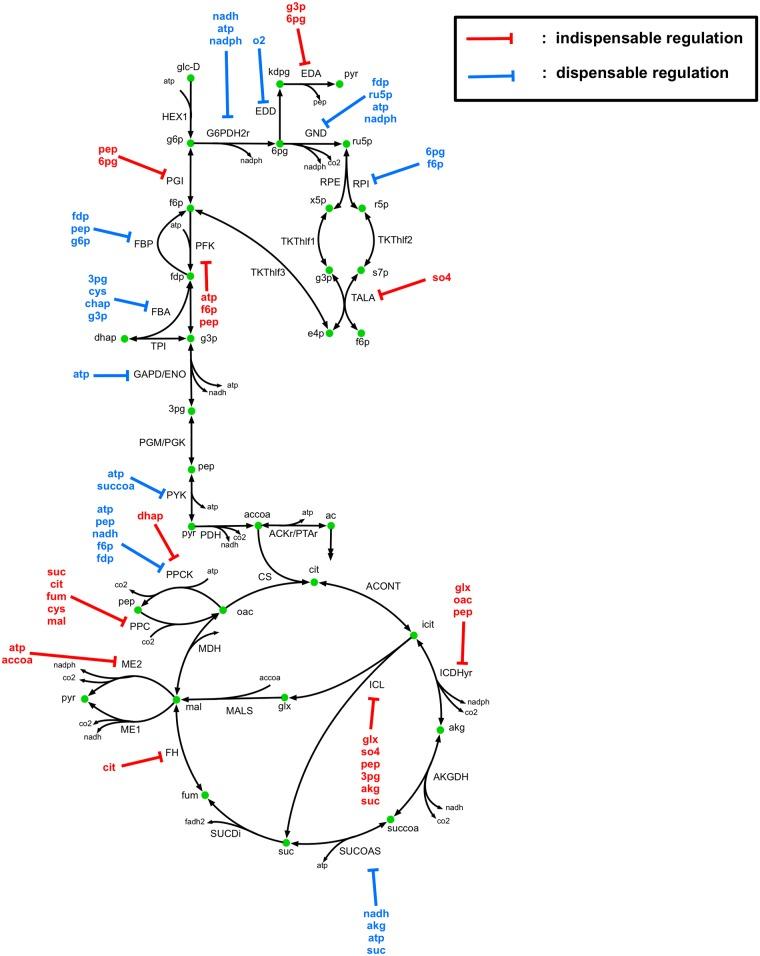
Kinetic models of metabolic networks offer the promise of quantitative phenotype prediction. The mechanistic characterization of enzyme catalyzed reactions allows for tracing the effect of perturbations in metabolite concentrations and reaction fluxes in response to genetic and environmental perturbation that are beyond the scope of stoichiometric models. In this study, we develop a two-step computational pipeline for the rapid parameterization of kinetic models of metabolic networks using a curated metabolic model and available 13C-labeling distributions under multiple genetic and environmental perturbations. The first step involves the elucidation of all intracellular fluxes in a core model of E. coli containing 74 reactions and 61 metabolites using 13C-Metabolic Flux Analysis (13C-MFA). Here, fluxes corresponding to the mid-exponential growth phase are elucidated for seven single gene deletion mutants from upper glycolysis, pentose phosphate pathway and the Entner-Doudoroff pathway. The computed flux ranges are then used to parameterize the same (i.e., k-ecoli74) core kinetic model for E. coli with 55 substrate-level regulations using the newly developed K-FIT parameterization algorithm. The K-FIT algorithm employs a combination of equation decomposition and iterative solution techniques to evaluate steady-state fluxes in response to genetic perturbations. k-ecoli74 predicted 86% of flux values for strains used during fitting within a single standard deviation of 13C-MFA estimated values. By performing both tasks using the same network, errors associated with lack of congruity between the two networks are avoided, allowing for seamless integration of data with model building. Product yield predictions and comparison with previously developed kinetic models indicate shifts in flux ranges and the presence or absence of mutant strains delivering flux towards pathways of interest from training data significantly impact predictive capabilities. Using this workflow, the impact of completeness of fluxomic datasets and the importance of specific genetic perturbations on uncertainties in kinetic parameter estimation are evaluated.
代谢网络的动力学模型提供了定量表型预测的可能性。酶催化反应的机理特征允许追踪代谢物浓度和反应通量的扰动效应,这些扰动效应超出了计量模型的范围。在这项研究中,我们开发了一种两步计算流程,用于使用经过精心整理的代谢模型和多种遗传和环境扰动下可用的 13C 标记分布,快速参数化代谢网络的动力学模型。第一步涉及使用 13C-代谢通量分析(13C-MFA)阐明含有 74 个反应和 61 种代谢物的大肠杆菌核心模型中的所有细胞内通量。在这里,阐明了来自上糖酵解、戊糖磷酸途径和 Entner-Doudoroff 途径的七个单基因突变体的中指数生长阶段的通量。然后,将计算出的通量范围用于使用新开发的 K-FIT 参数化算法对具有 55 种底物水平调节的相同(即 k-ecoli74)核心动力学模型进行参数化。K-FIT 算法采用方程分解和迭代求解技术的组合来评估遗传扰动下的稳态通量。k-ecoli74 在单个标准差内预测了拟合过程中使用的菌株的 86%的通量值 13C-MFA 估计值。通过使用相同的网络执行这两个任务,可以避免两个网络之间缺乏一致性相关的错误,从而实现数据与模型构建的无缝集成。产物产率预测和与先前开发的动力学模型的比较表明,通量范围的变化以及存在或不存在从训练数据向感兴趣途径输送通量的突变体菌株对预测能力有重大影响。使用此工作流程,可以评估通量组数据集的完整性和特定遗传扰动的重要性对动力学参数估计不确定性的影响。


 Zotero 插件