Office of Neurological Education, Department of Neurology, National Neuroscience Institute, Singapore, Singapore.
BMC Med Educ. 2011 Oct 30;11:91. doi: 10.1186/1472-6920-11-91.
Team-based learning (TBL), a new active learning method, has not been reported for neurology education. We aimed to determine if TBL was more effective than passive learning (PL) in improving knowledge outcomes in two key neurology topics - neurological localization and neurological emergencies.
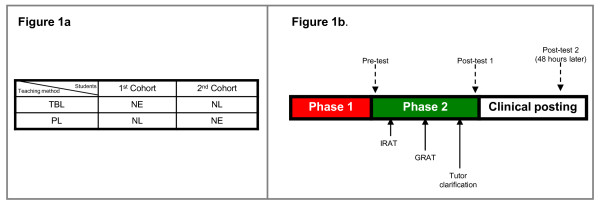
We conducted a modified crossover study during a nine-week internal medicine posting involving 49 third-year medical undergraduates, using TBL as the active intervention, compared against self-reading as a PL control, for teaching the two topics. Primary outcome was the mean percentage change in test scores immediately after (post-test 1) and 48 hours after TBL (post-test 2), compared to a baseline pre-test. Student engagement was the secondary outcome.
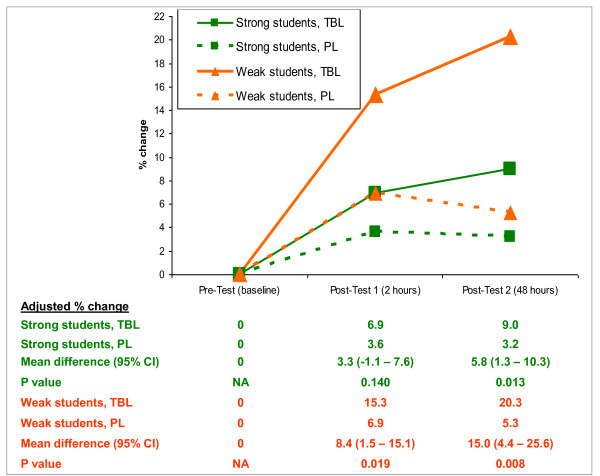
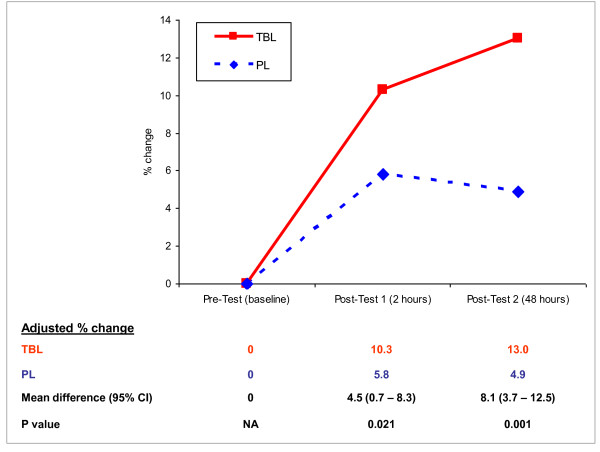
Mean percentage change in scores was greater in the TBL versus the PL group in post-test 1 (8.8% vs 4.3%, p = 0.023) and post-test 2 (11.4% vs 3.4%, p = 0.001). After adjustment for gender and second year examination grades, mean percentage change in scores remained greater in the TBL versus the PL group for post-test 1 (10.3% vs 5.8%, mean difference 4.5%,95% CI 0.7 - 8.3%, p = 0.021) and post-test 2 (13.0% vs 4.9%, mean difference 8.1%,95% CI 3.7 - 12.5%, p = 0.001), indicating further score improvement 48 hours post-TBL. Academically weaker students, identified by poorer examination grades, showed a greater increase in scores with TBL versus strong students (p < 0.02). Measures of engagement were high in the TBL group, suggesting that continued improvements in scores 48 hours post-TBL may result from self-directed learning.
Compared to PL, TBL showed greater improvement in knowledge scores, with continued improvement up to 48 hours later. This effect is larger in academically weaker students. TBL is an effective method for improving knowledge in neurological localization and neurological emergencies in undergraduates.
团队学习(TBL)是一种新的主动学习方法,尚未在神经病学教育中报道。我们旨在确定 TBL 是否比被动学习(PL)更能有效提高两个关键神经病学主题-神经定位和神经急症的知识成果。
我们在内科实习期间进行了一项改良的交叉研究,涉及 49 名三年级医学生,使用 TBL 作为主动干预措施,与自我阅读作为 PL 对照组进行比较,以教授这两个主题。主要结果是 TBL 后(后测 1)和 48 小时后(后测 2)与基线前测相比,测试分数的平均百分比变化。学生参与是次要结果。
TBL 组的分数平均百分比变化大于 PL 组在后测 1(8.8%比 4.3%,p=0.023)和后测 2(11.4%比 3.4%,p=0.001)。在调整性别和第二年考试成绩后,TBL 组的分数平均百分比变化仍大于 PL 组在后测 1(10.3%比 5.8%,平均差异 4.5%,95%CI 0.7-8.3%,p=0.021)和后测 2(13.0%比 4.9%,平均差异 8.1%,95%CI 3.7-12.5%,p=0.001),表明 TBL 后 48 小时的分数进一步提高。通过考试成绩较差来确定的学习成绩较弱的学生,与成绩较好的学生相比,TBL 组的分数增加幅度更大(p<0.02)。TBL 组的参与度很高,表明 48 小时后分数的持续提高可能是由于自我指导学习。
与 PL 相比,TBL 在知识分数上显示出更大的提高,并且直到 48 小时后仍有持续的提高。这种效果在学习成绩较差的学生中更大。TBL 是提高本科生神经定位和神经急症知识的有效方法。