Institute of Molecular and Cell Biology, Agency for Science, Technology and Research, Singapore, Singapore.
PLoS One. 2011;6(10):e26242. doi: 10.1371/journal.pone.0026242. Epub 2011 Oct 27.
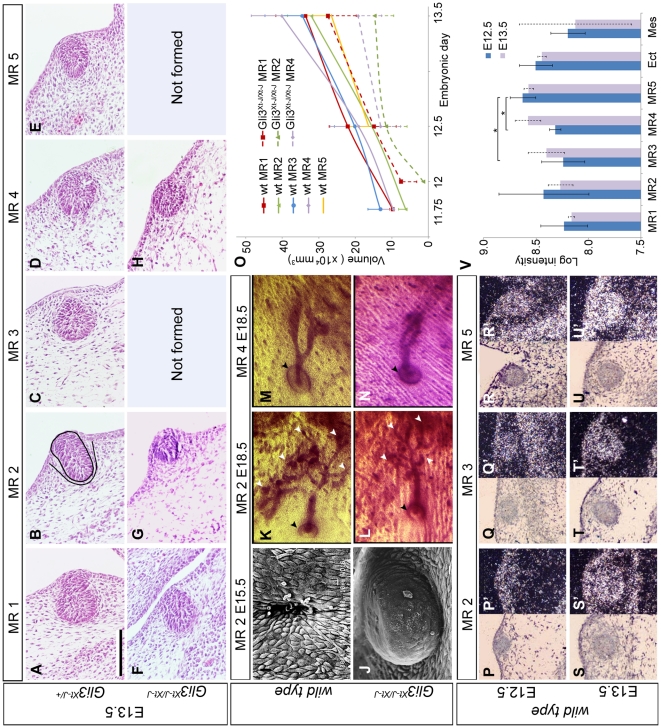
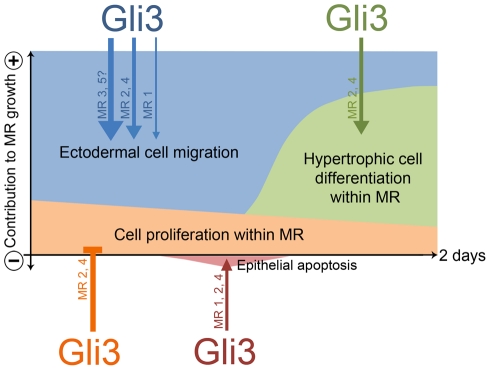
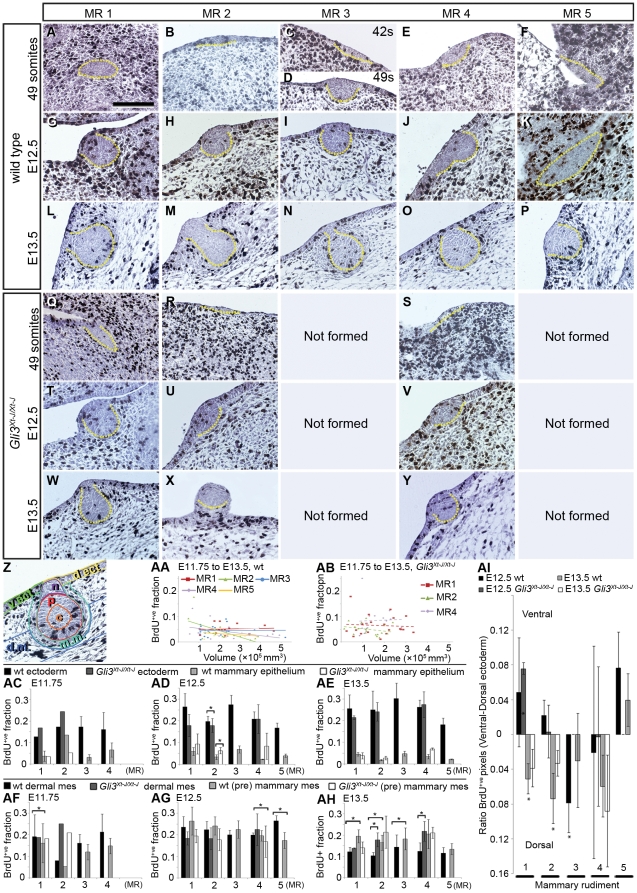
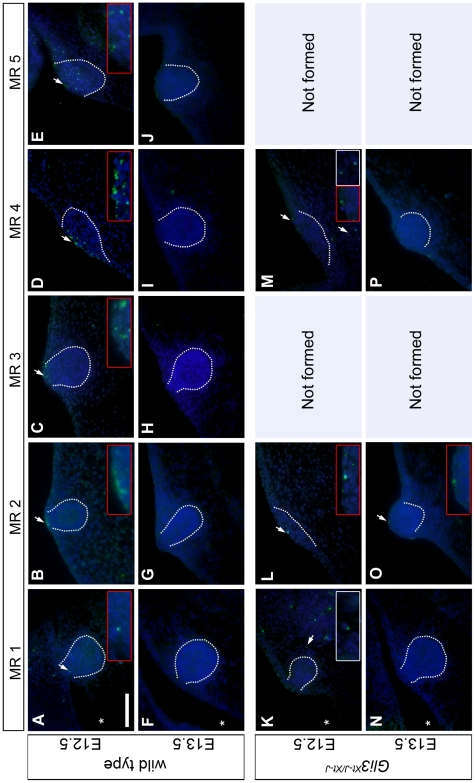
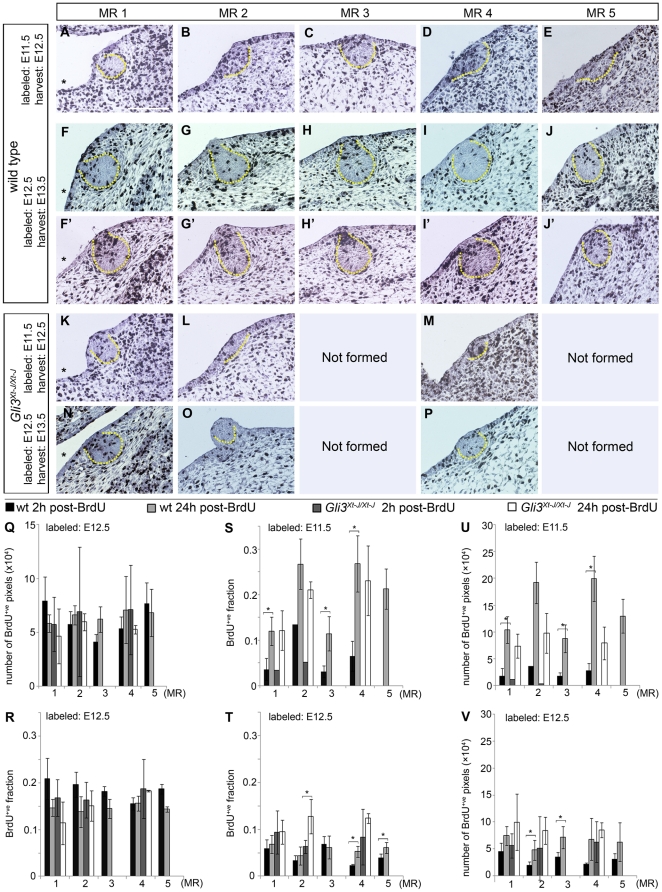
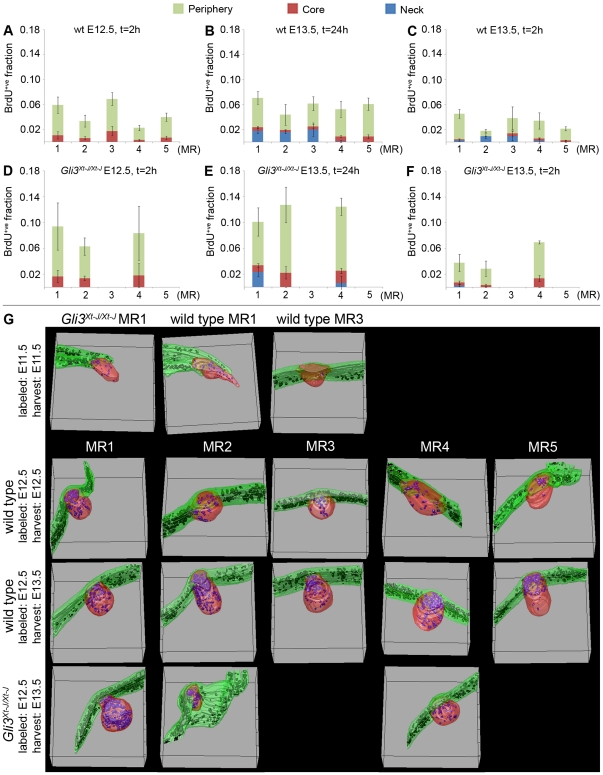
Mammary gland development starts in utero with one or several pairs of mammary rudiments (MRs) budding from the surface ectodermal component of the mammalian embryonic skin. Mice develop five pairs, numbered MR1 to MR5 from pectoral to inguinal position. We have previously shown that Gli3(Xt-J/Xt-J) mutant embryos, which lack the transcription factor Gli3, do not form MR3 and MR5. We show here that two days after the MRs emerge, Gli3(Xt-J/Xt-J) MR1 is 20% smaller, and Gli3(Xt-J/Xt-J) MR2 and MR4 are 50% smaller than their wild type (wt) counterparts. Moreover, while wt MRs sink into the underlying dermis, Gli3(Xt-J/Xt-J) MR4 and MR2 protrude outwardly, to different extents. To understand why each of these five pairs of functionally identical organs has its own, distinct response to the absence of Gli3, we determined which cellular mechanisms regulate growth of the individual MRs, and whether and how Gli3 regulates these mechanisms. We found a 5.5 to 10.7-fold lower cell proliferation rate in wt MRs compared to their adjacent surface ectoderm, indicating that MRs do not emerge or grow via locally enhanced cell proliferation. Cell-tracing experiments showed that surface ectodermal cells are recruited toward the positions where MRs emerge, and contribute to MR growth during at least two days. During the second day of MR development, peripheral cells within the MRs undergo hypertrophy, which also contributes to MR growth. Limited apoptotic cell death counterbalances MR growth. The relative contribution of each of these processes varies among the five MRs. Furthermore, each of these processes is impaired in the absence of Gli3, but to different extents in each MR. This differential involvement of Gli3 explains the variation in phenotype among Gli3(Xt-J/Xt-J) MRs, and may help to understand the variation in numbers and positions of mammary glands among mammals.
乳腺发育始于胚胎期,哺乳动物胚胎皮肤的表面外胚层从乳腺原基(MRs)开始萌芽。老鼠发育出五对,从胸侧到腹股沟位置编号为 MR1 到 MR5。我们之前已经表明,缺乏转录因子 Gli3 的 Gli3(Xt-J/Xt-J) 突变体胚胎不会形成 MR3 和 MR5。我们在这里表明,MRs 出现两天后,Gli3(Xt-J/Xt-J)MR1 缩小了 20%,而 Gli3(Xt-J/Xt-J)MR2 和 MR4 缩小了 50%,与野生型(wt)相比。此外,虽然 wtMRs 沉入下面的真皮中,但 Gli3(Xt-J/Xt-J)MR4 和 MR2 向外突出,程度不同。为了了解为什么这五个功能相同的器官对 Gli3 的缺失有各自独特的反应,我们确定了哪些细胞机制调节每个 MR 的生长,以及 Gli3 是否以及如何调节这些机制。我们发现 wtMRs 的细胞增殖率比其相邻的表面外胚层低 5.5 到 10.7 倍,这表明 MRs 不是通过局部增强的细胞增殖而出现或生长的。细胞示踪实验表明,表面外胚层细胞被招募到 MR 出现的位置,并在至少两天内有助于 MR 的生长。在 MR 发育的第二天,MR 内的周围细胞发生肥大,这也有助于 MR 的生长。有限的细胞凋亡死亡与 MR 生长相平衡。这些过程中的每一个在五个 MR 中的贡献程度不同。此外,这些过程在没有 Gli3 的情况下都会受到损害,但在每个 MR 中受到的损害程度不同。Gli3 的这种差异参与解释了 Gli3(Xt-J/Xt-J)MRs 表型之间的差异,并可能有助于理解哺乳动物中乳腺数量和位置的变化。