Munasir Zakiudin, Sastroasmoro Sudigdo, Djauzi Samsuridjal, Waspadji Sarwono, Ramelan Wahyuning, Aminullah Asril, Widowati Retno, Harahap Alida Roswita, Endaryanto Anang, Wahidiyat Iskandar
Department of Child Health, Cipto Mangunkusumo Hospital - Faculty of Medicine, University of Indonesia, Jakarta 10430, Indonesia.
Asia Pac Allergy. 2011 Jul;1(2):73-9. doi: 10.5415/apallergy.2011.1.2.73. Epub 2011 Jul 28.
Atopic dermatitis (AD) is a chronic inflammation of the skin that often appears in early childhood. The manifestation is related to the tendency towards T helper 2 cytokine immune responses (interleukin (IL)-4, IL-5). Genetic factors are suggested to play important roles in AD, and it can be transmitted to newborns, increasing their risk of developing allergies.
To determine the association between cord-blood cytokine levels (IL-5, interferon (IFN) γ), cord-blood total immunoglobulin E (IgE) level, perinatal environmental exposure, and the risks of allergy as well as the development of AD in the first 6 months of life.
A 6-month cohort study with a nested case-control within was conducted on newborns in Jakarta from December 2008 until May 2009. After the umbilical cord blood samples were taken and stored, subjects were followed up monthly until 6 months old. The occurrence of AD and lifestyle or environmental exposures were recorded. The allergic risk was determined using a modified pediatric allergy immunology work groups scoring system based on allergic history (allergic rhinitis, asthma, AD) in the family. The levels of IL-5 and IFN-γ were measured using ELISA and total IgE by CAP system FEIA. Multivariate analysis was used to evaluate risk factors.
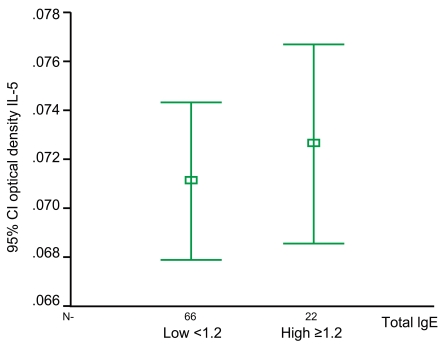
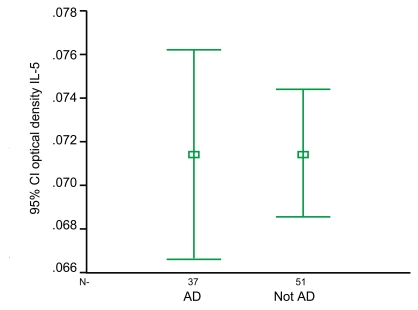
This study was conducted on 226 subjects. The incidence of AD was 16.4%; of those, 59% had low risk allergy, 38.5% moderate, and 2% high risk. AD mostly occurred at the age of 1 month (57%). Cord blood samples were examined in 37 subjects with AD and 51 without AD; of those, 25% showed high levels of total IgE (>1.2 IU/µL), and 51% showed normally-distributed high absorbance IL-5 values (≥0.0715, absolute value was undetected). The increased level of IL-5 was directly proportional to IgE. High absorbance IFN-γ values (≥0.0795, absolute value = 18.681 pg/µL) were observed in 52% of subjects.
The associations between the risk of allergy in the family, cord-blood total IgE, IL-5, IFN levels, and some perinatal environmental exposure with AD in the first 6 months of life have not been established.
特应性皮炎(AD)是一种常见于儿童早期的慢性皮肤炎症。其表现与辅助性T细胞2细胞因子免疫反应(白细胞介素(IL)-4、IL-5)倾向有关。遗传因素被认为在AD中起重要作用,且可遗传给新生儿,增加其患过敏症的风险。
确定脐血细胞因子水平(IL-5、干扰素(IFN)γ)、脐血总免疫球蛋白E(IgE)水平、围产期环境暴露与过敏风险以及出生后6个月内AD发病之间的关联。
2008年12月至2009年5月在雅加达对新生儿进行了一项为期6个月的队列研究,并进行巢式病例对照研究。采集脐血样本并储存后,对受试者每月进行随访直至6个月大。记录AD的发生情况以及生活方式或环境暴露情况。使用基于家族过敏史(过敏性鼻炎、哮喘、AD)的改良儿科过敏免疫工作组评分系统确定过敏风险。采用酶联免疫吸附测定法(ELISA)测量IL-5和IFN-γ水平,采用荧光酶免疫分析(FEIA)通过CAP系统测量总IgE水平。采用多变量分析评估风险因素。
本研究共纳入226名受试者。AD的发病率为16.4%;其中,59%的人过敏风险低,38.5%的人中等,2%的人高风险。AD大多发生在1个月龄时(57%)。对37名患有AD的受试者和51名未患AD的受试者的脐血样本进行了检测;其中,25%的人总IgE水平较高(>1.2 IU/µL),51%的人IL-5值呈正态分布且较高(≥0.0715,绝对值未检测到)。IL-5水平的升高与IgE成正比。52%的受试者观察到IFN-γ高吸光度值(≥0.0795,绝对值 = 18.681 pg/µL)。
尚未确定家族过敏风险、脐血总IgE、IL-5、IFN水平以及一些围产期环境暴露与出生后6个月内AD之间的关联。