Swiss Tropical and Public Heath Institute, Basel, Switzerland.
PLoS Negl Trop Dis. 2011 Nov;5(11):e1358. doi: 10.1371/journal.pntd.0001358. Epub 2011 Nov 1.
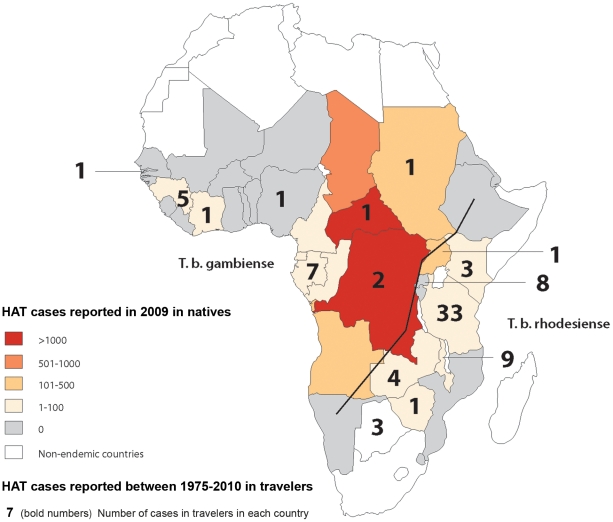
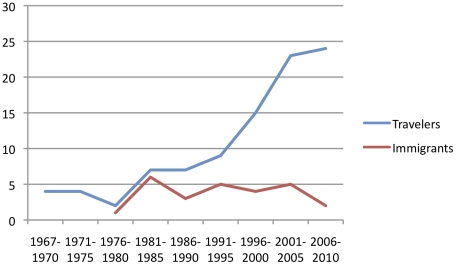
The number of imported Human African Trypanosomiasis (HAT) cases in non-endemic countries has increased over the last years. The objective of this analysis is to describe the clinical presentation of HAT in Caucasian travelers. Literature was screened (MEDLINE, Pubmed) using the terms "Human African Trypanosomiasis", "travelers" and "expatriates"; all European languages except Slavic ones were included. Publications without clinical description of patients were only included in the epidemiological analysis. Forty-five reports on Caucasians with T.b. rhodesiense and 15 with T.b. gambiense infections were included in the analysis of the clinical parameters. Both species have presented with fever (T.b. rhodesiense 97.8% and T.b. gambiense 93.3%), headache (50% each) and a trypanosomal chancre (T.b. rhodesiense 84.4%, T.b. gambiense 46.7%). While sleeping disorders dominate the clinical presentation of HAT in endemic regions, there have been only rare reports in travelers: insomnia (T.b. rhodesiense 7.1%, T.b. gambiense 21.4%), diurnal somnolence (T.b. rhodesiense 4.8%, T.b. gambiense none). Surprisingly, jaundice has been seen in 24.2% of the Caucasian T.b. rhodesiense patients, but has never been described in HAT patients in endemic regions. These results contrast to the clinical presentation of T.b. gambiense and T.b. rhodesiense HAT in Africans in endemic regions, where the presentation of chronic T.b. gambiense and acute T.b. rhodesiense HAT is different. The analysis of 14 reports on T.b. gambiense HAT in Africans living in a non-endemic country shows that neurological symptoms such as somnolence (46.2%), motor deficit (64.3%) and reflex anomalies (14.3%) as well as psychiatric symptoms such as hallucinations (21.4%) or depression (21.4%) may dominate the clinical picture. Often, the diagnosis has been missed initially: some patients have even been hospitalized in psychiatric clinics. In travelers T.b. rhodesiense and gambiense present as acute illnesses and chancres are frequently seen. The diagnosis of HAT in Africans living outside the endemic region is often missed or delayed, leading to presentation with advanced stages of the disease.
近年来,非流行国家输入性非洲人类锥虫病(HAT)病例数量有所增加。本分析的目的是描述白人旅行者中的 HAT 临床特征。使用“非洲人类锥虫病”、“旅行者”和“侨民”等术语对文献(MEDLINE、PubMed)进行筛选;除斯拉夫语外,还包括所有欧洲语言。仅将未描述患者临床特征的出版物纳入流行病学分析。在分析临床参数时,共纳入了 45 份关于罗得西亚锥虫病和 15 份冈比亚锥虫病感染的白人报告。这两种病原体均表现出发热(罗得西亚锥虫病 97.8%,冈比亚锥虫病 93.3%)、头痛(各占 50%)和锥虫下疳(罗得西亚锥虫病 84.4%,冈比亚锥虫病 46.7%)。虽然睡眠障碍是流行地区 HAT 的主要临床表现,但在旅行者中很少有报道:失眠(罗得西亚锥虫病 7.1%,冈比亚锥虫病 21.4%)、日间嗜睡(罗得西亚锥虫病 4.8%,冈比亚锥虫病无)。令人惊讶的是,24.2%的白人罗得西亚锥虫病患者出现黄疸,但在流行地区的 HAT 患者中从未有过描述。这些结果与流行地区非洲人感染罗得西亚锥虫病和冈比亚锥虫病的临床表现形成对比,在流行地区,慢性冈比亚锥虫病和急性罗得西亚锥虫病的表现不同。对居住在非流行国家的 14 份冈比亚锥虫病报告的分析表明,昏睡(46.2%)、运动缺陷(64.3%)和反射异常(14.3%)等神经症状以及幻觉(21.4%)或抑郁(21.4%)等精神症状可能主导临床症状。通常,最初会漏诊诊断:一些患者甚至被收治在精神科病房。在旅行者中,罗得西亚锥虫病和冈比亚锥虫病表现为急性疾病,经常出现下疳。居住在流行地区以外的非洲人感染 HAT 的诊断经常被漏诊或延迟,导致疾病处于晚期才被发现。