Department of Neurology, University of Lübeck, Lübeck, Germany.
PLoS One. 2011;6(11):e27668. doi: 10.1371/journal.pone.0027668. Epub 2011 Nov 16.
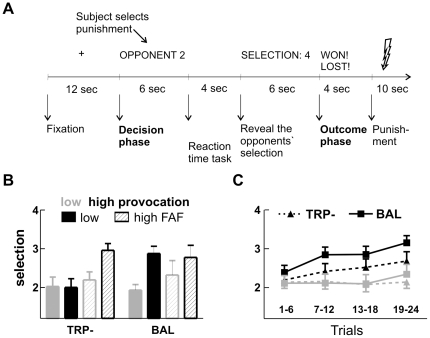
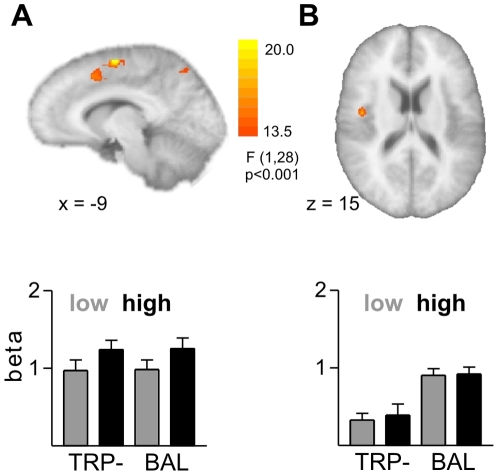
Reactive aggression after interpersonal provocation is a common behavior in humans. Little is known, however, about brain regions and neurotransmitters critical for the decision-making and affective processes involved in aggressive interactions. With the present fMRI study, we wanted to examine the role of serotonin in reactive aggression by means of an acute tryptophan depletion (ATD). Participants performed in a competitive reaction time task (Taylor Aggression Paradigm, TAP) which entitled the winner to punish the loser. The TAP seeks to elicit aggression by provocation. The study followed a double-blind between-subject design including only male participants. Behavioral data showed an aggression diminishing effect of ATD in low trait-aggressive participants, whereas no ATD effect was detected in high trait-aggressive participants. ATD also led to reduced insula activity during the decision phase, independently of the level of provocation. Whereas previous reports have suggested an inverse relationship between serotonin level and aggressive behavior with low levels of serotonin leading to higher aggression and vice versa, such a simple relationship is inconsistent with the current data.
人际挑衅后的反应性攻击是人类的一种常见行为。然而,对于在攻击性互动中涉及决策和情感过程的关键大脑区域和神经递质知之甚少。本 fMRI 研究通过急性色氨酸耗竭(ATD)来检验血清素在反应性攻击中的作用。参与者在竞争性反应时间任务(Taylor 攻击范式,TAP)中表现出色,胜者有权惩罚败者。TAP 通过挑衅来引发攻击。该研究采用双盲组间设计,仅包括男性参与者。行为数据显示,ATD 在低特质攻击性参与者中表现出攻击性降低的作用,而在高特质攻击性参与者中则未检测到 ATD 效应。ATD 还导致决策阶段岛叶活动减少,而与挑衅程度无关。虽然之前的报告表明血清素水平与攻击性行为呈负相关,即低水平的血清素导致更高的攻击性,反之亦然,但这种简单的关系与当前数据不一致。