
纳米级 TiO₂ 增强骨骼肌细胞表型和行为。
Nanometer-thin TiO₂ enhances skeletal muscle cell phenotype and behavior.
机构信息
Laboratory for Bone and Implant Sciences, The Jane and Jerry, Weintraub Center for Reconstructive, Biotechnology, Division of Advanced, Prosthodontics, Biomaterials and Hospital Dentistry, UCLA School of Dentistry, Los Angeles, CA 90095-1668, USA.
出版信息
Int J Nanomedicine. 2011;6:2191-203. doi: 10.2147/IJN.S24839. Epub 2011 Oct 3.
BACKGROUND
The independent role of the surface chemistry of titanium in determining its biological properties is yet to be determined. Although titanium implants are often in contact with muscle tissue, the interaction of muscle cells with titanium is largely unknown. This study tested the hypotheses that the surface chemistry of clinically established microroughened titanium surfaces could be controllably varied by coating with a minimally thin layer of TiO(2) (ideally pico-to-nanometer in thickness) without altering the existing topographical and roughness features, and that the change in superficial chemistry of titanium is effective in improving the biological properties of titanium.
METHODS AND RESULTS
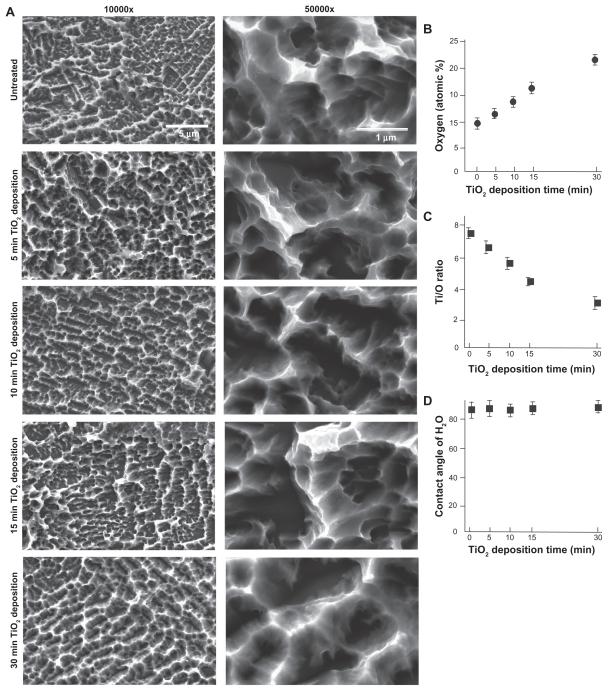
Acid-etched microroughened titanium surfaces were coated with TiO(2) using slow-rate sputter deposition of molten TiO(2) nanoparticles. A TiO(2) coating of 300 pm to 6.3 nm increased the surface oxygen on the titanium substrates in a controllable manner, but did not alter the existing microscale architecture and roughness of the substrates. Cells derived from rat skeletal muscles showed increased attachment, spread, adhesion strength, proliferation, gene expression, and collagen production at the initial and early stage of culture on 6.3 nm thick TiO(2)-coated microroughened titanium surfaces compared with uncoated titanium surfaces.
CONCLUSION
Using an exemplary slow-rate sputter deposition technique of molten TiO(2) nanoparticles, this study demonstrated that titanium substrates, even with microscale roughness, can be sufficiently chemically modified to enhance their biological properties without altering the existing microscale morphology. The controllable and exclusive chemical modification technique presented in this study may open a new avenue for surface modifications of titanium-based biomaterials for better cell and tissue affinity and reaction.
背景
钛的表面化学在决定其生物学特性方面的独立作用尚未确定。尽管钛植入物通常与肌肉组织接触,但肌肉细胞与钛的相互作用在很大程度上是未知的。本研究检验了以下假设:通过用极薄的 TiO2(理想厚度为皮米到纳米级)层涂覆,临床应用的微粗糙钛表面的表面化学可以得到可控制的变化,而不会改变现有的形貌和粗糙度特征,并且钛的表面化学变化可有效改善钛的生物学性能。
方法和结果
使用熔融 TiO2 纳米粒子的慢速率溅射沉积法对酸蚀微粗糙钛表面进行 TiO2 涂层。300 pm 至 6.3 nm 的 TiO2 涂层以可控的方式增加了钛基底表面的氧含量,但不会改变基底的现有微观结构和粗糙度。源自大鼠骨骼肌的细胞在培养的初始和早期阶段在 6.3nm 厚的 TiO2 涂层微粗糙钛表面上显示出比未涂层钛表面更高的附着、展开、粘附强度、增殖、基因表达和胶原蛋白产生。
结论
使用熔融 TiO2 纳米粒子的示例性慢速率溅射沉积技术,本研究表明,即使具有微观粗糙度的钛基底也可以进行充分的化学改性,以增强其生物学特性,而不会改变现有的微观形态。本研究中提出的可控且独特的化学改性技术可能为改善细胞和组织亲和性和反应的钛基生物材料的表面改性开辟新途径。



 Zotero 插件