Department Biochemistry and Molecular Biology, Gordon Center of Integrative Science, University of Chicago, Chicago, IL 60637, USA.
J Gen Physiol. 2011 Dec;138(6):571-80. doi: 10.1085/jgp.201110670.
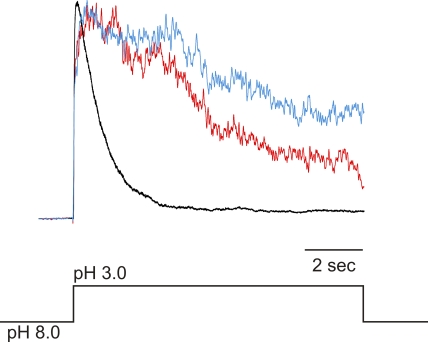
The amount of ionic current flowing through K(+) channels is determined by the interplay between two separate time-dependent processes: activation and inactivation gating. Activation is concerned with the stimulus-dependent opening of the main intracellular gate, whereas inactivation is a spontaneous conformational transition of the selectivity filter toward a nonconductive state occurring on a variety of timescales. A recent analysis of multiple x-ray structures of open and partially open KcsA channels revealed the mechanism by which movements of the inner activation gate, formed by the inner helices from the four subunits of the pore domain, bias the conformational changes at the selectivity filter toward a nonconductive inactivated state. This analysis highlighted the important role of Phe103, a residue located along the inner helix, near the hinge position associated with the opening of the intracellular gate. In the present study, we use free energy perturbation molecular dynamics simulations (FEP/MD) to quantitatively elucidate the thermodynamic basis for the coupling between the intracellular gate and the selectivity filter. The results of the FEP/MD calculations are in good agreement with experiments, and further analysis of the repulsive, van der Waals dispersive, and electrostatic free energy contributions reveals that the energetic basis underlying the absence of inactivation in the F103A mutation in KcsA is the absence of the unfavorable steric interaction occurring with the large Ile100 side chain in a neighboring subunit when the intracellular gate is open and the selectivity filter is in a conductive conformation. Macroscopic current analysis shows that the I100A mutant indeed relieves inactivation in KcsA, but to a lesser extent than the F103A mutant.
通过两种独立的时变过程的相互作用来决定 K(+)通道中离子电流的大小:激活和失活门控。激活涉及主要的细胞内门在刺激依赖性下的打开,而失活是选择性过滤器在各种时间尺度上自发地向非传导状态的构象转变。最近对开放和部分开放的 KcsA 通道的多个 X 射线结构的分析揭示了由孔域的四个亚基的内螺旋形成的内激活门的运动如何使选择性过滤器的构象变化偏向非传导失活状态的机制。该分析强调了残基 Phe103 的重要作用,Phe103 位于内螺旋上,靠近与细胞内门打开相关的铰链位置。在本研究中,我们使用自由能微扰分子动力学模拟 (FEP/MD) 来定量阐明细胞内门和选择性过滤器之间的耦合的热力学基础。FEP/MD 计算的结果与实验结果非常吻合,对排斥、范德华分散和静电自由能贡献的进一步分析表明,在 KcsA 中的 F103A 突变中不存在失活的能量基础是,当细胞内门打开且选择性过滤器处于传导构象时,与相邻亚基中的大 Ile100 侧链发生不利的空间相互作用不存在。宏观电流分析表明,I100A 突变确实减轻了 KcsA 的失活,但程度不如 F103A 突变。