Inui Atsuyuki, Kokubu Takeshi, Fujioka Hiroyuki, Nagura Issei, Sakata Ryosuke, Nishimoto Hanako, Kotera Masaru, Nishino Takashi, Kurosaka Masahiro
Department of Orthopaedic Surgery, Kobe University Graduate School of Medicine 7-5-1 Kusunoki-cho, Chuo-ku, Kobe, 650-0017, Japan.
Sports Med Arthrosc Rehabil Ther Technol. 2011 Dec 2;3:29. doi: 10.1186/1758-2555-3-29.
This study evaluated the application of a layered cell free poly (L-lactic acid) (PLLA) scaffold to regenerate an infraspinatus tendon defect in a rabbit model. We hypothesized that PLLA scaffold without cultivated cells would lead to regeneration of tissue with mechanical properties similar to reattached infraspinatus without tendon defects.
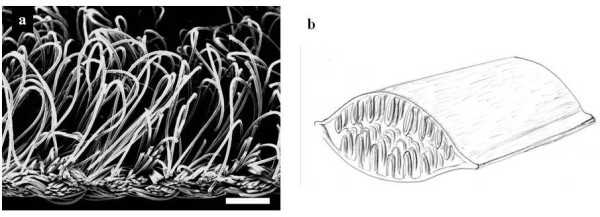
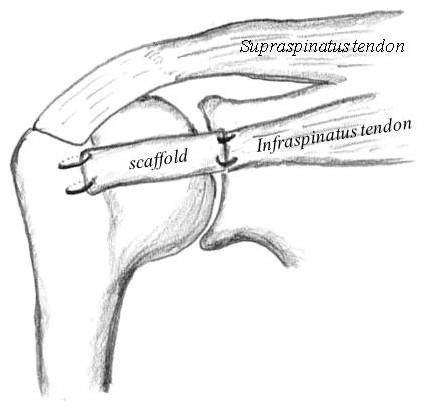
Layered PLLA fabric with a smooth surface on one side and a pile-finished surface on the other side was used. Novel form of layered PLLA scaffold was created by superimposing 2 PLLA fabrics. Defects of the infraspinatus tendon were created in 32 rabbits and the PLLA scaffolds were transplanted, four rabbits were used as normal control. Contralateral infraspinatus tendons were reattached to humeral head without scaffold implantation. Histological and mechanical evaluations were performed at 4, 8, and 16 weeks after operation.
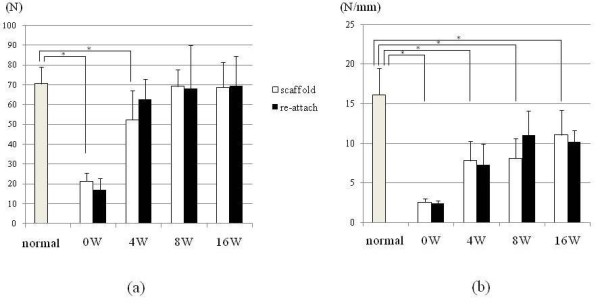
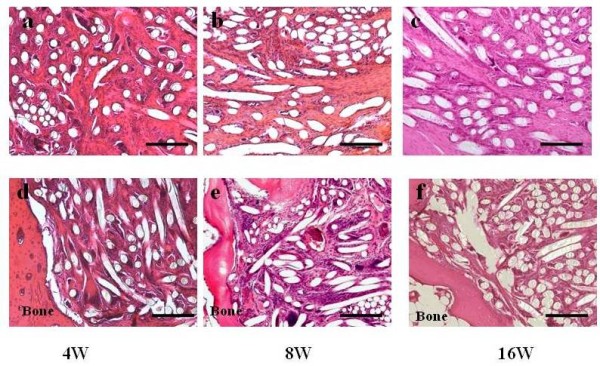
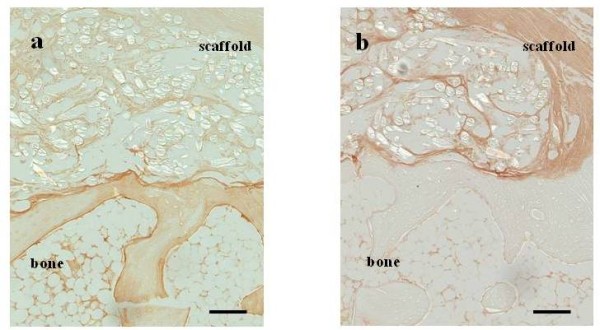
At 4 weeks postoperatively, cell migration was observed in the interstice of the PLLA fibers. Regenerated tissue was directly connected to the bone composed mainly of type III collagen, at 16 weeks postoperatively. The ultimate failure load increased in a time-dependent manner and no statistical difference was seen between normal infraspinatus tendon and scaffold group at 8 and 16 weeks postoperatively. There were no differences between scaffold group and reattach group at each time of point. The stiffness did not improve significantly in both groups.
A novel form of layered PLLA scaffold has the potential to induce cell migration into the scaffold and to bridge the tendon defect with mechanical properties similar to reattached infraspinatus tendon model.
本研究评估了分层无细胞聚(L-乳酸)(PLLA)支架在兔模型中修复冈下肌腱缺损的应用。我们假设不含培养细胞的PLLA支架将导致组织再生,其力学性能类似于无肌腱缺损的重新附着的冈下肌。
使用一侧表面光滑而另一侧表面有绒毛处理的分层PLLA织物。通过叠加两块PLLA织物制成新型分层PLLA支架。在32只兔中制造冈下肌腱缺损并植入PLLA支架,4只兔作为正常对照。对侧冈下肌腱在不植入支架的情况下重新附着于肱骨头。在术后4、8和16周进行组织学和力学评估。
术后4周,在PLLA纤维间隙中观察到细胞迁移。术后16周,再生组织直接与主要由III型胶原组成的骨相连。极限破坏载荷呈时间依赖性增加,术后8周和16周时,正常冈下肌腱与支架组之间未见统计学差异。在每个时间点,支架组和重新附着组之间均无差异。两组的刚度均未显著改善。
新型分层PLLA支架有潜力诱导细胞迁移至支架内,并以类似于重新附着的冈下肌腱模型的力学性能桥接肌腱缺损。