Kharitonova Maria, Munakata Yuko
Department of Psychology and Neuroscience, University of Colorado Boulder, CO, USA.
Front Psychol. 2011 Nov 30;2:347. doi: 10.3389/fpsyg.2011.00347. eCollection 2011.
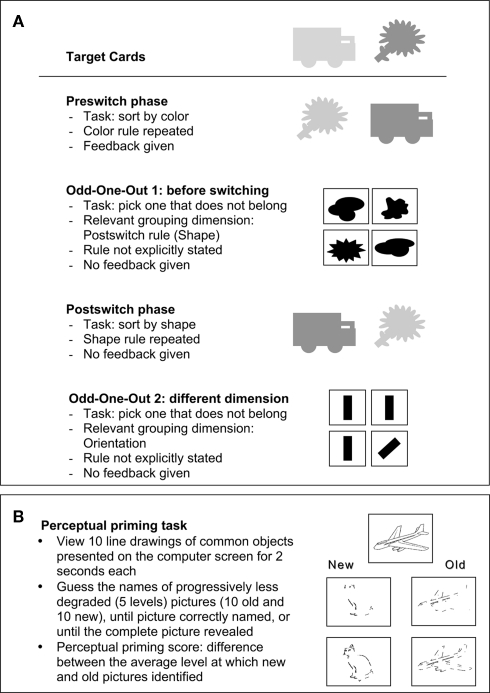
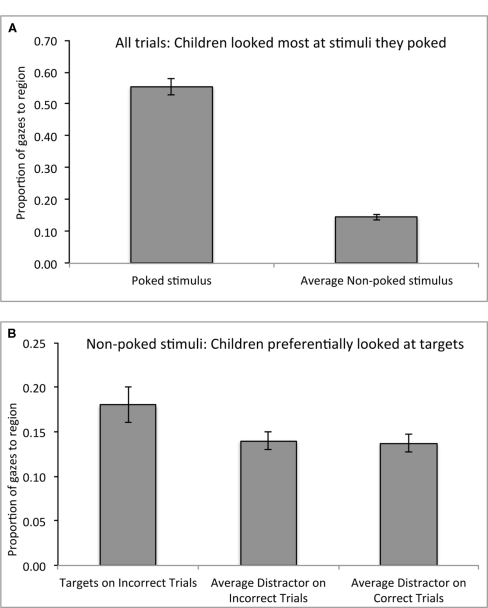
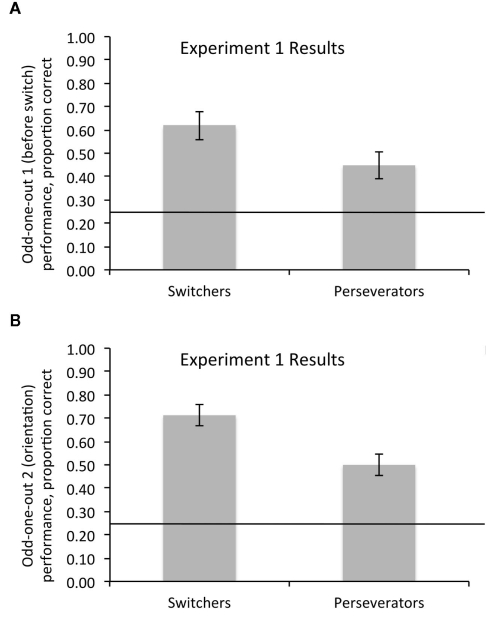
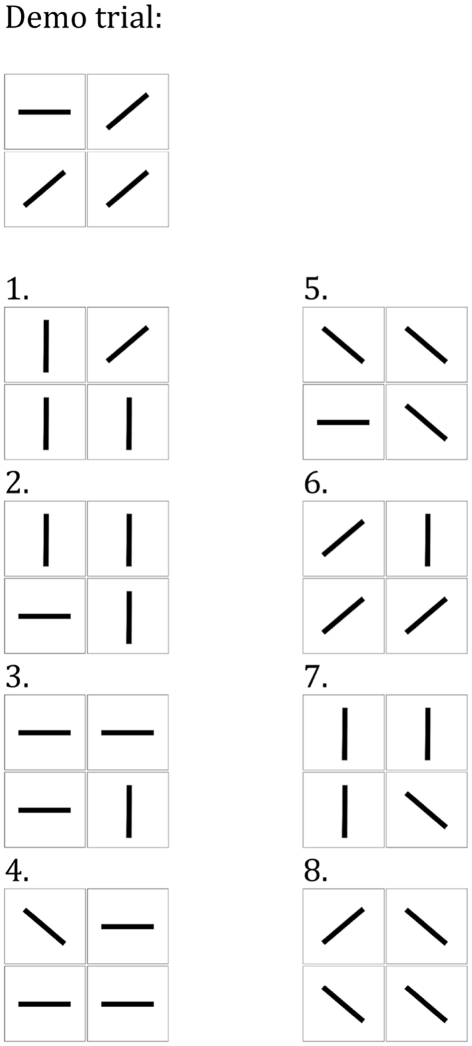
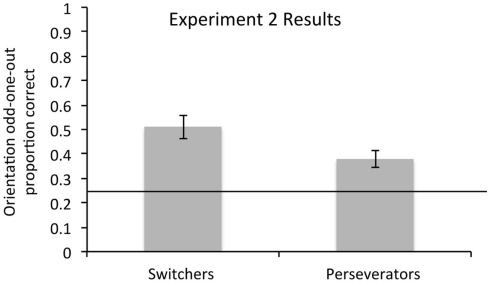
Young children often perseverate, engaging in previously correct, but no longer appropriate behaviors. One account posits that such perseveration results from the use of stimulus-specific representations of a situation, which are distinct from abstract, generalizable representations that support flexible behavior. Previous findings supported this account, demonstrating that only children who flexibly switch between rules could generalize their behavior to novel stimuli. However, this link between flexibility and generalization might reflect general cognitive abilities, or depend upon similarities across the measures or their temporal order. The current work examined these issues by testing the specificity and generality of this link. In two experiments with 3-year-old children, flexibility was measured in terms of switching between rules in a card-sorting task, while abstraction was measured in terms of selecting which stimulus did not belong in an odd-one-out task. The link between flexibility and abstraction was general across (1) abstraction dimensions similar to or different from those in the card-sorting task and (2) abstraction tasks that preceded or followed the switching task. Good performance on abstraction and flexibility measures did not extend to all cognitive tasks, including an IQ measure, and dissociated from children's ability to gaze at the correct stimulus in the odd-one-out task, suggesting that the link between flexibility and abstraction is specific to such measures, rather than reflecting general abilities that affect all tasks. We interpret these results in terms of the role that developing prefrontal cortical regions play in processes such as working memory, which can support both flexibility and abstraction.
幼儿常常会出现持续性行为,即重复之前正确但现在已不再合适的行为。一种观点认为,这种持续性行为源于对特定情境的刺激表征的使用,这些表征与支持灵活行为的抽象、可推广的表征不同。先前的研究结果支持了这一观点,表明只有那些能够在规则之间灵活切换的儿童才能将他们的行为推广到新的刺激上。然而,灵活性与推广之间的这种联系可能反映了一般认知能力,或者取决于测量方法之间的相似性或它们的时间顺序。当前的研究通过测试这种联系的特异性和普遍性来检验这些问题。在针对3岁儿童的两项实验中,灵活性是通过在卡片分类任务中规则之间的切换来衡量的,而抽象能力则是通过在“挑出不同项”任务中选择不属于同类的刺激来衡量的。灵活性与抽象能力之间的联系在以下方面具有普遍性:(1)与卡片分类任务中相似或不同的抽象维度;(2)在切换任务之前或之后的抽象任务。在抽象和灵活性测量上的良好表现并没有扩展到所有认知任务,包括智商测量,并且与儿童在“挑出不同项”任务中注视正确刺激的能力无关,这表明灵活性与抽象能力之间的联系特定于这些测量方法,而不是反映影响所有任务的一般能力。我们根据发育中的前额叶皮质区域在工作记忆等过程中所起的作用来解释这些结果,工作记忆可以支持灵活性和抽象能力。