Department of Family Medicine, David Geffen School of Medicine, University of California, Los Angeles, CA, USA.
Int J Chron Obstruct Pulmon Dis. 2011;6:605-14. doi: 10.2147/COPD.S24692. Epub 2011 Nov 21.
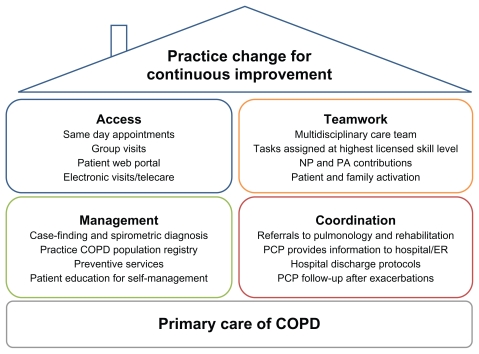
Current primary care patterns for chronic obstructive pulmonary disease (COPD) focus on reactive care for acute exacerbations, often neglecting ongoing COPD management to the detriment of patient experience and outcomes. Proactive diagnosis and ongoing multifactorial COPD management, comprising smoking cessation, influenza and pneumonia vaccinations, pulmonary rehabilitation, and symptomatic and maintenance pharmacotherapy according to severity, can significantly improve a patient's health-related quality of life, reduce exacerbations and their consequences, and alleviate the functional, utilization, and financial burden of COPD. Redesign of primary care according to principles of the chronic care model, which is implemented in the patient-centered medical home, can shift COPD management from acute rescue to proactive maintenance. The chronic care model and patient-centered medical home combine delivery system redesign, clinical information systems, decision support, and self-management support within a practice, linked with health care organization and community resources beyond the practice. COPD care programs implementing two or more chronic care model components effectively reduce emergency room and inpatient utilization. This review guides primary care practices in improving COPD care workflows, highlighting the contributions of multidisciplinary collaborative team care, care coordination, and patient engagement. Each primary care practice can devise a COPD care workflow addressing risk awareness, spirometric diagnosis, guideline-based treatment and rehabilitation, and self-management support, to improve patient outcomes in COPD.
目前慢性阻塞性肺疾病(COPD)的主要治疗模式侧重于急性加重期的反应性治疗,往往忽视了 COPD 的持续管理,从而影响了患者的体验和结局。积极诊断和持续的多因素 COPD 管理,包括戒烟、流感和肺炎疫苗接种、肺康复以及根据严重程度进行的对症和维持药物治疗,可以显著改善患者的健康相关生活质量,减少加重及其后果,并减轻 COPD 的功能、利用和经济负担。根据慢性病护理模式的原则对初级保健进行重新设计,并在以患者为中心的医疗之家实施,可以将 COPD 管理从急性抢救转变为主动维持。慢性病护理模式和以患者为中心的医疗之家将交付系统重新设计、临床信息系统、决策支持和自我管理支持结合在一个实践中,并与实践之外的医疗保健组织和社区资源相联系。实施两个或更多慢性病护理模式组成部分的 COPD 护理计划可有效减少急诊室和住院利用率。本综述指导初级保健实践改善 COPD 护理工作流程,强调多学科协作团队护理、护理协调和患者参与的贡献。每个初级保健实践都可以制定 COPD 护理工作流程,解决风险意识、肺量计诊断、基于指南的治疗和康复以及自我管理支持问题,从而改善 COPD 患者的结局。