Mental Health Sciences Unit, University College London, London, United Kingdom.
PLoS One. 2011;6(12):e28725. doi: 10.1371/journal.pone.0028725. Epub 2011 Dec 7.
To determine changes in prescribing patterns in primary care of antipsychotic and mood stabiliser medication in a representative sample of patients with bipolar disorder in the United Kingdom over a fifteen year period and association with socio-demographic factors.
We identified 4700 patients in the Health Improvement Network (THIN) primary care database, who had received treatment for bipolar disorder between 1995 and 2009. The proportion of time for which each individual was prescribed a particular medication was studied, along with variation by sex, age and social depravation status (quintiles of Townsend scores). The number of drugs an individual was taking within a particular year was also examined.
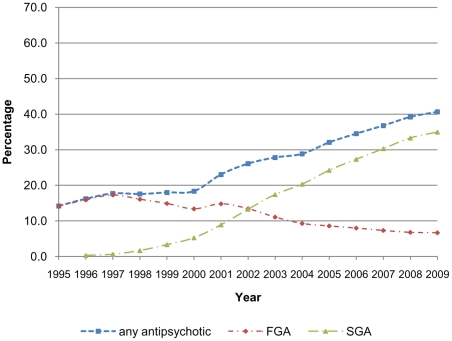
In 1995, 40.6% of patients with bipolar disorder were prescribed a psychotropic medication at least twice. By 2009 this had increased to 78.5% of patients. Valproate registered with the greatest increase in use (22.7%) followed by olanzapine (15.7%) and quetiapine (9.9%). There were differences by age and sex; with young (18-30 year old) women having the biggest increase in proportion of time on medication. There were no differences by social deprivation status. By 2009, 34.2% of women of childbearing age were treated with valproate.
Lithium use overall remained relatively constant, whilst second generation antipsychotic and valproate use increased dramatically. Changes in prescribing practice preceded published trial evidence, especially with the use of second generation antipsychotics, perhaps with inferences being made from treatment of schizophrenia and use of first generation antipsychotics. Women of childbearing age were prescribed valproate frequently, against best advice.
在英国,通过对一个代表性的双相情感障碍患者样本进行为期 15 年的研究,来确定初级保健中抗精神病药和心境稳定剂药物的处方模式变化,并探讨其与社会人口因素的关联。
我们在健康改进网络(THIN)初级保健数据库中确定了 4700 名患有双相情感障碍的患者,这些患者在 1995 年至 2009 年间接受了治疗。研究了每个患者被处方特定药物的时间比例,以及性别、年龄和社会贫困状况(汤森五分位数评分)的差异。还研究了个体在特定年份内服用的药物数量。
1995 年,40.6%的双相情感障碍患者至少两次被处方了精神药物。到 2009 年,这一比例增加到 78.5%的患者。丙戊酸钠的使用增长幅度最大(22.7%),其次是奥氮平(15.7%)和喹硫平(9.9%)。年龄和性别存在差异;年轻(18-30 岁)女性的用药比例增加幅度最大。社会贫困状况没有差异。到 2009 年,34.2%的育龄妇女接受丙戊酸钠治疗。
总的来说,锂的使用相对保持稳定,而第二代抗精神病药和丙戊酸钠的使用则大幅增加。处方实践的变化先于已发表的试验证据,尤其是第二代抗精神病药的使用,这可能是从治疗精神分裂症和第一代抗精神病药的使用中得出的推断。育龄妇女经常被处方丙戊酸钠,这与最佳建议相悖。