Laboratório de Química e Bioquímica de Alimentos, Universidade de São Paulo (USP), São Paulo, SP, Brasil.
BMC Complement Altern Med. 2011 Dec 20;11:133. doi: 10.1186/1472-6882-11-133.
Exercise stress was shown to increase oxidative stress in rats. It lacks reports of increased protection afforded by dietary antioxidant supplements against ROS production during exercise stress. We evaluated the effects of vitamin E supplementation on renal non-enzymatic antioxidants in young rats submitted to exhaustive exercise stress.
Wistar rats were divided into three groups: 1) control group; 2) exercise stress group and; 3) exercise stress + Vitamin E group. Rats from the group 3 were treated with gavage administration of 1 mL of Vitamin E (5 mg/kg) for seven consecutive days. Animals from groups 2 and 3 were submitted to a bout of swimming exhaustive exercise stress. Kidney samples were analyzed for Thiobarbituric Acid Reactive Substances to (TBARS) by malondialdehyde (MDA), reduced glutathione (GSH) and vitamin-E levels.
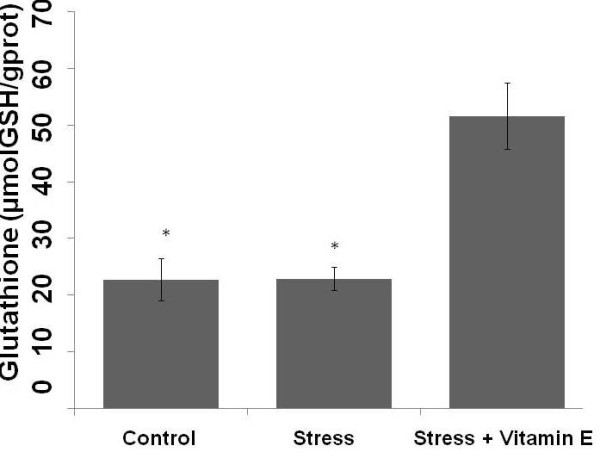
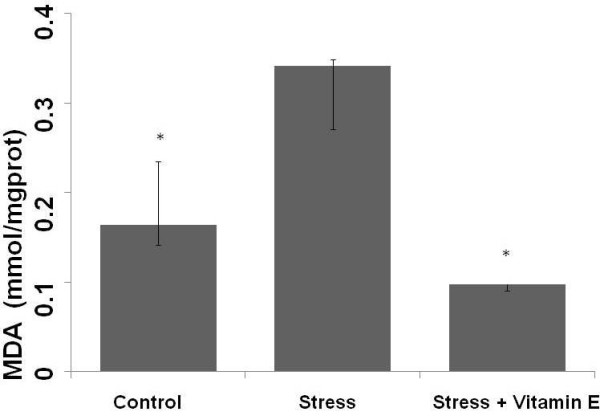
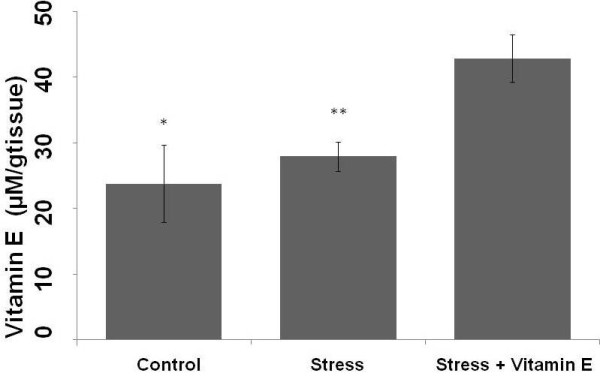
The group treated with vitamin E and submitted to exercise stress presented the lowest levels of renal MDA (1: 0.16+0.02 mmmol/mgprot vs. 2: 0.34+0.07 mmmol/mgprot vs. 3: 0.1+0.01 mmmol/mgprot; p < 0.0001), the highest levels of renal GSH (1: 23+4 μmol/gprot vs. 2: 23+2 μmol/gprot vs. 3: 58+9 μmol/gprot; p < 0.0001) and the highest levels of renal vitamin E (1: 24+6 μM/gtissue vs. 2: 28+2 μM/gtissue vs. 3: 43+4 μM/gtissue; p < 0.001).
Vitamin E supplementation improved non-enzymatic antioxidant activity in young rats submitted to exhaustive exercise stress.
运动应激会增加大鼠的氧化应激。目前缺乏关于在运动应激期间,膳食抗氧化补充剂增加 ROS 产生的保护作用的报告。我们评估了维生素 E 补充对年轻大鼠在进行剧烈运动应激时肾脏非酶抗氧化剂的影响。
将 Wistar 大鼠分为三组:1)对照组;2)运动应激组;3)运动应激+维生素 E 组。第 3 组大鼠连续 7 天给予灌胃 1 mL 维生素 E(5mg/kg)。第 2 组和第 3 组动物进行游泳力竭运动应激。通过丙二醛(MDA)、还原型谷胱甘肽(GSH)和维生素 E 水平分析肾脏硫代巴比妥酸反应物质(TBARS)来分析肾脏样本。
给予维生素 E 并进行运动应激的组肾 MDA 水平最低(1:0.16+0.02 mmmol/mgprot vs. 2:0.34+0.07 mmmol/mgprot vs. 3:0.1+0.01 mmmol/mgprot;p < 0.0001),肾 GSH 水平最高(1:23+4 μmol/gprot vs. 2:23+2 μmol/gprot vs. 3:58+9 μmol/gprot;p < 0.0001),肾维生素 E 水平最高(1:24+6 μM/gtissue vs. 2:28+2 μM/gtissue vs. 3:43+4 μM/gtissue;p < 0.001)。
维生素 E 补充可改善年轻大鼠进行力竭运动应激时的非酶抗氧化活性。