Wellcome Trust Centre for Neuroimaging, UCL Institute of Neurology, University College London, London, UK.
Neuroimage. 2012 Mar;60(1):562-70. doi: 10.1016/j.neuroimage.2011.12.009. Epub 2011 Dec 14.
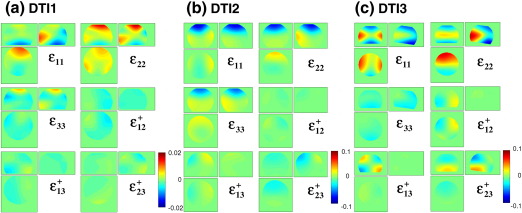
Indices derived from diffusion tensor imaging (DTI) data, including the mean diffusivity (MD) and fractional anisotropy (FA), are often used to better understand the microstructure of the brain. DTI, however, is susceptible to imaging artefacts, which can bias these indices. The most important sources of artefacts in DTI include eddy currents, nonuniformity and mis-calibration of gradients. We modelled these and other artefacts using a local perturbation field (LPF) approach. LPFs during the diffusion-weighting period describe the local mismatches between the effective and the expected diffusion gradients resulting in a spatially varying error in the diffusion weighting B matrix and diffusion tensor estimation. We introduced a model that makes use of phantom measurements to provide a robust estimation of the LPF in DTI without requiring any scanner-hardware-specific information or special MRI sequences. We derived an approximation of the perturbed diffusion tensor in the isotropic-diffusion limit that can be used to identify regions in any DTI index map that are affected by LPFs. Using these models, we simulated and measured LPFs and characterised their effect on human DTI for three different clinical scanners. The small FA values found in grey matter were biased towards greater anisotropy leading to lower grey-to-white matter contrast (up to 10%). Differences in head position due to e.g. repositioning produced errors of up to 10% in the MD, reducing comparability in multi-centre or longitudinal studies. We demonstrate the importance of the proposed correction by showing improved consistency across scanners, different head positions and an increased FA contrast between grey and white matter.
基于弥散张量成像(DTI)数据的指标,包括平均弥散度(MD)和各向异性分数(FA),常用于更好地了解大脑的微观结构。然而,DTI 易受成像伪影的影响,这些伪影会使这些指标产生偏差。DTI 中最重要的伪影来源包括涡流、梯度不均匀和失准。我们使用局部扰动场(LPF)方法对这些伪影和其他伪影进行建模。在弥散加权期间的 LPF 描述了有效弥散梯度与预期弥散梯度之间的局部不匹配,导致弥散加权 B 矩阵和弥散张量估计中的空间变化误差。我们引入了一种模型,该模型利用体模测量来提供对 DTI 中 LPF 的稳健估计,而无需任何特定于扫描仪硬件的信息或特殊的 MRI 序列。我们推导出了各向同性弥散极限下扰动弥散张量的近似值,可用于识别任何 DTI 指数图中受 LPF 影响的区域。使用这些模型,我们模拟并测量了 LPF,并对来自三个不同临床扫描仪的人体 DTI 进行了特征描述。在灰质中发现的较小 FA 值偏向于更大的各向异性,从而导致灰白质对比度降低(高达 10%)。由于例如重新定位引起的头部位置差异,MD 会产生高达 10%的误差,从而降低多中心或纵向研究的可比性。我们通过展示跨扫描仪、不同头部位置和灰质与白质之间增加的 FA 对比度的一致性提高,证明了所提出的校正的重要性。