Image Sciences Institute, University Medical Center Utrecht, Utrecht University, Utrecht, The Netherlands.
Cardiff University Brain Research Imaging Centre (CUBRIC), Cardiff University, Cardiff, UK.
Hum Brain Mapp. 2021 Feb 1;42(2):367-383. doi: 10.1002/hbm.25228. Epub 2020 Oct 9.
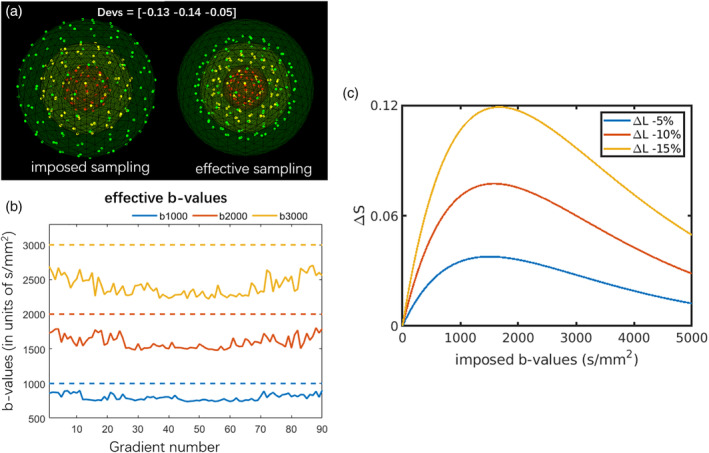
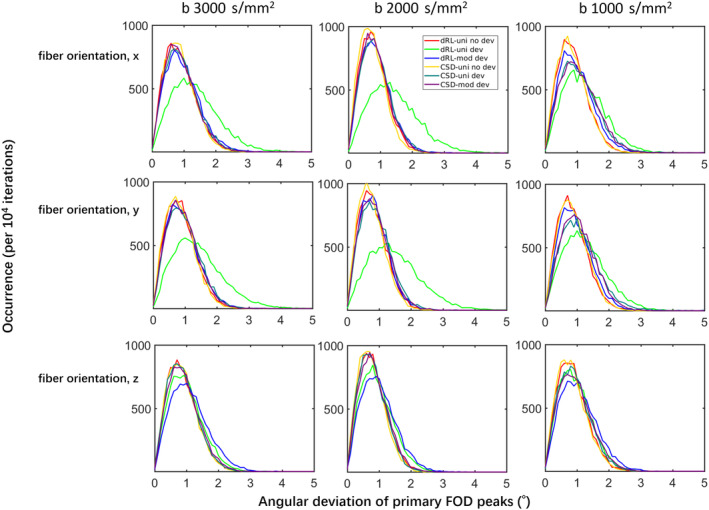
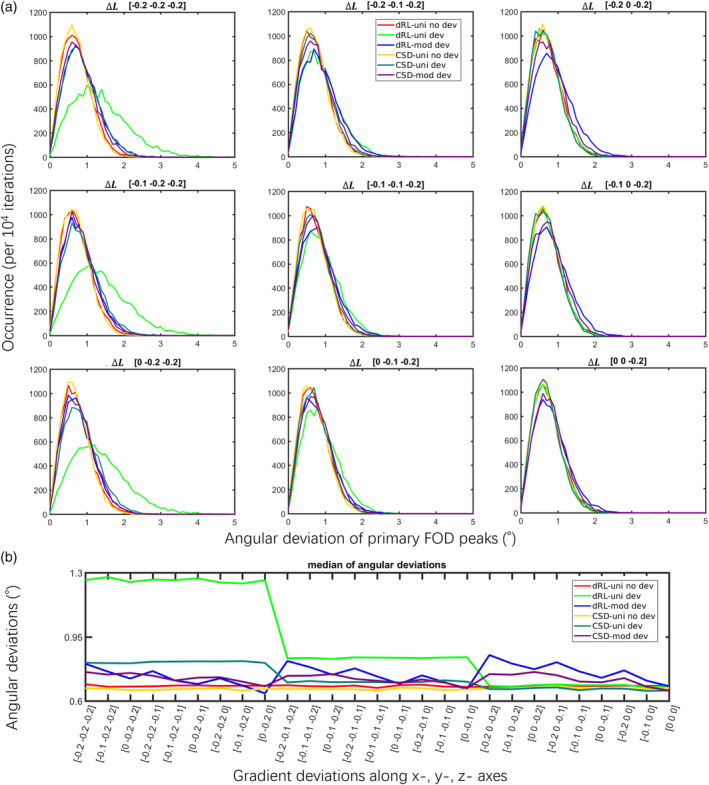
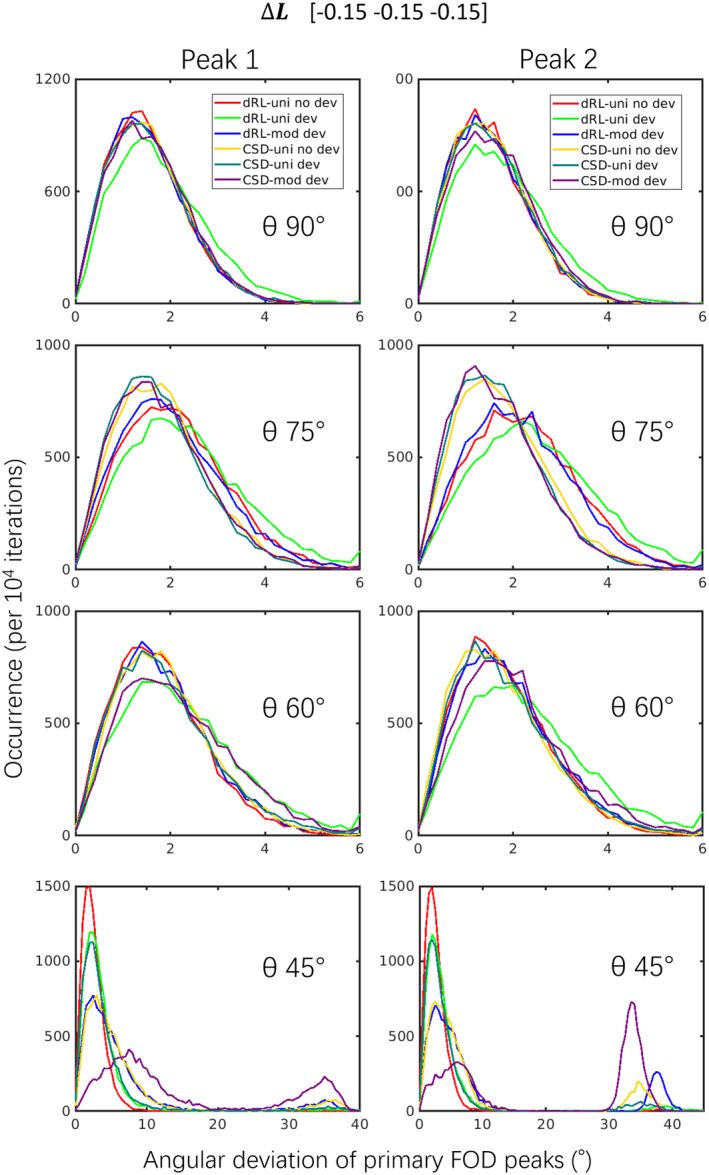
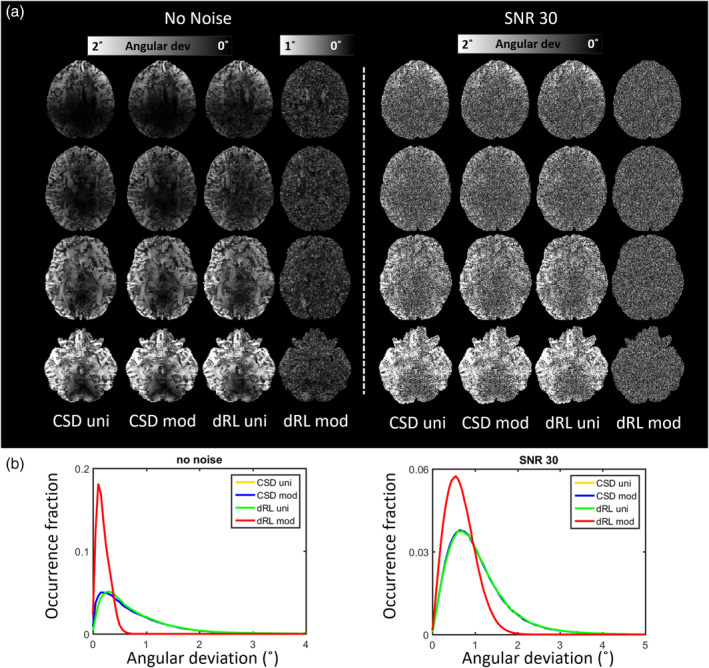
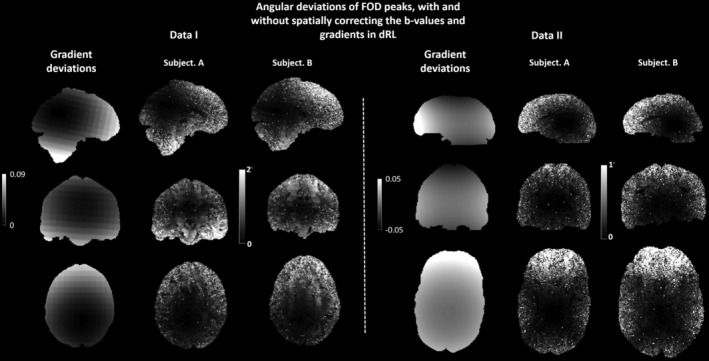
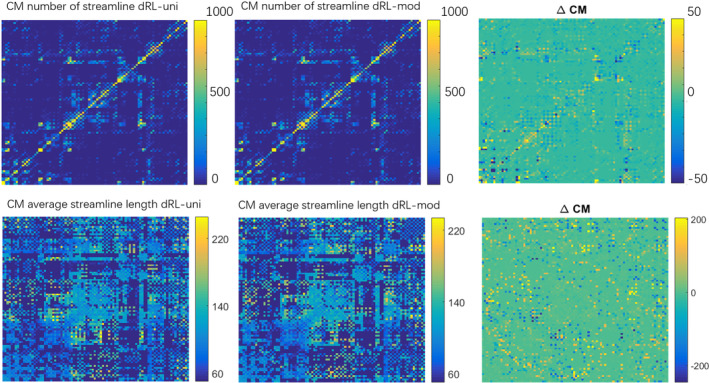
Gradient nonlinearities in magnetic resonance imaging (MRI) cause spatially varying mismatches between the imposed and the effective gradients and can cause significant biases in rotationally invariant diffusion MRI measures derived from, for example, diffusion tensor imaging. The estimation of the orientational organization of fibrous tissue, which is nowadays frequently performed with spherical deconvolution techniques ideally using higher diffusion weightings, can likewise be biased by gradient nonlinearities. We explore the sensitivity of two established spherical deconvolution approaches to gradient nonlinearities, namely constrained spherical deconvolution (CSD) and damped Richardson-Lucy (dRL). Additionally, we propose an extension of dRL to take into account gradient imperfections, without the need of data interpolation. Simulations show that using the effective b-matrix can improve dRL fiber orientation estimation and reduces angular deviations, while CSD can be more robust to gradient nonlinearity depending on the implementation. Angular errors depend on a complex interplay of many factors, including the direction and magnitude of gradient deviations, underlying microstructure, SNR, anisotropy of the effective response function, and diffusion weighting. Notably, angular deviations can also be observed at lower b-values in contrast to the perhaps common assumption that only high b-value data are affected. In in vivo Human Connectome Project data and acquisitions from an ultrastrong gradient (300 mT/m) scanner, angular differences are observed between applying and not applying the effective gradients in dRL estimation. As even small angular differences can lead to error propagation during tractography and as such impact connectivity analyses, incorporating gradient deviations into the estimation of fiber orientations should make such analyses more reliable.
磁共振成像(MRI)中的梯度非线性会导致施加的梯度与有效梯度之间存在空间变化的不匹配,从而导致从扩散张量成像等方法得出的旋转不变扩散 MRI 测量值产生显著偏差。如今,使用球形反卷积技术(理想情况下使用更高的扩散权重)对纤维组织的方位组织进行估计时,同样会受到梯度非线性的影响。我们探讨了两种已建立的球形反卷积方法(即约束球形反卷积(CSD)和阻尼 Richardson-Lucy(dRL))对梯度非线性的敏感性。此外,我们提出了一种扩展的 dRL 方法,可以考虑梯度不完美,而无需进行数据插值。模拟结果表明,使用有效 b 矩阵可以改善 dRL 纤维方向估计并减少角度偏差,而 CSD 的梯度非线性鲁棒性可能取决于其实现方式。角度误差取决于许多因素的复杂相互作用,包括梯度偏差的方向和大小、基础微结构、SNR、有效响应函数的各向异性以及扩散加权。值得注意的是,与人们可能普遍认为只有高 b 值数据受影响的假设相反,在较低的 b 值下也可以观察到角度偏差。在人类连接组计划数据和来自超强梯度(300 mT/m)扫描仪的采集数据中,在 dRL 估计中应用和不应用有效梯度时观察到角度差异。由于即使是小的角度差异也会在轨迹追踪过程中导致误差传播,并因此影响连通性分析,因此将梯度偏差纳入纤维方向的估计中应该会使这些分析更加可靠。