Faculty of Health Sciences, University of Copenhagen, Denmark.
Scand J Trauma Resusc Emerg Med. 2011 Dec 28;19:74. doi: 10.1186/1757-7241-19-74.
Using blood lactate monitoring for risk assessment in the critically ill patient remains controversial. Some of the discrepancy is due to uncertainty regarding the appropriate reference interval, and whether to perform a single lactate measurement as a screening method at admission to the hospital, or serial lactate measurements. Furthermore there is no consensus whether the sample should be drawn from arterial, peripheral venous, or capillary blood. The aim of this review was: 1) To examine whether blood lactate levels are predictive for in-hospital mortality in patients in the acute setting, i.e. patients assessed pre-hospitally, in the trauma centre, emergency department, or intensive care unit. 2) To examine the agreement between arterial, peripheral venous, and capillary blood lactate levels in patients in the acute setting.
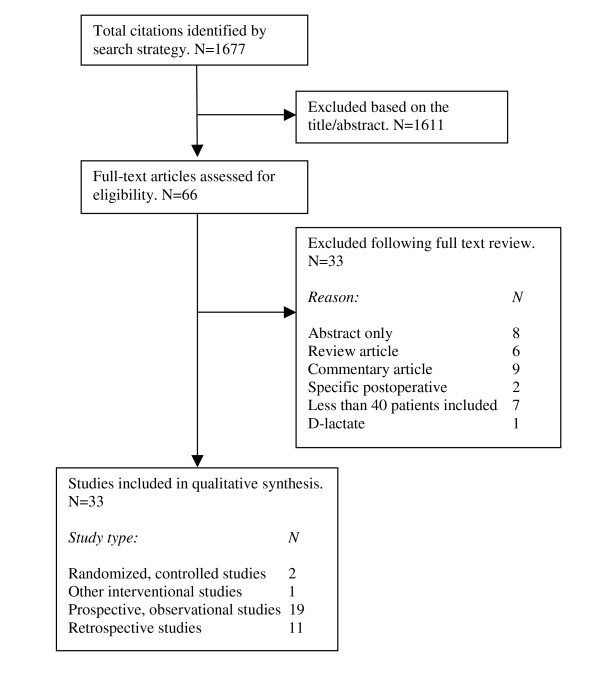
We performed a systematic search using PubMed, Cochrane Central Register of Controlled Trials, Cochrane Database of Systematic Reviews, and CINAHL up to April 2011. 66 articles were considered potentially relevant and evaluated in full text, of these ultimately 33 articles were selected.
The literature reviewed supported blood lactate monitoring as being useful for risk assessment in patients admitted acutely to hospital, and especially the trend, achieved by serial lactate sampling, is valuable in predicting in-hospital mortality. All patients with a lactate at admission above 2.5 mM should be closely monitored for signs of deterioration, but patients with even lower lactate levels should be considered for serial lactate monitoring. The correlation between lactate levels in arterial and venous blood was found to be acceptable, and venous sampling should therefore be encouraged, as the risk and inconvenience for this procedure is minimal for the patient. The relevance of lactate guided therapy has to be supported by more studies.
在危重病患者中使用血乳酸监测进行风险评估仍然存在争议。部分差异是由于不确定适当的参考区间,以及是否在入院时进行单次乳酸测量作为筛查方法,或者进行连续乳酸测量。此外,对于应该从动脉、外周静脉还是毛细血管采血,也没有共识。本综述的目的是:1)检查在急性情况下(即在院前、创伤中心、急诊室或重症监护病房评估的患者),血乳酸水平是否对院内死亡率具有预测性。2)检查急性患者的动脉、外周静脉和毛细血管血乳酸水平之间的一致性。
我们使用 PubMed、Cochrane 对照试验中心注册库、Cochrane 系统评价数据库和 CINAHL 进行了系统搜索,截至 2011 年 4 月。考虑 66 篇文章可能与研究相关,并对全文进行评估,其中最终选择了 33 篇文章。
综述文献支持血乳酸监测作为急性入院患者风险评估的有用方法,特别是通过连续乳酸采样获得的趋势对于预测院内死亡率具有价值。所有入院时乳酸值超过 2.5 mM 的患者都应密切监测病情恶化的迹象,但即使乳酸水平较低的患者也应考虑进行连续乳酸监测。动脉和静脉血中乳酸水平之间的相关性被认为是可接受的,因此应鼓励静脉采血,因为这种操作对患者的风险和不便最小。乳酸指导治疗的相关性需要更多的研究来支持。